
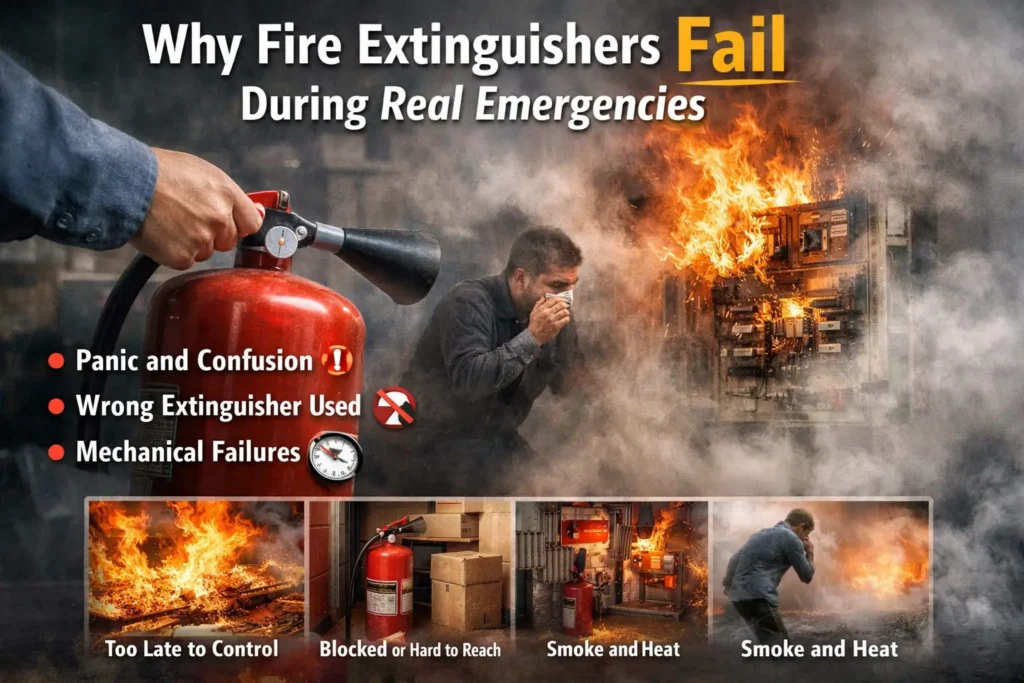
Why Fire Extinguishers Fail During Real Emergencies
Fire extinguishers are present in almost every workplace.
You will find them in:
- Offices
- Factories
- Warehouses
- Hospitals
- Construction sites
They are inspected, tagged, and maintained regularly.
However, during real fire emergencies, extinguishers often fail to control the fire, fail to operate properly, or are not used effectively at all.
In many fire investigations, the extinguisher was available and suitable, but the fire still escalated.
This shows that the problem is not just equipment. It is how fire behaves and how people respond.
Fire Extinguishers Are Designed for Limited Use
Fire extinguishers are only effective for incipient-stage fires, meaning:
- Small
- Localized
- Detected early
In real workplaces, fires often:
- Grow rapidly
- Involve high fuel load
- Produce intense heat
- Spread beyond control quickly
Once a fire grows beyond this stage, portable extinguishers become ineffective.
Panic and Stress Affect Human Performance
Most training is conducted in calm environments.
Real emergencies are completely different.
During a fire, people experience:
- Panic and fear
- Reduced coordination
- Poor decision-making
- Difficulty remembering procedures
Even trained individuals may:
- Forget to pull the pin
- Aim incorrectly
- Stand too close or too far
This is a natural human reaction under stress.
Wrong Extinguisher Selection
In emergencies, people often grab the nearest extinguisher instead of the correct one.
Common mistakes include:
- Using water on electrical fires
- Using CO₂ on deep-seated materials
- Using foam without isolating fuel
- Using powder without controlling re-ignition
Incorrect use reduces effectiveness and can increase danger.
Fire Growth Is Faster Than Expected
Many failures occur because the fire is already too large.
Contributing factors include:
- Delayed detection
- Slow response
- Underestimation of fire severity
- Smoke reducing visibility
Even a short delay can make the extinguisher ineffective.
Poor Accessibility During Emergencies
Extinguishers are often installed correctly but become inaccessible due to workplace changes.
Common issues include:
- Storage blocking access
- Equipment placed in front
- Poor signage visibility
- Incorrect mounting height
During a fire, even a few seconds of delay can be critical.
Mechanical Failures That Go Unnoticed
Visual inspections cannot detect all faults.
Hidden problems include:
- Compacted dry powder
- Pressure loss in cylinders
- Internal corrosion
- Blocked hoses or nozzles
An extinguisher may look fine but fail to discharge properly.
Fire Source Is Not Isolated
Extinguishers suppress flames, but they do not remove the source.
Failures occur when:
- Electrical power remains on
- Gas continues to flow
- Fuel supply is not stopped
- Hot surfaces remain active
This leads to re-ignition even after discharge.
Smoke and Heat Limit Safe Use
In real fires:
- Smoke reduces visibility
- Toxic gases affect breathing
- Heat makes it difficult to approach
Workers often retreat for safety before effectively using the extinguisher.
Overconfidence Delays Evacuation
A common assumption is:
“The extinguisher will handle it.”
This leads to:
- Delayed evacuation
- Increased exposure to danger
- Higher risk of injury
Extinguishers are for first response, not full firefighting.
What Safety Officers Commonly Miss
In real workplaces, these issues are often overlooked:
- Lack of practical training
- No real discharge practice
- Poor extinguisher placement
- Ignoring accessibility
- Over-reliance on compliance
These gaps reduce effectiveness during emergencies.
Real Workplace Example
In an office building, a small electrical fire started near a workstation.
An employee attempted to use a water extinguisher.
This caused:
- Increased risk due to electrical hazard
- Delay in effective response
- Fire spread to nearby equipment
Investigation revealed:
- Lack of extinguisher training
- Incorrect selection under pressure
The extinguisher was available, but not used correctly.
Fire Extinguisher Effectiveness Checklist
Before Emergency
- Ensure correct extinguisher type is installed
- Maintain clear access
- Conduct regular inspection
- Provide hands-on training
- Display clear signage
During Emergency
- Assess fire size
- Use correct extinguisher
- Maintain safe distance
- Keep escape route behind
- Stop if fire grows
After Use
- Monitor for re-ignition
- Report and replace used extinguishers
- Investigate root cause
Practical Steps to Improve Performance
- Conduct real discharge training
- Educate workers on fire types
- Improve visibility and access
- Integrate extinguisher use with evacuation planning
- Train workers to prioritize safety over firefighting
Industry Guidance and Standards
According to the National Fire Protection Association, fire extinguishers must be properly selected, installed, inspected, and maintained, and users must be trained to use them effectively under real conditions.
NFPA emphasizes:
- Correct extinguisher selection
- Regular maintenance
- Hands-on training
- Integration with overall fire safety systems
For detailed guidance, refer to:
👉 https://www.nfpa.org/News-and-Research/Publications-and-media/NFPA-Journal
Warning Signs of Ineffective Fire Extinguisher Systems
Watch for these indicators:
- Employees unsure how to use extinguishers
- Blocked or hidden equipment
- Lack of training records
- No practical drills
- Overconfidence in equipment
These signs indicate increased risk.
Conclusion
Fire extinguishers do not fail because they are poorly designed.
They fail because:
- Fires grow too fast
- People react under stress
- Equipment is misused
- Systems are incomplete
Fire safety must consider both:
- Equipment performance
- Human behavior
Extinguishers are important, but they are only one part of a complete fire safety system.
For a complete understanding, read our full Workplace Fire Safety Guide.
Complete Workplace Fire Safety Guide (2026): Prevention, Equipment, Risk & Response
Wrong Fire Extinguisher Selection in Indian Industries
Fire Extinguishers Installed but Never Ready
Common Mistakes While Using Fire Extinguishers
Why Monthly Fire Extinguisher Checks Are Ignored
Types of Fire Extinguishers Explained, How to Select the Right One for Real Workplace Fires
Frequently Asked Questions
Why do extinguishers fail even when maintained
Because real conditions involve stress, heat, and rapid fire growth.
Can extinguishers stop all fires
No. They are only for small, early-stage fires.
Is training enough to prevent failure
Training helps, but real behavior under stress must be considered.
Which extinguisher fails most often
Dry powder extinguishers may fail due to compaction if not maintained.
Should employees fight fire or evacuate
Evacuation should always be the priority if the fire is not controllable.
