
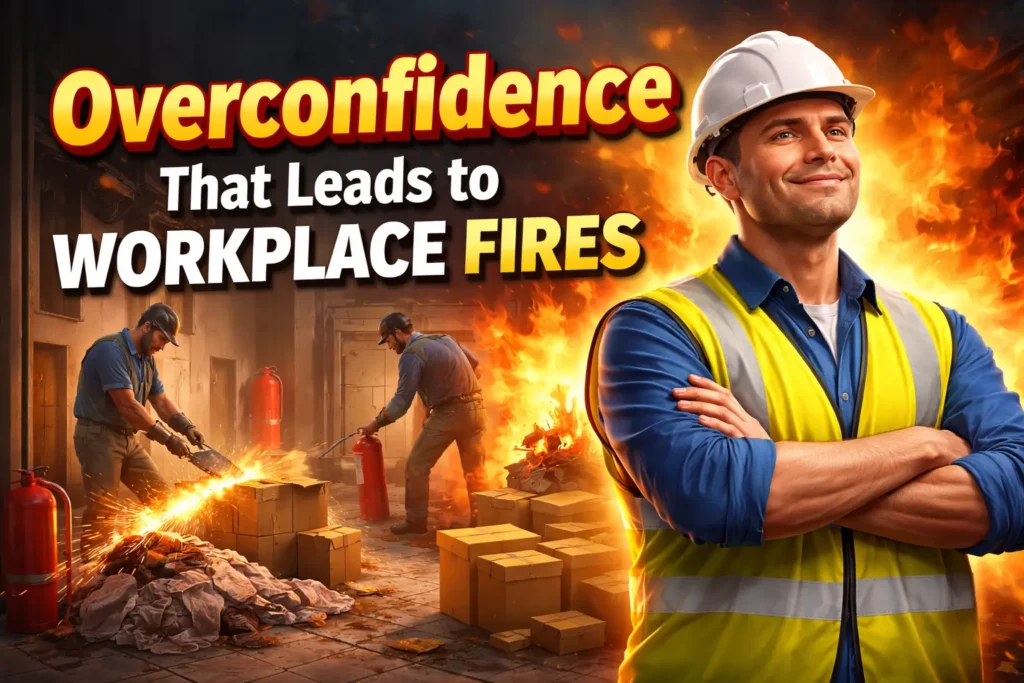
Overconfidence That Leads to Workplace Fires
Workplace fires are not always caused by missing safety systems. In many cases, systems are installed, procedures are documented, and inspections are carried out.
Yet fires still occur.
The real cause is often not the absence of safety, but the presence of overconfidence.
Overconfidence develops when individuals and organizations begin to believe that past success, experience, or existing systems are enough to prevent future incidents. This mindset gradually weakens safety controls and increases fire risk.
What Overconfidence Means in Fire Safety
Overconfidence in fire safety is the belief that:
- Existing systems will always work
- Past incident-free operations guarantee future safety
- Experienced workers do not need strict supervision
- Minor hazards are not worth attention
- Emergencies can always be controlled
This belief replaces verification with assumption.
Why Overconfidence Becomes Dangerous
Fire prevention depends on continuous alertness. Overconfidence reduces that alertness over time.
It leads to:
- Ignored warning signs
- Skipped inspections
- Delayed maintenance
- Unsafe shortcuts
- Poor emergency response
Fire risk does not increase suddenly. It builds gradually as unsafe conditions are accepted.
Common Workplace Behaviors Caused by Overconfidence
Ignoring Minor Fire Hazards
Small hazards are often dismissed because they have not caused problems before.
Examples include:
- Loose electrical connections
- Temporary wiring used permanently
- Blocked fire extinguishers
- Oil leakage near equipment
- Dust accumulation in enclosed areas
During one site inspection in a fabrication workshop, fine dust accumulation near electrical panels was ignored because it had been present for months without incident. This created a combustible environment that could easily ignite under the right conditions.
Assuming Fire Equipment Will Work
Many workplaces assume that installed systems are always reliable.
Typical assumptions include:
- Fire extinguishers are usable because they are available
- Hydrant systems will operate when required
- Fire pumps will start automatically
However, in real incidents, equipment failure is common due to lack of testing.
In one facility audit, a fire pump that appeared operational during inspection failed to start automatically during a simulated emergency test. The system was installed, but not verified under real conditions.
Relaxed Control of Hot Work Activities
Hot work is one of the highest fire risk activities.
Overconfidence leads to:
- Skipping permit requirements
- Inadequate fire watch
- Poor housekeeping before welding
- Early removal of fire watch after work
In several incidents, fires have occurred after welding was completed because sparks ignited hidden combustible materials.
Experience Replacing Procedure
Experienced workers often rely on familiarity instead of following procedures.
This leads to:
- Bypassing safety steps
- Ignoring standard operating procedures
- Refusing personal protective equipment
- Avoiding supervision
Experience is valuable, but without discipline, it increases risk.
Delayed Maintenance Decisions
Overconfidence at management level often results in delayed action.
Common examples include:
- Postponing electrical repairs
- Delaying fire pump servicing
- Extending inspection intervals
These decisions are usually justified by statements like “there has never been a problem before.”
Normalization of Unsafe Conditions
Over time, unsafe conditions become accepted as normal.
Examples include:
- Temporary storage becoming permanent
- Blocked exits being ignored
- Damaged cables remaining in use
Once unsafe conditions are normalized, they are no longer treated as risks.
Real Workplace Example
In an industrial plant, a transformer room had minor oil seepage for several months.
Supervisors ignored the issue because:
- No fire had occurred previously
- The equipment had been operating for years
- Production pressure discouraged shutdown
Eventually, oil vapors ignited due to overheating, resulting in a major fire and production shutdown.
The root cause was not equipment failure alone. It was the assumption that the condition was not serious.
How Overconfidence Weakens Risk Assessment
When overconfidence exists, fire risk assessments lose effectiveness.
This leads to:
- Underestimation of hazards
- Lower risk ratings
- Weak control measures
- Closure of findings without action
Risk assessments become documentation exercises rather than practical safety tools.
Warning Signs of Overconfidence
Organizations may be experiencing overconfidence if:
- Inspections consistently show no issues
- Workers resist safety instructions
- Fire drills are treated casually
- Management dismisses safety concerns
- Incidents are labeled as unavoidable
These are warning signs, not indicators of good safety performance.
How to Control Overconfidence in Fire Safety
Conduct Surprise Inspections
Unannounced inspections reveal real working conditions instead of prepared environments.
Enforce Permit Systems Strictly
Hot work and other high-risk activities must follow permit procedures without exception.
Use Real Incident Case Studies
Training should include actual fire incidents to reinforce risk awareness.
Improve Accountability
Supervisors and managers must be responsible for safety performance, not just documentation.
Strengthen Emergency Preparedness
Fire drills should be realistic, unannounced, and evaluated critically.
External Reference
Organizations such as the National Fire Protection Association highlight that many workplace fires are caused by human error, delayed maintenance, and unsafe practices rather than sudden equipment failure.
Their guidance emphasizes the importance of continuous inspection, proper maintenance, and disciplined safety behavior.
For more information, refer to:
👉 https://www.nfpa.org
Conclusion
Overconfidence is not confidence. It is a false sense of safety.
Many workplace fires occur not because safety systems are missing, but because they are assumed to be effective without verification.
Fire safety requires:
- Continuous attention
- Practical discipline
- Regular verification
The moment a workplace believes it is fully safe, it becomes vulnerable.
For a complete understanding, read our full Workplace Fire Safety Guide.
Complete Workplace Fire Safety Guide (2026): Prevention, Equipment, Risk & Response
Fire Prevention Rules That Are Followed Only on Paper
Why Fire Audits Fail to Prevent Accidents
How Poor Housekeeping Leads to Fire Accidents
Fire Risks Created by Temporary Work Activities
Electrical Fire Safety Explained, Why Electrical Fires Start and How to Stop Them Before Ignition
Frequently Asked Questions
Can overconfidence really cause workplace fires
Yes. It leads to ignored hazards, delayed maintenance, and unsafe practices.
Is overconfidence more common in experienced teams
Yes. Familiarity can reduce alertness if not controlled.
How can management reduce overconfidence
By enforcing inspections, accountability, and realistic safety training.
Are new workplaces free from this risk
No. Overconfidence can develop quickly if safety is not actively managed.
Is training alone enough to control overconfidence
No. Training must be supported by enforcement, supervision, and regular verification.
