
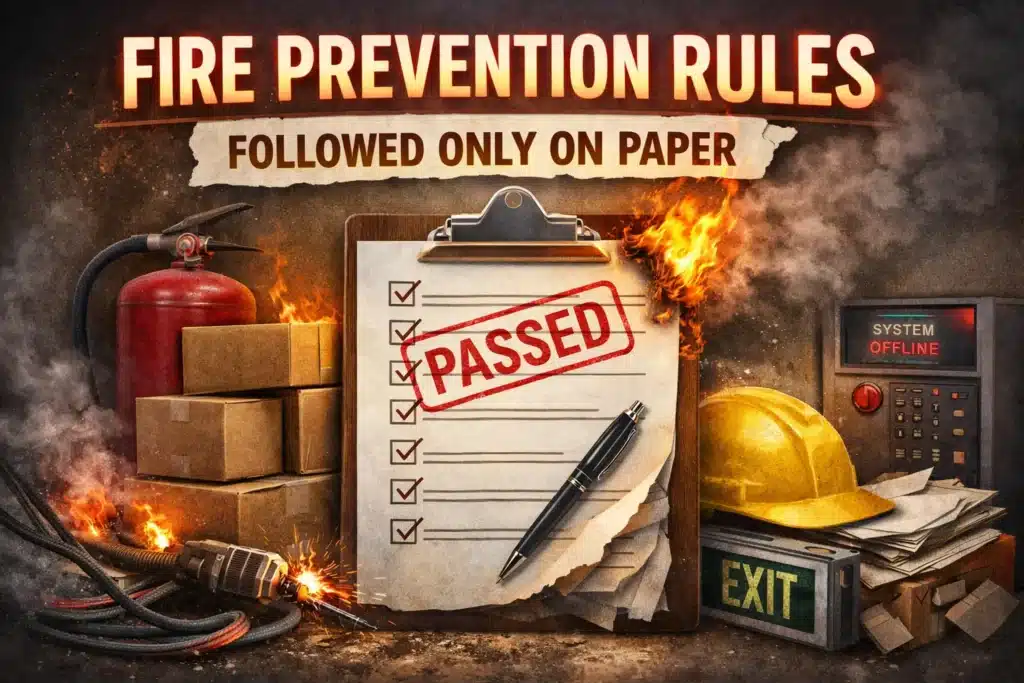
Fire Prevention Rules That Are Followed Only on Paper
Most workplaces claim that fire prevention systems are fully implemented. Procedures are documented, inspections are recorded, and checklists are signed regularly.
However, when you walk through actual work areas, a different reality often appears. Fire hazards are visible, unsafe practices are common, and basic controls are missing.
This gap between documentation and actual conditions is one of the biggest reasons why workplace fires still occur. Fire prevention rules are often followed only on paper, not in daily operations.
What Paper Compliance Really Means
Paper compliance does not mean a lack of rules. It means a lack of real implementation.
It exists when:
- Procedures are written but not followed
- Checklists are completed without verification
- Inspections are conducted only for records
- Unsafe conditions are ignored because documentation is complete
In such cases, fire safety becomes an administrative activity rather than an operational priority.
Common Fire Prevention Rules Ignored in Practice
Housekeeping and Fire Load Control
Housekeeping policies require regular cleaning, removal of waste, and control of combustible materials.
In real workplaces, combustible waste such as cardboard, plastic packaging, and oily materials often accumulates in hidden areas like behind machines or near storage racks.
In one site inspection, housekeeping records showed daily compliance, but physical conditions revealed waste buildup that had not been removed for several days. This created a high fire load near active equipment.
Such conditions allow even a small ignition source to develop into a serious fire.
Electrical Safety Practices
Electrical systems are one of the most common sources of fire.
Policies usually require:
- Regular inspection of cables and panels
- Proper load distribution
- Safe wiring practices
However, actual conditions often include:
- Temporary wiring used permanently
- Overloaded sockets and extension boards
- Damaged or exposed cables
- Unauthorized electrical connections
These hazards often remain unnoticed because equipment continues to operate without immediate failure.
According to the National Fire Protection Association, electrical distribution systems are a leading cause of industrial fires. Proper inspection and maintenance are critical to prevent ignition.
For detailed fire safety standards, refer to:
👉 https://www.nfpa.org
Hot Work Permit System
Hot work activities such as welding and cutting require strict control because they introduce ignition sources.
On paper, the system includes:
- Permit approval before work
- Fire watch personnel
- Availability of fire extinguishers
- Area inspection
In reality, it is common to see:
- Work starting before permit approval
- Fire watch not present
- Combustible materials not removed
- Permits reused without proper checks
In one observation, welding was performed near stored packaging material without proper fire watch. The permit existed, but safety controls were not implemented.
Storage and Segregation of Materials
Fire prevention rules define safe storage practices for flammable materials.
These include:
- Segregation of chemicals
- Safe distance from ignition sources
- Controlled storage quantities
In practice, many workplaces show:
- Overcrowded storage areas
- Flammable materials placed near heat sources
- Temporary storage becoming permanent
These conditions increase fire load and make fire control more difficult.
Fire Extinguisher Accessibility
Fire extinguishers must be easily accessible and visible at all times.
However, in many workplaces:
- Extinguishers are blocked by materials
- Access paths are not maintained
- Responsibility for inspection is unclear
In an emergency, even a short delay in accessing an extinguisher can allow fire to spread rapidly.
Training and Emergency Preparedness
Training is a key part of fire prevention programs.
Most organizations conduct:
- Safety inductions
- Periodic training sessions
- Fire drills
However, in many cases:
- Training is done only for compliance
- Workers are not engaged
- Drills are predictable and not realistic
As a result, workers may know the rules but are not prepared to respond during a real emergency.
Why Paper Compliance Exists
Focus on Documentation
Maintaining records is easier than enforcing real safety practices.
Production Pressure
Fire safety rules are often ignored when they affect productivity or slow down work.
Weak Supervision
When supervisors do not actively monitor safety, unsafe practices become normal.
Audit Limitations
Audits that focus only on documents fail to identify actual hazards in the workplace.
How Paper Compliance Leads to Fire Incidents
Paper compliance creates a false sense of safety.
When actual conditions are not verified:
- Hazards remain uncontrolled
- Warning signs are ignored
- Risks accumulate over time
In many fire investigations, it is found that safety procedures were documented, but basic violations were clearly visible before the incident.
The failure is not in the rules, but in their implementation.
Practical Steps to Ensure Real Fire Prevention
Conduct Physical Inspections
Always verify actual conditions on the shop floor instead of relying only on documentation.
Focus on High-Risk Areas
Pay attention to:
- Electrical systems
- Hot work activities
- Storage areas
- Housekeeping conditions
Improve Accountability
Supervisors and managers must take responsibility for enforcing safety practices.
Use Unannounced Inspections
Random checks reveal real conditions rather than prepared environments.
Strengthen Training
Training should be practical, scenario-based, and focused on real emergency response.
Conclusion
Fire prevention rules do not fail because they are poorly written.
They fail because they are not implemented in daily operations.
A workplace that depends only on documentation is not truly safe.
Real fire prevention exists only when rules are actively followed, monitored, and enforced in the workplace.
Until organizations move beyond paper compliance, fire risks will continue to exist despite having strong policies on paper.
For a complete understanding, read our full Workplace Fire Safety Guide.
Complete Workplace Fire Safety Guide (2026): Prevention, Equipment, Risk & Response
Why Fire Audits Fail to Prevent Accidents
Overconfidence That Leads to Workplace Fires
How Poor Housekeeping Leads to Fire Accidents
Fire Risks Created by Temporary Work Activities
Electrical Fire Safety Explained, Why Electrical Fires Start and How to Stop Them Before Ignition
Frequently Asked Questions
What is paper compliance in fire safety
It means safety rules exist in documents but are not followed in real working conditions.
Why do fire incidents happen in compliant workplaces
Because documentation often does not reflect actual hazards.
What is the most common fire safety failure
Poor housekeeping and unsafe electrical practices are among the most common issues.
How can organizations improve fire safety
By focusing on real inspections, accountability, and consistent implementation of safety measures.
