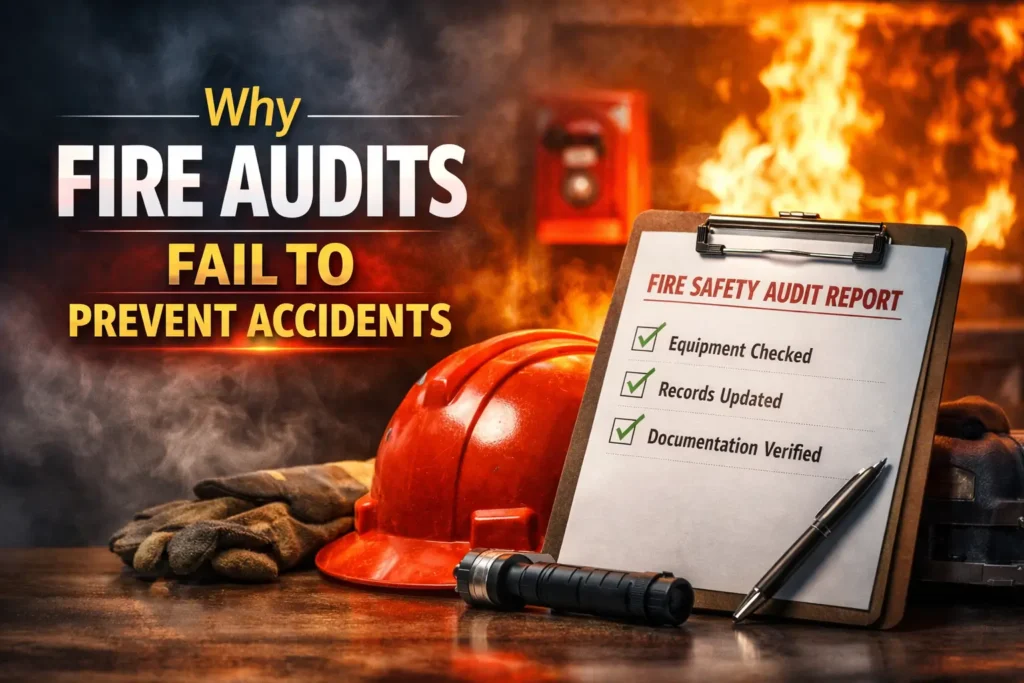
Why Fire Audits Fail to Prevent Accidents
Fire audits are conducted in almost every industrial, commercial, and institutional workplace. Reports are generated, observations are recorded, and compliance is documented.
Yet, fire incidents continue to occur even in facilities that have recently passed fire audits.
This raises an important question.
Why do fire audits fail to prevent real fire accidents?
The issue is not the existence of audits. The problem is how audits are conducted, interpreted, and implemented in real working conditions.
What a Fire Audit Is Meant to Achieve
A fire audit is intended to:
- Identify fire hazards
- Evaluate fire protection systems
- Verify compliance with applicable standards
- Assess emergency preparedness
- Recommend corrective actions
When performed correctly, a fire audit should identify weaknesses before an incident occurs and reduce the likelihood of fire.
However, in many workplaces, audits confirm compliance without verifying actual readiness.
Why Fire Audits Fail in Real Workplaces
Focus on Documentation Instead of Field Conditions
One of the most common failures is over-reliance on documentation.
Audits typically verify:
- Certificates
- Maintenance records
- Inspection checklists
- Approval documents
But they often fail to verify:
- Actual equipment performance
- System reliability under load
- Real emergency response capability
In several site audits, it has been observed that documents show full compliance while physical conditions reveal blocked access, poor maintenance, and inactive safety systems.
Fire safety cannot be confirmed through paperwork alone.
Visual Inspection Without Functional Testing
Many audits stop at visual confirmation.
For example:
- Fire extinguishers are present
- Hydrant systems are installed
- Alarm panels are powered
However, critical aspects are often not tested, such as:
- Fire pump auto-start
- Water pressure in hydrant lines
- Alarm audibility in noisy areas
- Sprinkler system flow
In one industrial facility, a fire pump that appeared operational during inspection failed to start automatically during an actual emergency.
The audit verified presence, not performance.
Predictable and Pre-Planned Audits
When audits are scheduled in advance, workplaces often prepare temporarily.
Common practices include:
- Cleaning areas before inspection
- Clearing blocked exits
- Hiding damaged equipment
- Pausing unsafe activities
This creates a controlled environment that does not represent normal operations.
Once the audit is completed, conditions return to previous unsafe states.
Repeated Observations Without Closure
In many organizations, the same audit findings appear repeatedly.
Examples include:
- Training not conducted
- Maintenance pending
- System upgrades required
If these observations are not closed with verified actions, the audit becomes a routine exercise rather than a preventive tool.
Over time, unresolved issues become normalized.
Lack of Practical Audit Competence
Fire audits are sometimes conducted by individuals who:
- Depend only on standard checklists
- Lack site-specific operational understanding
- Have limited exposure to real fire incidents
Without practical experience, audits remain surface-level and fail to identify critical risks.
Management Focus on Compliance
In many workplaces, audits are treated as a requirement rather than a safety tool.
They are conducted to:
- Satisfy regulatory authorities
- Meet insurance requirements
- Avoid penalties
When compliance becomes the objective, risk reduction is no longer the priority.
Ignoring Human Behavior
Most fire audits focus on systems and installations but ignore human factors.
They often fail to assess:
- Unsafe work practices
- Shortcut behaviors
- Permit violations
- Worker response during emergencies
In reality, many fire incidents occur due to human error rather than system failure.
Lack of Scenario-Based Evaluation
Effective fire safety requires thinking beyond installation.
Audits rarely ask critical questions such as:
- What happens if fire occurs at night?
- What if power supply fails?
- What if trained personnel are unavailable?
- What if multiple systems fail simultaneously?
Without scenario-based evaluation, audits remain incomplete.
Real Workplace Example
In one manufacturing facility, a fire audit was completed with no major observations.
Two months later, a fire occurred due to electrical overheating.
During the incident:
- The alarm response was delayed
- The fire pump did not start automatically
- Workers were unsure of emergency procedures
The audit had verified documentation and system presence but failed to assess actual readiness.
The incident exposed the gap between compliance and performance.
How Fire Audits Lose Effectiveness Over Time
Fire audits gradually lose value when:
- The same checklist is reused repeatedly
- Audit results become predictable
- No surprise inspections are conducted
- Corrective actions are delayed
- Risk awareness decreases
Routine auditing creates a false sense of security and reduces attention to real hazards.
How Fire Audits Should Be Conducted
Focus on Functional Testing
Systems must be tested under real conditions, not just visually inspected.
Conduct Unannounced Inspections
Surprise audits reveal actual working conditions instead of prepared environments.
Evaluate Real Fire Scenarios
Audits should consider:
- Different fire locations
- System failure conditions
- Emergency response limitations
Involve Workers
Workers should be interviewed to assess their understanding of emergency procedures.
Verify Closure of Observations
All audit findings must be followed up and closed with evidence.
Ensure Management Accountability
Safety performance must be reviewed at management level, not just documented.
External Reference
According to the National Fire Protection Association, fire safety inspections and audits are effective only when they include functional testing, real-world evaluation, and follow-up actions rather than relying solely on compliance checklists.
For detailed guidance, refer to:
👉 https://www.nfpa.org
Conclusion
Fire audits do not fail because they exist.
They fail because they are used incorrectly.
An audit that focuses only on documentation, ignores real conditions, and avoids critical evaluation cannot prevent fire incidents.
Fire safety improves only when audits are practical, challenging, and action-driven.
Until audits move beyond paperwork, they will continue to approve workplaces that are not truly prepared for fire.
For a complete understanding, read our full Workplace Fire Safety Guide.
Complete Workplace Fire Safety Guide (2026): Prevention, Equipment, Risk & Response
Fire Prevention Rules That Are Followed Only on Paper
Overconfidence That Leads to Workplace Fires
How Poor Housekeeping Leads to Fire Accidents
Fire Risks Created by Temporary Work Activities
Electrical Fire Safety Explained, Why Electrical Fires Start and How to Stop Them Before Ignition
Frequently Asked Questions
Can fire audits prevent accidents
Yes, but only when they include functional testing and follow-up actions.
Why do fires occur after audits
Because audits often confirm compliance without verifying actual readiness.
How often should fire audits be conducted
Regularly, with a combination of scheduled and unannounced inspections.
Are third-party audits reliable
Only if auditors are competent and independent.
What is the biggest weakness in fire audits
Over-reliance on documentation and lack of real-world evaluation.
