
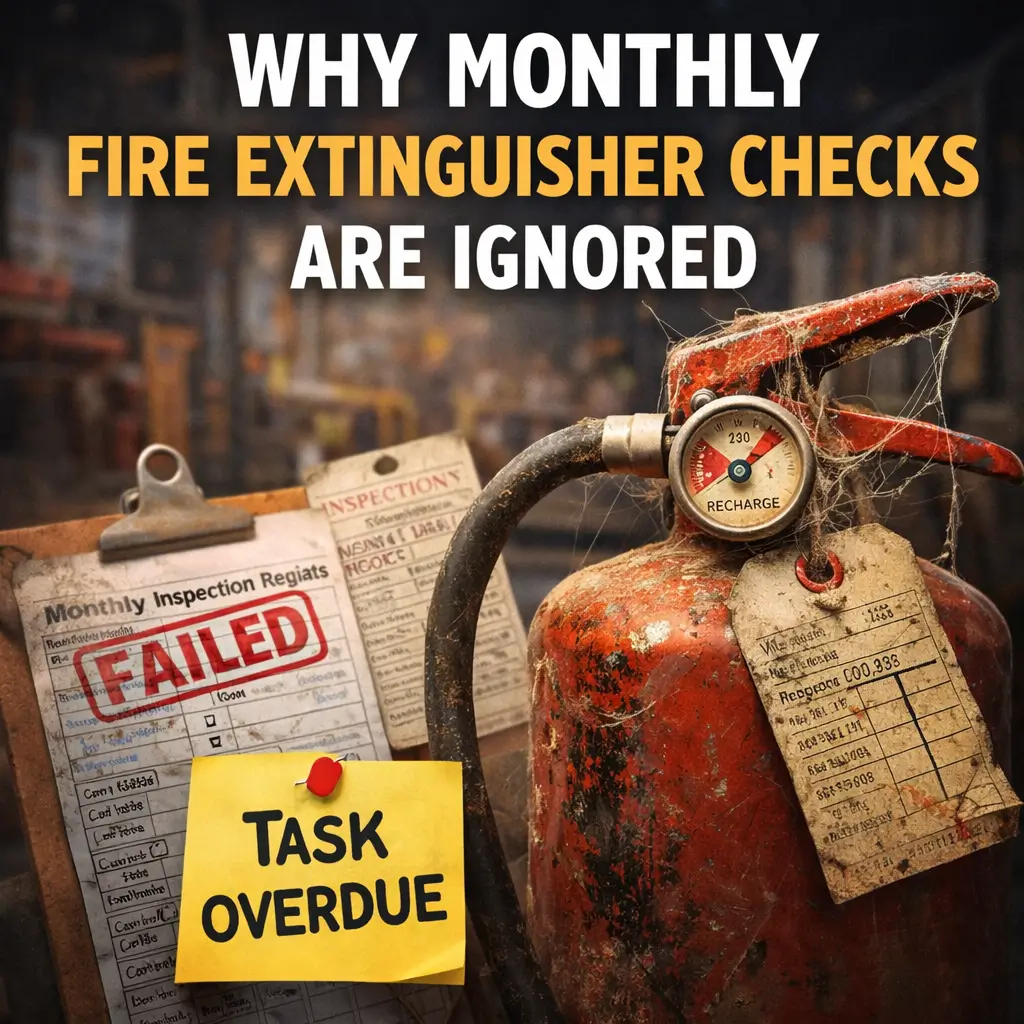
Why Monthly Fire Extinguisher Checks Are Ignored
The Hidden Gap Between Installation and Readiness
Fire extinguishers are installed in almost every workplace.
They are visible, counted, and documented.
But in many real fire incidents, extinguishers fail to perform when needed.
The issue is not the absence of equipment.
The issue is that monthly fire extinguisher checks are ignored, and as a result, the equipment is not ready.
This gap between installation and readiness is one of the most common and dangerous fire safety failures.
What Monthly Fire Extinguisher Checks Actually Mean
Monthly checks are simple visual inspections designed to ensure that extinguishers remain:
- Available
- Accessible
- Functional
- Safe to use
A proper monthly inspection verifies:
- Extinguisher is in correct location
- Access is not blocked
- Pressure gauge is in green zone
- Safety pin and seal are intact
- No visible damage or leakage
- Inspection tag is updated
These checks take less than two minutes per extinguisher but have a major impact on fire safety.
Why Monthly Checks Are Ignored in Workplaces
Fire Safety Treated as Paperwork
In many organizations:
- Inspections are recorded without being performed
- Registers are filled in advance
- Compliance is shown without verification
This creates a false sense of safety.
When inspections exist only on paper, real risks remain hidden.
No Clear Responsibility
A very common issue is lack of ownership.
- Safety assumes maintenance will check
- Maintenance assumes safety will check
- Supervisors assume someone else is responsible
When responsibility is shared, accountability disappears.
Lack of Training and Awareness
Many employees do not understand:
- What the pressure gauge indicates
- Why tamper seals matter
- How damage affects performance
- How often checks should be done
Without training, extinguishers are treated as background objects.
Over-Reliance on Annual Servicing
A major misconception is:
“Annual servicing is enough.”
In reality:
- Pressure can drop within weeks
- Nozzles can get blocked
- Extinguishers can be damaged anytime
Monthly inspections are essential to identify these issues early.
Weak Safety Culture
When production is prioritized over safety:
- Inspections are skipped
- Issues are ignored
- Compliance becomes a formality
A weak safety culture leads to equipment failure.
No Action on Reported Issues
Even when inspections are done, problems are often not corrected.
Common examples:
- Low pressure not refilled
- Missing pins not replaced
- Blocked extinguishers not cleared
When employees see no action, they stop taking inspections seriously.
Real Workplace Observations
In many industrial audits, common findings include:
- Pressure gauges in red zone
- Corroded extinguishers
- Missing safety pins
- Blocked access
- Inspection tags filled in advance
These are not rare issues. They are routine in workplaces where checks are ignored.
Consequences of Ignoring Monthly Checks
Ignoring monthly inspections can lead to:
- Extinguishers failing during emergencies
- Small fires becoming major incidents
- Increased property damage
- Worker injuries
- Legal penalties
- Insurance claim rejection
In many cases, extinguishers were present but unusable.
Fire Extinguisher Monthly Inspection Checklist
Basic Monthly Check
- Verify location and accessibility
- Check pressure gauge
- Inspect safety pin and seal
- Examine hose and nozzle
- Look for damage or corrosion
- Update inspection tag
Red Flag Conditions
Take immediate action if:
- Pressure is low
- Seal is broken
- Hose is damaged
- Cylinder is corroded
- Extinguisher is missing
How to Ensure Monthly Checks Are Actually Done
Assign Clear Ownership
Assign inspection responsibility to a specific person, not a department.
Use Simple Checklists
Keep inspections simple and visual to improve consistency.
Provide Practical Training
Train employees on:
- How to inspect extinguishers
- What to look for
- When to report issues
Conduct Random Verification
Management should:
- Check extinguishers randomly
- Verify inspection accuracy
- Ensure compliance is real
Take Immediate Action
Fix issues immediately.
Delays reduce confidence and increase risk.
Role of Safety Officers
Safety professionals must:
- Ensure inspections are conducted
- Verify accuracy of records
- Track deficiencies
- Close corrective actions
- Promote accountability
Without active supervision, inspection systems fail.
Industry Guidance and Standards
According to the National Fire Protection Association, portable fire extinguishers must be inspected regularly to ensure they remain in a fully charged and operable condition.
NFPA emphasizes:
- Monthly visual inspections
- Annual maintenance
- Immediate correction of defects
- User awareness
For detailed guidance, refer to:
👉 https://www.nfpa.org/News-and-Research/Publications-and-media/NFPA-Journal
Warning Signs That Checks Are Being Ignored
Watch for these indicators:
- Identical handwriting on all inspection tags
- No variation in inspection dates
- Dust-covered extinguishers
- Repeated unresolved issues
- Missing inspection records
These signs indicate inspections are not being done properly.
Practical System to Improve Compliance
Implement the following:
- Monthly inspection schedule
- Assigned inspection zones
- Digital tracking system
- Supervisor verification
- Audit-based validation
This ensures inspections are consistent and reliable.
Conclusion
Monthly fire extinguisher checks are ignored not because they are difficult, but because they are underestimated.
Fire extinguishers are only effective when they are ready.
A simple monthly inspection can prevent:
- Equipment failure
- Fire escalation
- Serious losses
Fire safety is not about installing equipment.
It is about ensuring that equipment works when needed.
For a complete understanding, read our full Workplace Fire Safety Guide.
Complete Workplace Fire Safety Guide (2026): Prevention, Equipment, Risk & Response
Types of Fire Extinguishers Explained, How to Select the Right One for Real Workplace Fires
Water Extinguisher, When It Works, When It Fails, and How People Misuse It
Foam Fire Extinguishers, When They Are the Best Choice and When They Are Dangerous
CO₂ Fire Extinguisher, Where It Works Perfectly and Where It Becomes Dangerous
DCP Fire Extinguisher, Why It Works So Fast and Why It Often Fails After That
Frequently Asked Questions
Are monthly checks mandatory
Yes. Most fire safety standards require monthly inspections.
Can annual servicing replace monthly checks
No. Both are required.
How long does a monthly inspection take
Usually less than two minutes per extinguisher.
Who should perform inspections
Trained internal personnel such as safety officers or supervisors.
What is the biggest risk of skipping checks
Extinguishers may fail during emergencies.
