
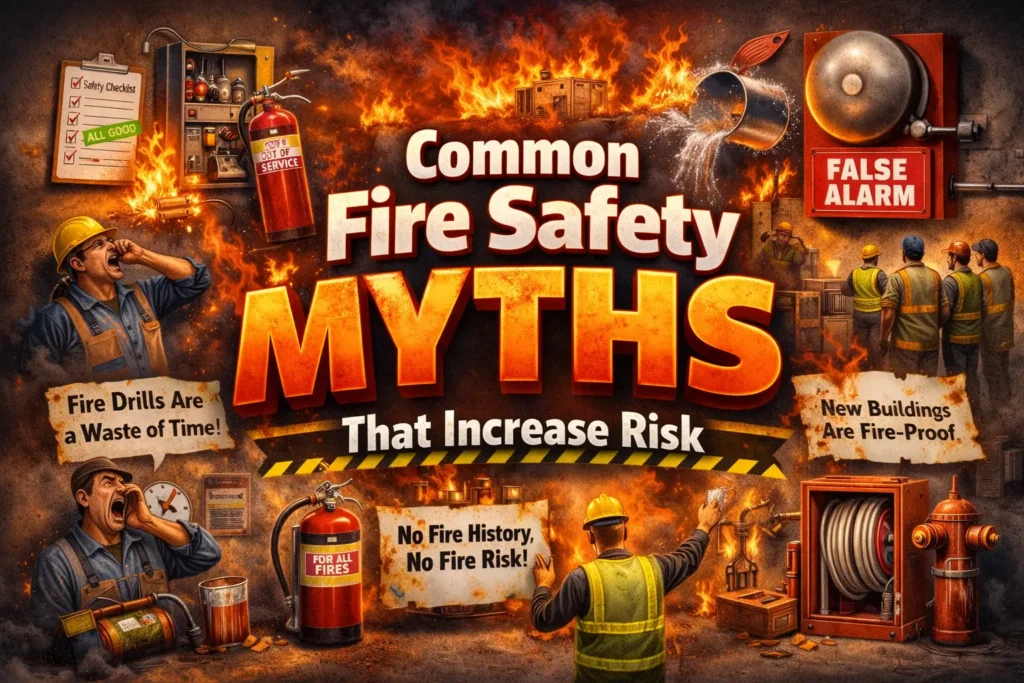
Common Fire Safety Myths That Increase Risk
Fire hazards are visible.
Myths are not.
In many workplaces, fire accidents occur not because safety systems are missing, but because people believe incorrect information about fire behavior, equipment, and emergency response.
These myths create:
- False confidence
- Delayed reaction
- Unsafe decisions
Understanding and correcting these misconceptions is essential for effective fire prevention.
Why Fire Safety Myths Still Exist
Fire safety myths continue due to:
- Lack of training
- Outdated knowledge
- Overconfidence
- Poor safety culture
- Assumptions instead of facts
Without proper education, incorrect beliefs become normal practice.
Most Common Fire Safety Myths and the Reality
Myth 1: Fire Will Always Be Visible Before It Becomes Dangerous
Many people believe they will see flames before danger increases.
Reality:
- Fire produces toxic smoke early
- Carbon monoxide spreads quickly
- Heat builds before flames become visible
Most fatalities occur due to smoke inhalation, not burns.
Myth 2: Fire Extinguishers Are Easy to Use Without Training
People assume extinguishers can be used instinctively.
Reality:
- Wrong usage can worsen fire
- Incorrect selection increases risk
- Panic affects performance
Even basic knowledge is essential.
Myth 3: Smoke Alarms Are Only Needed in Large Buildings
Some believe small offices or homes do not require alarms.
Reality:
- Fires grow rapidly in small spaces
- Detection delay increases risk
- Night-time fires are especially dangerous
Early warning is critical in all environments.
Myth 4: No Fire History Means No Fire Risk
Workplaces often assume:
“No incident means no risk.”
Reality:
- Fire risk depends on current conditions
- New hazards can develop anytime
- Changes in equipment increase risk
Past safety does not guarantee future safety.
Myth 5: Water Can Be Used on Any Fire
This is one of the most dangerous myths.
Reality:
- Water spreads flammable liquid fires
- Water conducts electricity
- Water reacts with certain metals
Water is suitable only for Class A fires.
Myth 6: Fire Safety Is Only the Safety Officer’s Responsibility
Many workers rely entirely on safety personnel.
Reality:
- Unsafe behavior increases risk
- Poor housekeeping contributes to fire
- Hazard reporting is essential
Fire safety requires collective responsibility.
Myth 7: Modern Buildings Are Fire-Proof
Modern construction creates a false sense of security.
Reality:
- Materials may resist fire, not prevent it
- Contents inside buildings still burn
- Electrical systems create ignition sources
Fire-resistant does not mean fire-proof.
Myth 8: Fire Drills Are a Waste of Time
Some see drills as unnecessary.
Reality:
- Drills improve response time
- Reduce panic
- Improve evacuation efficiency
People react based on practice during emergencies.
Myth 9: Fires Spread Slowly
Media often shows gradual fire growth.
Reality:
- Fire can grow exponentially
- Flashover can occur within minutes
- Synthetic materials increase speed
Small fires can become uncontrollable quickly.
Myth 10: Fire Safety Equipment Always Works
Many assume installed systems will function automatically.
Reality:
- Equipment fails without maintenance
- Extinguishers lose pressure
- Alarms may be disabled
Equipment reliability depends on regular inspection.
What Safety Officers Commonly Miss
In real workplaces, these issues are often overlooked:
- Workers relying on incorrect assumptions
- Lack of fire behavior awareness
- No myth-based training
- Overconfidence in systems
This gap leads to unsafe decisions during emergencies.
Real Workplace Example
In a small office, a fire started due to electrical overheating.
Employees believed:
- The fire would grow slowly
- Extinguishers could be used anytime
Delay in response led to:
- Rapid smoke spread
- Reduced visibility
- Fire escalation
The incident occurred because of incorrect assumptions, not lack of equipment.
Fire Safety Awareness Checklist
What Every Worker Must Understand
- Fire grows faster than expected
- Smoke is more dangerous than flames
- Not all extinguishers are suitable for every fire
- Equipment must be maintained
- Evacuation is often safer than firefighting
Workplace Control Measures
- Conduct regular training
- Include myth-based awareness sessions
- Use real-life examples
- Reinforce correct fire behavior knowledge
- Encourage hazard reporting
How to Eliminate Fire Safety Myths
Organizations should:
- Provide structured fire safety training
- Conduct practical demonstrations
- Update safety knowledge regularly
- Promote open communication
- Strengthen safety culture
Knowledge replaces myths and improves safety performance.
Industry Guidance and Standards
According to the National Fire Protection Association, fire safety education is essential for preventing incidents, as human behavior and awareness play a major role in fire prevention and response.
NFPA emphasizes:
- Public and workplace education
- Correct understanding of fire behavior
- Proper use of fire protection systems
- Continuous awareness programs
For detailed guidance, refer to:
👉 https://www.nfpa.org/News-and-Research/Publications-and-media/NFPA-Journal
Warning Signs That Myths Are Influencing Safety
Watch for these indicators:
- Workers hesitant during drills
- Incorrect extinguisher usage
- Delayed evacuation
- Overconfidence in equipment
- Lack of training participation
These signs indicate poor fire awareness.
Conclusion
Fire safety myths are invisible hazards.
They do not burn, but they lead to fires becoming more dangerous.
Incorrect beliefs about fire behavior, equipment, and response create conditions where small incidents escalate into major accidents.
Replacing myths with accurate knowledge is essential.
Fire safety depends on:
- Awareness
- Training
- Correct understanding
- Continuous improvement
Understanding the truth about fire is one of the most powerful tools in prevention.
For a complete understanding, read our full Workplace Fire Safety Guide.
Complete Workplace Fire Safety Guide (2026): Prevention, Equipment, Risk & Response
Why Fire Starts Even When All Safety Rules Are Followed
Fire Triangle Explained, Practical Fire Risk Control Guide for Workplaces
Heat Sources in Industrial Fires, Where Ignition Really Starts and How to Stop It
Fuel Types and Their Fire Behaviour, Why Different Fuels Burn Differently and How Fires Escalate
Role of Oxygen in Combustion, How Oxygen Makes Fires Grow and Why It Becomes Dangerous
Frequently Asked Questions
Are fire safety myths really dangerous
Yes. They lead to incorrect actions during emergencies.
Why do people believe fire myths
Due to lack of training and reliance on assumptions.
Can training eliminate these myths
Yes. Proper training replaces incorrect beliefs with accurate knowledge.
Is fire safety only important in industries
No. It is essential in all environments.
How often should awareness be updated
At least annually or when workplace conditions change.
