Fire Behavior That Most Workers Do Not Understand
Fire is often seen as a sudden and uncontrollable event.
In reality, fire behaves in predictable ways based on physical and chemical principles.
Most workers, even in industrial environments, are not trained to understand how fire actually behaves. This lack of awareness leads to poor decisions during emergencies, which can turn small incidents into major accidents.
Understanding fire behavior helps workers:
- Recognize early warning signs
- React correctly during initial fire stages
- Avoid actions that worsen the situation
- Evacuate safely and quickly
Fire safety is not only about equipment. It is about understanding how fire develops.
Common Misconceptions About Fire in Workplaces
Many workers believe:
- Fire grows slowly
- Flames are the main danger
- Smoke is not harmful initially
- Opening doors helps reduce fire
- All fires behave the same
These assumptions are incorrect and dangerous.
Fire Grows Faster Than Most Workers Expect
One of the most critical misunderstandings is the speed of fire growth.
In real conditions:
- A small spark can ignite materials
- Heat builds rapidly
- Flammable vapors are released
- Fire intensity increases exponentially
Within minutes, a small fire can become uncontrollable.
Why Workers Underestimate Fire Growth
- Early flames appear manageable
- Lack of real exposure to fire behavior
- Overconfidence in extinguishers
- Delayed decision-making
By the time the fire appears serious, it may already be too late.
Heat Travels Before Flames Become Visible
Workers often look for flames as the first sign of danger.
However, heat spreads much earlier through:
- Conduction through metal
- Convection via hot air
- Radiation across surfaces
This means:
- Equipment can ignite without visible flames
- Materials heat up silently
- Fire can spread before detection
This explains sudden ignition in electrical panels and storage areas.
Smoke Is More Dangerous Than Flames
A major misunderstanding is that fire kills, not smoke.
In reality:
- Smoke contains toxic gases
- Oxygen levels decrease quickly
- Visibility drops rapidly
- People become disoriented
Most fire-related deaths are caused by smoke inhalation.
Common Mistakes by Workers
- Standing upright instead of staying low
- Moving toward smoke
- Delaying evacuation
Understanding smoke behavior is essential for survival.
Oxygen Changes Fire Behavior Instantly
Many workers open doors or windows during a fire.
This is dangerous.
When oxygen enters:
- Fire intensity increases
- Flames spread rapidly
- Flashover risk increases
This is why fires suddenly intensify when doors are opened.
Different Materials Burn Differently
Not all fires behave the same way.
Fire behavior depends on:
- Type of fuel
- Surface area
- Arrangement
- Presence of liquids or gases
Examples
- Plastic fires produce dense toxic smoke
- Electrical fires spread internally
- Liquid fires spread horizontally
Using the wrong extinguisher or approach can worsen the situation.
Fire Can Spread Through Hidden Paths
Fire does not always remain visible.
It can travel through:
- Cable trays
- False ceilings
- Duct systems
- Wall cavities
Workers may believe the fire is controlled while it is spreading elsewhere.
This creates a false sense of safety.
Airflow and Ventilation Affect Fire Direction
Fire does not always move upward.
Airflow from:
- Exhaust fans
- Open doors
- HVAC systems
- Natural wind
can push fire:
- Sideways
- Downward
- Toward escape routes
Workers unaware of airflow risks may move into dangerous areas.
What Safety Officers Commonly Miss
In real workplaces, these issues are often overlooked:
- Workers not trained on fire behavior
- Focus only on equipment, not understanding
- Lack of practical fire awareness
- No explanation of smoke or heat movement
This gap leads to poor decision-making during emergencies.
Real Workplace Example
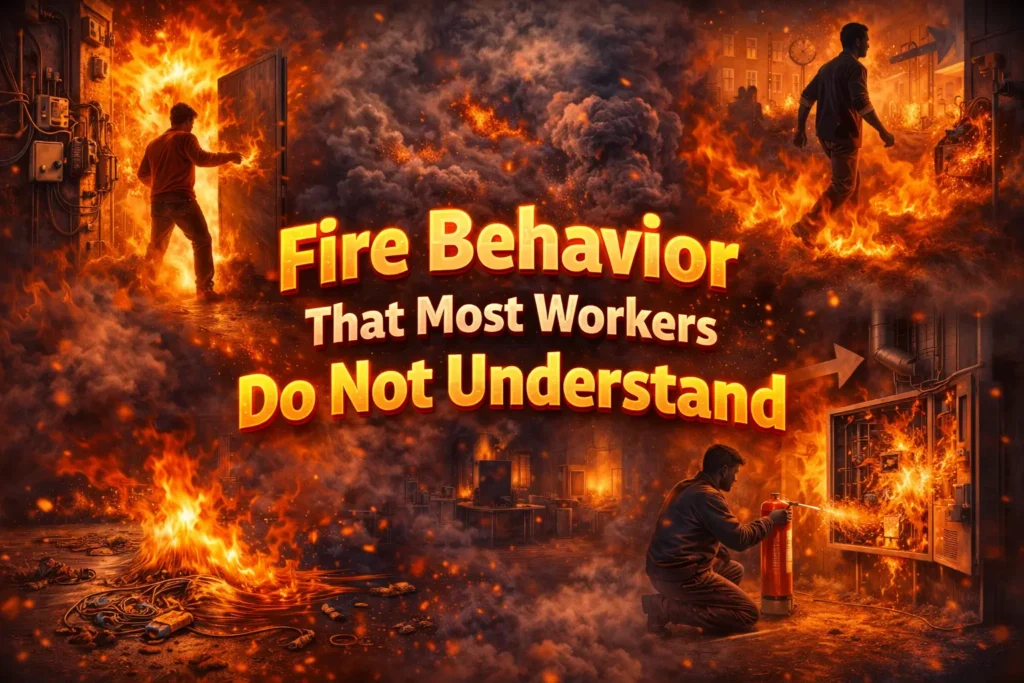
In a factory, a small electrical fire started inside a panel.
Workers saw minimal smoke and delayed response.
When the panel door was opened:
- Oxygen entered
- Fire intensified suddenly
- Flames spread to nearby cables
The situation escalated because workers did not understand fire behavior.
Practical Fire Behavior Awareness Checklist
Every Worker Should Know
- Fire grows rapidly, not slowly
- Heat spreads before flames
- Smoke is highly dangerous
- Oxygen increases fire intensity
- Fire spreads through hidden paths
- Airflow changes fire direction
Workplace Safety Controls
- Conduct fire behavior training
- Include behavior in toolbox talks
- Use real examples during training
- Combine theory with practical drills
- Ensure workers understand risks, not just rules
Role of Fire Risk Assessment
Fire risk assessments must consider:
- Heat sources
- Fuel types
- Oxygen availability
- Ventilation patterns
- Worker behavior
Understanding fire behavior improves risk identification and control measures.
Industry Guidance and Standards
Guidance from the Occupational Safety and Health Administration highlights that fire behavior depends on factors such as ignition sources, heat release, ventilation, and fuel load.
These factors directly influence:
- Fire growth rate
- Smoke development
- Evacuation time
- Overall fire risk
For detailed guidance, refer to:
👉 https://www.osha.gov/fire-safety
Warning Signs of Poor Fire Awareness
Look for these indicators:
- Workers hesitate during drills
- Misuse of extinguishers
- Panic during alarms
- Ignoring smoke hazards
- Lack of understanding of fire spread
These signs indicate weak fire behavior awareness.
Conclusion
Fire behavior is not random.
It follows predictable patterns based on heat, fuel, oxygen, and environmental conditions.
Most workplace incidents become serious because workers do not understand these basics.
Improving fire behavior awareness:
- Reduces panic
- Improves response
- Prevents escalation
- Saves lives
Fire safety is not only about equipment and procedures.
It is about understanding how fire actually behaves in real conditions.
For a complete understanding, read our full Workplace Fire Safety Guide.
Complete Workplace Fire Safety Guide (2026): Prevention, Equipment, Risk & Response
Common Fire Safety Myths That Increase Risk
Why Fire Starts Even When All Safety Rules Are Followed
Fire Triangle Explained, Practical Fire Risk Control Guide for Workplaces
Heat Sources in Industrial Fires, Where Ignition Really Starts and How to Stop It
Fuel Types and Their Fire Behaviour, Why Different Fuels Burn Differently and How Fires Escalate
Frequently Asked Questions
Why do workers underestimate fire danger
Because early-stage fires appear small and manageable.
Is smoke more dangerous than flames
Yes. Smoke contains toxic gases and reduces visibility.
Why does fire intensify when doors are opened
Because fresh oxygen increases combustion.
Do all fires behave the same
No. Fire behavior depends on fuel, ventilation, and environment.
Can understanding fire behavior save lives
Yes. It helps workers make safer decisions during emergencies.
