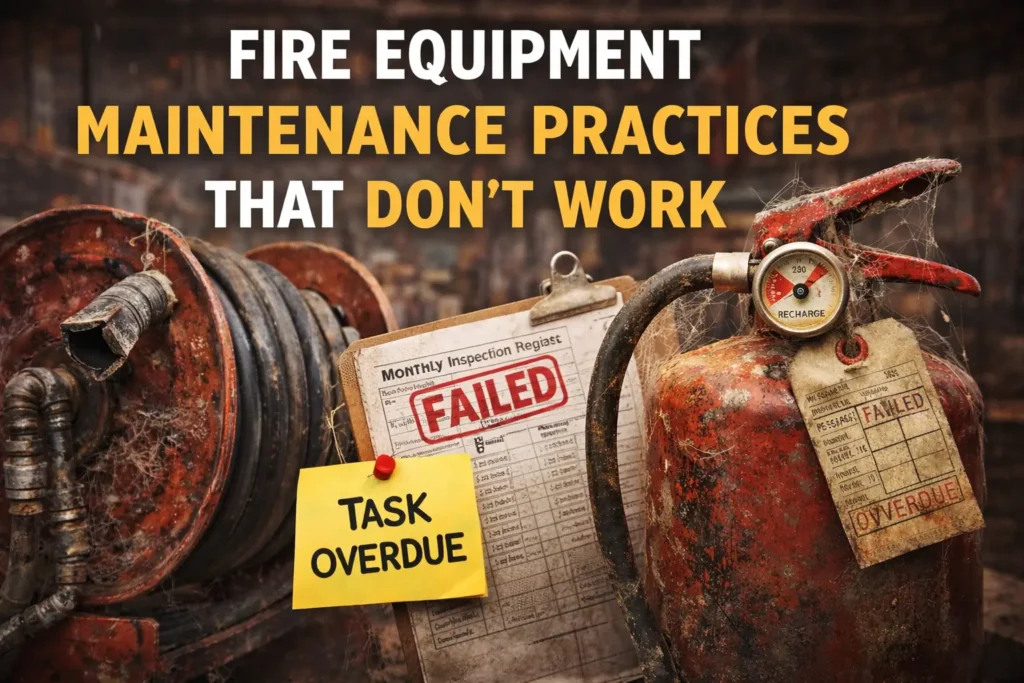
Fire Equipment Maintenance Practices That Don’t Work
Fire equipment is not installed for audits or inspections. It is installed for emergencies.
It must work during a real fire, under stress, when time is limited and conditions are unpredictable.
However, in many workplaces, fire equipment appears to be maintained but fails during actual incidents. Registers are filled, tags are updated, and reports are submitted, yet the equipment does not perform when needed.
This gap between documentation and real performance is one of the most dangerous weaknesses in fire safety systems.
Understanding the Role of Fire Equipment
Fire equipment includes:
- Fire extinguishers
- Fire hydrant systems
- Hose reels
- Fire pumps
- Fire alarm systems
- Emergency lighting
- Fire doors and dampers
- SCBA sets
These systems are interconnected. Failure of one system can affect the entire emergency response.
Maintenance is not about compliance. It is about ensuring that every system works under real fire conditions.
The Illusion of Maintained Equipment
Many workplaces assume equipment is maintained because:
- Inspection tags are updated
- Checklists are signed
- Records are complete
- Contractors visit periodically
But these are indicators of documentation, not performance.
A system that looks ready may still fail if it has not been tested under actual operating conditions.
Common Maintenance Practices That Fail in Real Situations
Checklist-Based Maintenance Without Functional Testing
One of the most common failures is relying only on visual inspection.
Typical practice includes:
- Checking appearance
- Verifying tags
- Signing checklists
But without:
- Operating valves
- Running pumps
- Discharging extinguishers
- Flow testing systems
Hidden faults remain undetected.
A hydrant system may look perfect but fail to deliver water when required.
Outsourced Maintenance Without Verification
Many organizations rely entirely on third-party contractors.
Problems arise when:
- Work is completed without supervision
- No functional testing is demonstrated
- Reports are accepted without verification
Contractors may focus on completing tasks quickly rather than ensuring performance.
Internal safety teams must verify the work, not just review documents.
Over-Reliance on Annual Maintenance
Some sites depend only on yearly servicing contracts.
This creates long gaps where failures go unnoticed.
Fire equipment requires:
- Daily observation
- Weekly testing
- Monthly inspection
- Annual servicing
Waiting for annual maintenance increases the risk of undetected failures.
Fire Pumps Not Tested Under Real Conditions
Fire pumps are the most critical part of a fire protection system.
Common issues include:
- Pumps never started
- Only jockey pump tested
- Diesel levels not checked
- Batteries not maintained
- No load testing conducted
During a fire, the pump may fail to start or deliver insufficient pressure.
Without pump performance, the entire fire protection system becomes ineffective.
Fire Extinguishers Never Tested by Discharge
Most extinguishers are only:
- Visually inspected
- Pressure checked
- Seal verified
But never discharged.
Hidden problems include:
- Blocked nozzle
- Compacted extinguishing agent
- Valve leakage
- Internal corrosion
Without testing, these issues remain undetected until failure occurs.
Hydrants and Hose Reels Not Flow Tested
Opening a valve slightly is not testing.
Proper testing requires:
- Full water flow
- Pressure verification
- Hose condition check
- Jet performance evaluation
In real cases, hoses fail due to cracks, leaks, or poor connections.
Only flow testing confirms system reliability.
Emergency Lights Not Tested Under Failure Conditions
Emergency lighting is often tested incorrectly.
Typical mistakes include:
- Checking lights during normal power supply
- Not testing battery backup
- Ignoring discharge time
During an actual power failure:
- Lights may not activate
- Batteries may drain instantly
- Escape routes become unsafe
Testing must simulate real power failure conditions.
Fire Doors and Dampers Ignored
Passive fire protection systems are often neglected.
Common issues include:
- Fire doors blocked open
- Damaged door seals
- Doors not closing properly
- Dampers stuck or corroded
During fire, smoke spreads rapidly if these systems fail.
Poor Equipment Identification and Records
Maintenance records may exist but often contain errors such as:
- Incorrect equipment numbers
- Missing locations
- Duplicate entries
In emergencies, this creates confusion and delays response.
Records must match actual equipment exactly.
No Performance Testing Through Drills
Fire drills are often conducted for compliance, not evaluation.
Without realistic drills:
- Equipment is not tested properly
- Response time is not measured
- Staff are not prepared
Drills should simulate real conditions to verify system performance.
What Safety Officers Commonly Miss
In many workplaces, the following issues are overlooked:
- Pumps not tested under load
- Hydrants not flow tested
- Extinguishers not discharged
- Emergency lights not tested during outage
- Fire doors not inspected
These gaps create a false sense of safety.
Real Workplace Example
In an industrial warehouse, a fire hydrant system was marked as fully maintained.
During a fire:
- The pump failed to start
- Hydrant pressure was zero
- Fire spread rapidly
Investigation revealed:
- Pump never tested under load
- Diesel tank was empty
- Battery was not functional
Maintenance existed only in records, not in reality.
Fire Equipment Maintenance Checklist
Daily Checks
- Visual condition of equipment
- Accessibility of extinguishers
- No obstruction to hydrants and exits
Weekly Checks
- Pump test (no load)
- Hose condition inspection
- Alarm system basic check
Monthly Checks
- Hydrant flow test
- Emergency lighting battery test
- Fire door inspection
Periodic Testing
- Pump load testing
- Extinguisher discharge testing
- Alarm system full testing
Industry Guidance and Standards
According to the National Fire Protection Association, fire protection systems must be regularly inspected, tested, and maintained to ensure reliability during emergencies.
NFPA guidelines emphasize:
- Functional testing over visual inspection
- Regular system verification
- Maintenance based on performance, not documentation
For detailed guidance, refer to:
👉 https://www.nfpa.org/News-and-Research/Publications-and-media/NFPA-Journal
How to Improve Fire Equipment Reliability
To ensure real performance:
- Conduct functional testing regularly
- Verify contractor work physically
- Maintain accurate records
- Perform realistic fire drills
- Assign clear responsibility for maintenance
- Take immediate corrective action
Maintenance must be based on evidence, not assumption.
Conclusion
Fire equipment does not fail randomly.
It fails because maintenance practices are incomplete or ineffective.
Checklists do not stop fires.
Registers do not control emergencies.
Tags do not ensure performance.
Only properly maintained and tested equipment can protect lives and property.
For a complete understanding, read our full Workplace Fire Safety Guide.
Complete Workplace Fire Safety Guide (2026): Prevention, Equipment, Risk & Response
Alarm Systems That Do Not Warn on Time
Hose Reels That Cannot Support Firefighting
Fire Pumps Installed but Not Reliable During Fires
Fire Hydrant Systems That Look Ready but Fail
Fire Hydrant System Explained, How It Works, Why It Fails, and How to Keep It Fire Ready
Frequently Asked Questions
Is visual inspection enough for fire equipment
No. Functional testing is essential.
How often should fire pumps be tested
Weekly no-load tests and periodic load testing are recommended.
Can contractors handle maintenance completely
Yes, but internal supervision is necessary.
Why do extinguishers fail despite inspection
Because internal faults are not visible without testing.
What is the biggest maintenance mistake
Relying on documentation instead of actual performance testing.
