
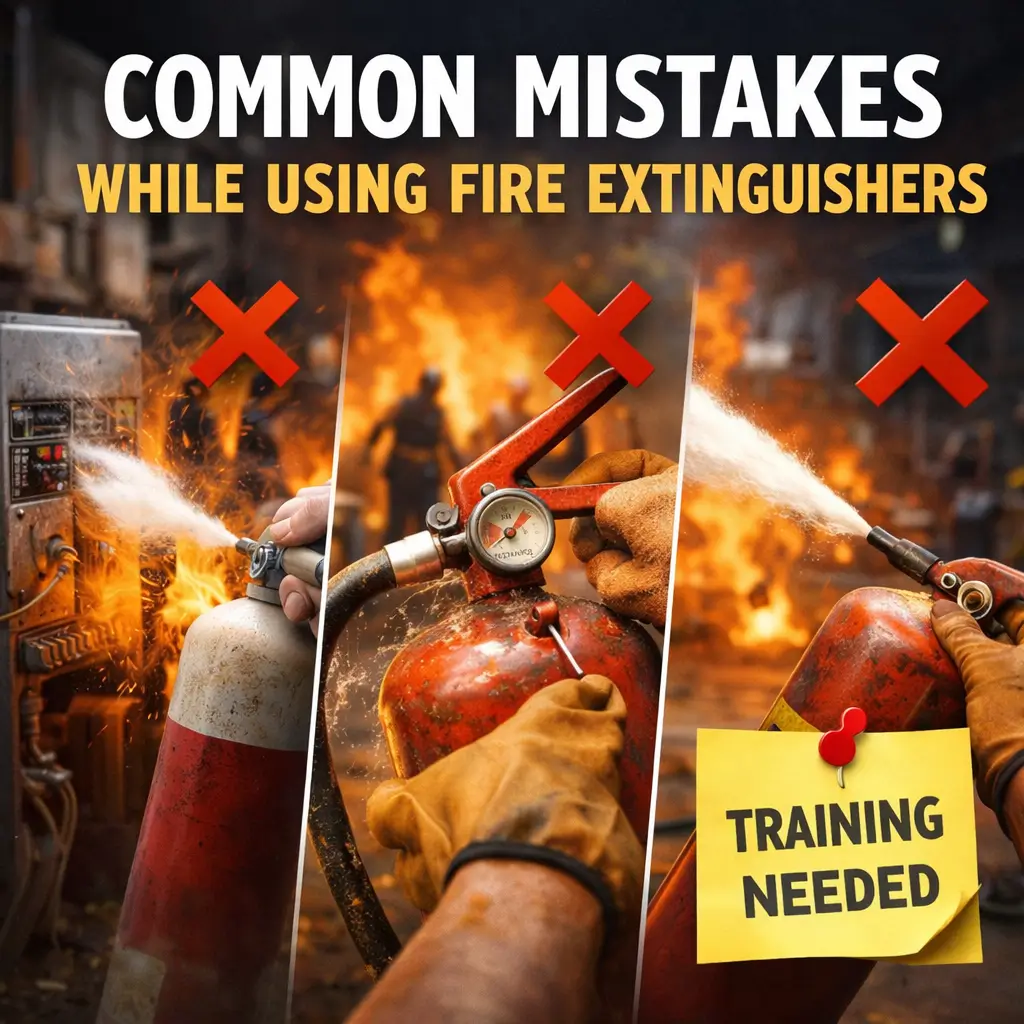
Common Mistakes While Using Fire Extinguishers
Fire extinguishers are installed in almost every workplace, commercial building, and industrial facility. Yet, during real fire emergencies, many extinguishers fail to control fires, not because the equipment is defective, but because of human mistakes.
Understanding these common mistakes is critical for fire safety officers, supervisors, engineers, and workers who may need to respond during the first few minutes of a fire incident.
For internationally accepted fire safety guidance, readers can refer to fire prevention and extinguisher usage recommendations published by the National Fire Protection Association (NFPA). NFPA provides practical education material on home and workplace fire safety, correct extinguisher use, and common mistakes that lead to fire spread, which aligns closely with real-world emergency response practices.
This article explains the most frequent mistakes made while using fire extinguishers, why they happen, and how they can be prevented through proper training and preparedness.
Why Fire Extinguisher Mistakes Are So Common
Fire emergencies create panic, confusion, and time pressure. In such situations, people often act instinctively rather than following correct fire-fighting procedures. In many workplaces, fire extinguishers are installed only to meet compliance requirements, while practical training and readiness are ignored.
According to internationally recognized fire safety education resources published by the National Fire Protection Association, early fire control depends more on correct human action than on equipment availability.
Mistake 1: Using the Wrong Type of Fire Extinguisher
One of the most dangerous mistakes is using an extinguisher that is not suitable for the fire class.
Examples:
- Using a water extinguisher on an electrical fire
- Using CO₂ on deep-seated Class A fires
- Using foam on reactive metal fires
This mistake can:
- Intensify the fire
- Cause electric shock
- Lead to flashback or re-ignition
How to avoid it
- Ensure extinguishers are clearly labeled with fire class symbols
- Train workers to identify fire classes quickly
- Conduct mock drills using real scenarios
Mistake 2: Not Pulling the Safety Pin Properly
Many people attempt to squeeze the operating lever without removing the safety pin. In high-stress situations, this simple step is often forgotten.
Result:
- Extinguisher does not discharge
- Critical response time is lost
- Fire grows uncontrollably
How to avoid it
- Teach the PASS technique clearly
Pull, Aim, Squeeze, Sweep - Include hands-on extinguisher handling during training
- Use demonstration extinguishers for practice
Mistake 3: Standing Too Close or Too Far from the Fire
Incorrect distance reduces extinguishing effectiveness.
Common errors:
- Standing too close and losing control
- Standing too far and missing the fire base
- Spraying flames instead of fuel source
Correct practice
- Maintain recommended distance mentioned on extinguisher label
- Aim at the base of the fire, not the flames
- Move forward slowly as fire reduces
Mistake 4: Spraying Randomly Instead of Sweeping
Random discharge wastes extinguishing agent quickly.
Effects:
- Agent finishes before fire is controlled
- Fire spreads sideways
- Loss of visibility due to poor spray control
How to avoid it
- Sweep side to side in a controlled motion
- Start from nearest edge of fire
- Maintain steady pressure on the lever
Mistake 5: Attempting to Fight Large or Spreading Fires
Fire extinguishers are designed for incipient stage fires only. Many people try to fight fires that are already beyond control.
Warning signs ignored:
- Fire taller than a person
- Thick smoke filling the area
- Rapid fire spread
- No clear exit route
Correct decision
- If fire is uncontrollable, evacuate immediately
- Never block your exit while firefighting
- Activate fire alarm and call emergency services
Mistake 6: Using Expired or Poorly Maintained Extinguishers
In many workplaces, extinguishers are:
- Expired
- Pressure gauge in red zone
- Nozzle blocked
- Tamper seal broken
During emergencies, these extinguishers fail instantly.
Prevention measures
- Monthly visual inspections
- Annual servicing by certified agency
- Maintain inspection records
- Replace damaged units immediately
Mistake 7: Lack of Training and Confidence
Untrained personnel often freeze during emergencies.
Common reasons:
- Never handled an extinguisher before
- Fear of explosion
- No practical fire drill experience
Solution
- Conduct live fire extinguisher training
- Use controlled fire pan demonstrations
- Repeat drills annually or bi-annually
Mistake 8: Ignoring Re-Ignition Risk
Some fires appear extinguished but re-ignite due to:
- Hot surfaces
- Smoldering materials
- Poor cooling
Best practice
- Observe area after extinguishing
- Cool surrounding materials if safe
- Do not leave the area immediately
Mistake 9: Poor Placement of Fire Extinguishers
Even trained personnel fail when extinguishers are:
- Blocked by storage
- Installed too high
- Located far from hazard areas
Correct placement
- Near exits
- Clearly visible
- Proper mounting height
- Unobstructed access
Mistake 10: Treating Fire Safety as a Formality
Fire extinguishers are often installed just for audits.
Consequences:
- No ownership
- No awareness
- No accountability
Fire safety must be treated as a life-saving system, not paperwork.
How Safety Officers Can Prevent These Mistakes
- Conduct toolbox talks on extinguisher use
- Display fire class charts near extinguishers
- Assign fire wardens for each zone
- Include extinguisher use in induction training
- Review incidents and near-misses
Frequently Asked Questions (FAQs)
Can anyone use a fire extinguisher?
Yes, but only after proper training. Untrained use can be dangerous.
Which mistake causes maximum fire injuries?
Using the wrong extinguisher type, especially water on electrical fires.
Is one extinguisher enough for an area?
No. Quantity and type depend on fire load and hazard assessment.
Should fire extinguishers be used without PPE?
Only if safe to do so. Smoke inhalation and heat exposure are serious risks.
How often should extinguisher training be conducted?
At least once a year, with refresher sessions during safety meetings.
Conclusion
Fire extinguishers save lives only when used correctly, confidently, and at the right time. Most failures during emergencies occur due to preventable human mistakes rather than equipment faults.
By understanding these common errors and investing in practical fire safety training, workplaces can significantly reduce fire damage, injuries, and fatalities.
Fire safety is not about having equipment.
It is about knowing how and when to use it.
Types of Fire Extinguishers Explained, How to Select the Right One for Real Workplace Fires
Water Extinguisher, When It Works, When It Fails, and How People Misuse It
Foam Fire Extinguishers, When They Are the Best Choice and When They Are Dangerous
CO₂ Fire Extinguisher, Where It Works Perfectly and Where It Becomes Dangerous
DCP Fire Extinguisher, Why It Works So Fast and Why It Often Fails After That
