
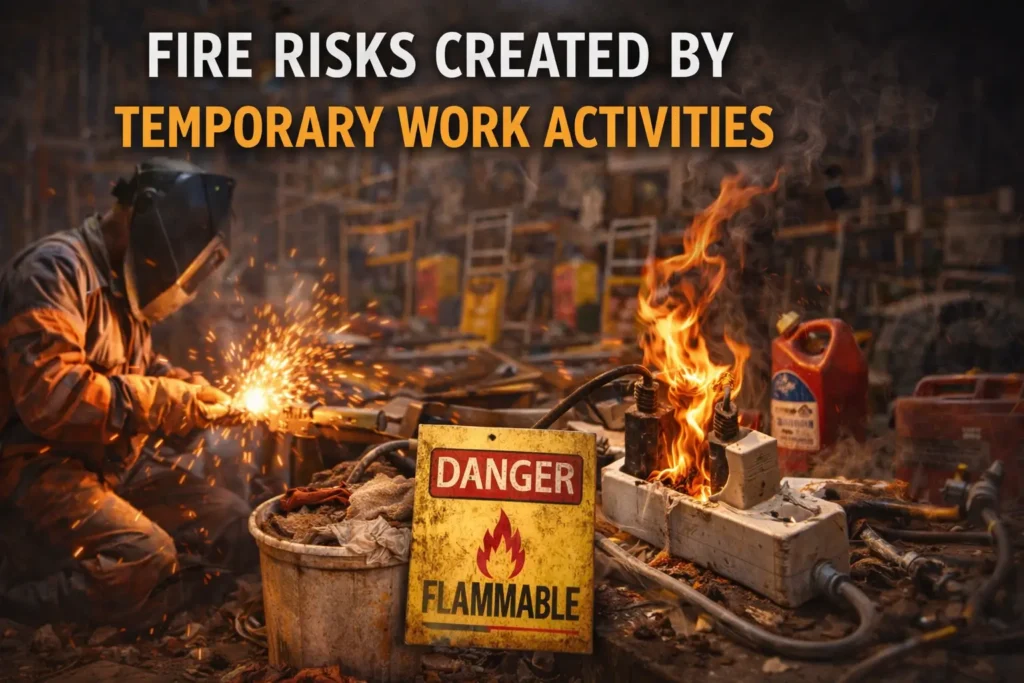
Fire Risks Created by Temporary Work Activities
Temporary work activities are often treated as low risk because they are short-term. However, many major workplace fires do not occur during normal operations. They occur during maintenance, shutdowns, modifications, or repair activities.
These tasks introduce conditions that are not present in routine operations. Systems may be disabled, layouts may change, and unfamiliar workers may be involved.
The danger is not the task itself. The danger is the change it creates in the working environment.
What Are Temporary Work Activities
Temporary work activities are tasks that:
- Are not part of routine operations
- Are performed for a limited duration
- Involve temporary equipment or connections
- Alter normal workplace conditions
Common examples include:
- Welding and cutting
- Electrical maintenance
- Shutdown repairs
- Scaffolding work
- Painting and solvent cleaning
- Temporary power installations
- Roofing and waterproofing
These activities disrupt normal fire safety arrangements.
Why Temporary Work Creates Fire Risk
Temporary work increases fire risk because it introduces:
- New ignition sources
- Additional combustible materials
- Disabled fire protection systems
- Reduced supervision
- Unfamiliar workers
Fire safety systems designed for normal operations may not be effective under these changed conditions.
Common Fire Risks Created by Temporary Work
Hot Work Ignition Sources
Hot work such as welding, cutting, and grinding is one of the leading causes of industrial fires.
Typical risks include:
- Sparks traveling long distances
- Hot slag falling through gaps
- Ignition of hidden combustible materials
- Smoldering fires that start after work is completed
In many real incidents, fires start hours after hot work due to unnoticed heat transfer.
Temporary Electrical Connections
Temporary electrical systems often bypass standard safety controls.
Common issues include:
- Overloaded extension cables
- Loose connections
- Exposed wiring
- Damaged insulation
- Unauthorized tapping
These temporary setups are not designed for long-term load, which increases the risk of overheating and electrical fires.
Isolation of Fire Protection Systems
During maintenance or shutdown:
- Sprinkler systems may be isolated
- Fire alarms may be disabled
- Detectors may be covered
- Hydrants may be obstructed
This creates periods where the workplace has reduced or no fire protection.
Even a small ignition during this time can lead to a major fire.
Accumulation of Combustible Materials
Temporary activities generate waste such as:
- Insulation scraps
- Packing materials
- Wooden supports
- Plastic sheets
- Oily rags
If housekeeping is not maintained, these materials act as fuel near ignition sources.
Use of Flammable Chemicals and Solvents
Activities like painting, cleaning, and coating introduce:
- Flammable vapors
- Low flash point liquids
- Volatile solvents
Without proper ventilation, vapors can accumulate and ignite, causing flash fires or explosions.
Untrained or Contract Workers
Temporary work often involves contractors.
Risks include:
- Lack of site-specific safety knowledge
- Poor understanding of emergency procedures
- Improper use of equipment
- Reduced hazard awareness
Contract workers may unknowingly create unsafe conditions.
Obstructed Escape Routes
Temporary work can block:
- Exit doors
- Corridors
- Staircases
- Fire doors
Scaffolding, cables, and stored materials can restrict evacuation during emergencies.
Reduced Supervision During Off-Hours
Temporary work is often performed:
- At night
- During weekends
- During shutdown periods
Reduced supervision leads to delayed detection and slower emergency response.
What Safety Officers Often Miss
In real workplaces, these issues are commonly overlooked:
- Hot work areas not inspected after completion
- Fire watch removed too early
- Temporary cables used for extended periods
- Fire systems disabled without backup
- Contractors not properly briefed
These gaps create conditions where incidents become highly likely.
Real Workplace Example
During a plant shutdown, welding was performed near insulation materials.
Although a permit was issued, proper monitoring was not maintained.
Several hours after the work was completed, smoldering insulation ignited.
The situation escalated because:
- Fire alarm system was isolated
- No fire watch was present
- Combustible materials were not removed
The fire started from a temporary activity that was assumed to be under control.
Fire Risk Assessment for Temporary Work
Temporary work requires a dedicated fire risk assessment.
This should include:
- Identification of ignition sources
- Evaluation of combustible materials
- Review of disabled fire systems
- Assessment of escape routes
- Contractor safety evaluation
Risk assessments must reflect actual working conditions, not standard procedures.
Control Measures for Temporary Work
Pre-Work Controls
- Conduct task-specific risk assessment
- Issue hot work permits
- Remove or shield combustible materials
- Ensure availability of firefighting equipment
During Work Controls
- Assign trained fire watch personnel
- Monitor work continuously
- Maintain proper ventilation
- Supervise contractors closely
Post-Work Controls
- Inspect work area thoroughly
- Continue fire watch for at least 30–60 minutes
- Check for hidden heat sources
- Restore fire protection systems immediately
Temporary Work Fire Safety Checklist
Before Work
- Permit approved
- Area cleared of combustibles
- Fire systems evaluated
- Equipment checked
During Work
- Fire watch present
- Sparks controlled
- Ventilation maintained
- Supervision active
After Work
- Area inspected
- Fire watch continued
- Waste removed
- Systems restored
Industry Guidance and Standards
According to the National Fire Protection Association, non-routine activities such as maintenance, hot work, and temporary electrical installations significantly increase fire risk because they introduce ignition sources and disrupt normal safety systems.
NFPA guidelines emphasize:
- Strict permit systems
- Continuous supervision
- Post-work monitoring
- Temporary fire protection measures
For detailed guidance, refer to:
👉 https://www.nfpa.org/News-and-Research/Publications-and-media/NFPA-Journal
Why Temporary Work Risks Are Underestimated
Temporary work is often ignored because:
- It is short-term
- Focus is on completing the task quickly
- Safety systems are assumed to be sufficient
- Risks are not visible immediately
This leads to unsafe conditions being accepted.
Conclusion
Temporary work activities create temporary conditions, but their consequences can be permanent.
Most major fires do not occur during routine operations. They occur during non-routine activities where controls are weakened.
Effective fire prevention during temporary work requires:
- Strong planning
- Strict control measures
- Continuous supervision
- Proper accountability
Ignoring these risks is one of the most common causes of serious workplace fires.
For a complete understanding, read our full Workplace Fire Safety Guide.
Complete Workplace Fire Safety Guide (2026): Prevention, Equipment, Risk & Response
How Poor Housekeeping Leads to Fire Accidents
Electrical Fire Safety Explained, Why Electrical Fires Start and How to Stop Them Before Ignition
Electrical Fire Causes Explained: Why Most Electrical Fires Start Without Warning
Preventing Short-Circuit Fires: Why They Happen and How to Stop Them Before Ignition
Safe Wiring Practices: How Proper Electrical Wiring Prevents Fires and Electrical Accidents
Frequently Asked Questions
Why are temporary activities more dangerous than routine work
Because they change normal conditions and bypass established safety systems.
Is a hot work permit enough
No. Continuous supervision and post-work monitoring are essential.
Should fire systems be disabled during maintenance
Only when necessary, and temporary protection must be provided.
How long should fire watch continue
At least 30 to 60 minutes, and longer if combustible materials are present.
Who is responsible for contractor safety
The site owner remains fully responsible for safety compliance.
