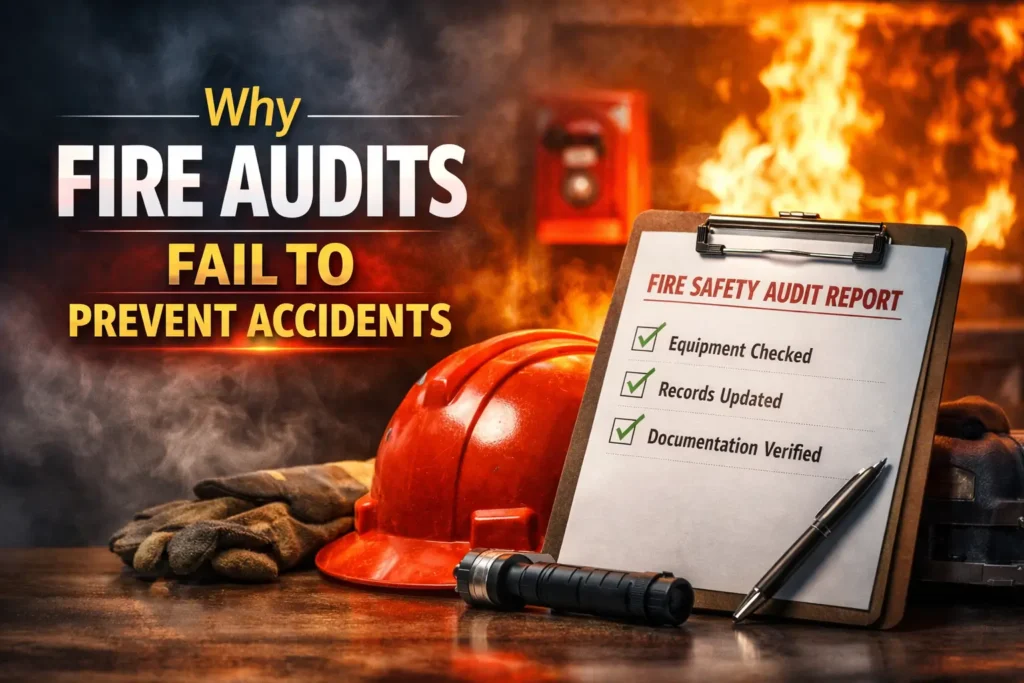
Why Fire Audits Fail to Prevent Accidents
Fire audits are conducted in almost every industrial, commercial, and institutional workplace.
Yet fires continue to occur even in facilities that have recently passed fire audits.
This raises a critical question:
Why do fire audits often fail to prevent real fire accidents?
The answer is uncomfortable but clear.
In many workplaces, fire audits exist only as formalities, not as active safety tools.
This article explains the real reasons fire audits fail, common gaps observed in audits, how audits become ineffective over time, and what must change for fire audits to actually prevent accidents.
What a Fire Audit Is Supposed to Do
A fire audit is intended to:
• identify fire hazards
• evaluate fire protection systems
• verify compliance with standards
• assess emergency preparedness
• recommend corrective actions
• reduce the likelihood of fire incidents
When performed correctly, a fire audit should expose weaknesses before a fire occurs.
Why Fire Audits Fail in Practice
1. Fire Audits Focus on Documentation, Not Reality
One of the most common failures is paper-based auditing.
Audits often verify:
• certificates
• checklists
• registers
• approvals
But they fail to verify:
• actual system performance
• real response capability
• equipment condition during operation
• worker awareness
Fire safety cannot be evaluated from documents alone.
2. Visual Inspections Without Functional Testing
Many audits stop at visual checks:
• extinguisher present
• hydrant installed
• alarm panel powered on
But do not test:
• water pressure
• pump auto-start
• alarm audibility
• valve operation
• sprinkler flow
Systems that look compliant often fail under real fire conditions.
3. Audits Are Conducted Predictably
When audits are scheduled in advance:
• housekeeping is temporarily improved
• blocked exits are cleared
• damaged equipment is hidden
• unsafe practices are paused
This creates a false safety picture.
Fire hazards return immediately after the audit.
4. Audit Findings Are Repeated but Never Closed
Many organizations carry the same audit observations for years:
• “training to be conducted”
• “maintenance required”
• “system upgrade recommended”
When findings are not closed with evidence, audits lose their preventive value.
5. Lack of Competent Fire Auditors
Fire audits are sometimes conducted by persons who:
• lack site-specific experience
• rely only on checklists
• do not understand fire behavior
• are unfamiliar with operational risks
Without practical understanding, audits become superficial.
6. Management Treats Audits as Compliance Tools
In many workplaces, audits are done to:
• satisfy insurance
• meet statutory requirements
• pass inspections
• avoid penalties
When compliance becomes the goal, risk reduction is ignored.
7. Human Behavior Is Ignored in Audits
Fire audits often focus on systems, not people.
They fail to assess:
• unsafe habits
• shortcut behaviors
• permit violations
• poor supervision
• emergency panic potential
Most fire accidents involve human failure, not system absence.
8. Fire Scenarios Are Not Considered
Audits frequently check installations without asking:
• What if fire occurs at night?
• What if power fails?
• What if trained staff are absent?
• What if fire spreads rapidly?
Without scenario-based thinking, audits remain incomplete.
Real-World Example
A manufacturing unit passed a fire audit with no major observations.
Two months later, a fire occurred due to:
• electrical overheating
• delayed alarm response
• fire pump not starting automatically
The audit had verified documentation, not performance.
The accident revealed that the audit confirmed compliance but missed readiness.
How Fire Audits Lose Preventive Power Over Time
Fire audits fail when:
• same checklist is reused repeatedly
• no surprise inspections occur
• audit results are predictable
• corrective actions are delayed
• risk perception decreases
Audits become routine, and routine creates blindness.
How Fire Audits Should Be Conducted to Prevent Accidents
Effective fire audits must include:
• functional testing of systems
• unannounced inspections
• real fire scenario evaluation
• worker interviews
• emergency drill assessment
• verification of corrective actions
• management accountability
Audits should challenge assumptions, not confirm them.
According to guidance and research published by the National Fire Protection Association, fire safety inspections and audits fail when they focus only on compliance checklists instead of evaluating real-world system performance, human behavior, and emergency response capability. Effective fire audits must include functional testing, scenario-based evaluation, and follow-up action to truly reduce fire risk rather than simply meeting regulatory requirements.
Conclusion
Fire audits do not fail because they exist.
They fail because they are misused.
A fire audit that focuses on documents instead of reality, compliance instead of risk, and routine instead of challenge cannot prevent accidents.
Fire safety improves only when audits become:
• practical
• critical
• uncomfortable
• action-driven
Until then, audits will continue to pass buildings that are not prepared for fire.
Overconfidence That Leads to Workplace Fires
How Poor Housekeeping Leads to Fire Accidents
Fire Risks Created by Temporary Work Activities
Frequently Asked Questions
1. Can fire audits really prevent fires?
Yes, when conducted properly with functional testing and follow-up.
2. Why do companies still have fires after audits?
Because audits often verify compliance, not actual readiness.
3. How often should fire audits be conducted?
Regularly, with a mix of scheduled and surprise audits.
4. Are third-party audits always effective?
Only if auditors are competent and independent.
5. What is the biggest weakness in fire audits?
Ignoring human behavior and system performance under real conditions.
