
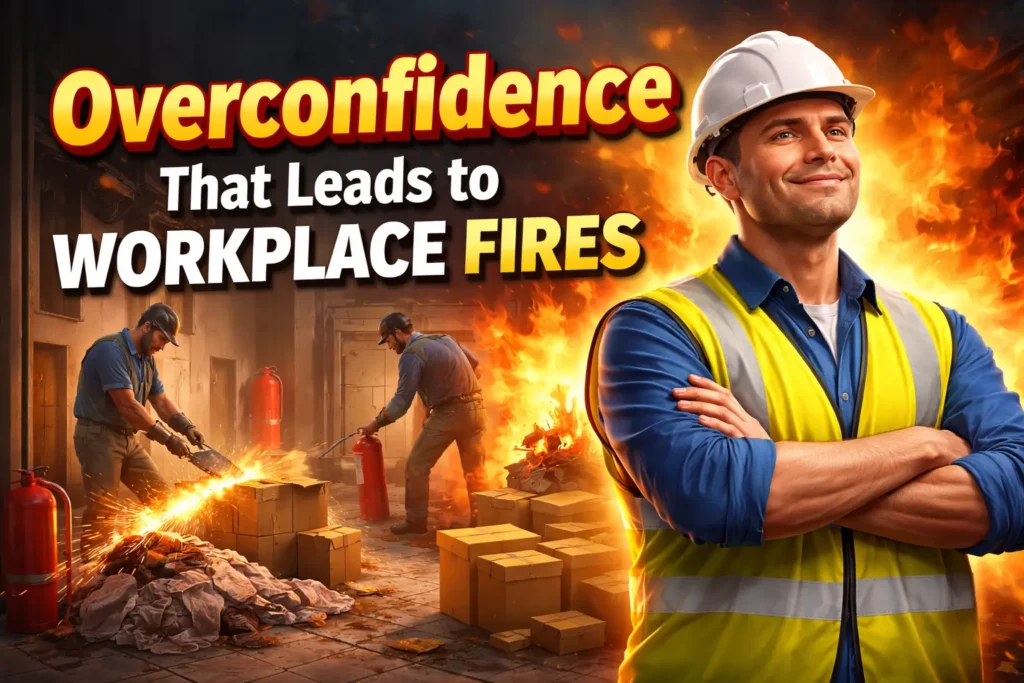
Overconfidence That Leads to Workplace Fires
Many workplace fires do not happen because safety systems are absent.
They happen because people believe “nothing will happen to us.”
Overconfidence is a silent but powerful fire hazard. When workers, supervisors, and management assume that experience, past success, or routine operations make them immune to fire risks, safety controls slowly weaken.
This article explains how overconfidence develops in workplaces, how it directly contributes to fire accidents, real situations where confidence replaced caution, and how organizations can correct this dangerous mindset.
What Is Overconfidence in Fire Safety?
Overconfidence in fire safety is the belief that:
• existing systems are always sufficient
• past incident-free history guarantees future safety
• experienced workers do not need reminders
• shortcuts will not cause consequences
• emergencies can always be controlled
This mindset gradually replaces compliance with assumption.
Why Overconfidence Is Dangerous
Overconfidence removes alertness, which is critical for fire prevention.
It leads to:
• ignored warning signs
• skipped inspections
• delayed maintenance
• unsafe work practices
• poor emergency response
Fire risk increases not suddenly, but progressively.
Common Workplace Behaviors Driven by Overconfidence
1. Ignoring Minor Fire Hazards
Small issues are dismissed as harmless:
• loose electrical connections
• temporary wiring
• blocked extinguishers
• oil leaks
• dust accumulation
These “minor” issues often become the ignition source during normal operations.
2. Assuming Fire Equipment Will Work When Needed
Many workplaces believe that:
• extinguishers are fine because they are installed
• hydrants will work because they worked before
• alarms will activate automatically
Without testing, this confidence is misplaced.
During real fires, equipment failures are common due to lack of checks.
3. Relaxed Attitude Toward Hot Work
Overconfidence leads to:
• skipping hot work permits
• inadequate fire watch
• poor housekeeping before welding
• early removal of fire watch
Most hot work fires occur after work completion, not during the task.
4. Experience Replacing Procedure
Experienced workers may:
• bypass safety steps
• ignore SOPs
• refuse PPE
• reject supervision
Experience without discipline becomes a liability.
5. Delayed Maintenance Decisions
Management overconfidence often causes:
• postponing electrical repairs
• delaying fire pump servicing
• extending inspection intervals
These decisions are usually cost-driven and justified by “no past issues.”
6. Normalization of Unsafe Conditions
Over time, unsafe conditions become accepted as normal:
• temporary storage becomes permanent
• blocked exits become routine
• damaged cables remain unrepaired
This is one of the most dangerous fire risk patterns.
Real Workplace Example
In an industrial plant, a transformer room had minor oil seepage for months.
Supervisors ignored it because:
• no fire had occurred previously
• the system had operated for years
• production demands were high
One night, oil vapors ignited due to overheating, causing a major fire and shutdown.
The root cause was not equipment failure.
It was overconfidence.
How Overconfidence Weakens Fire Risk Assessments
When overconfidence exists:
• hazards are underestimated
• risk ratings are lowered
• control measures are weakened
• inspection findings are closed without action
Fire risk assessments become paperwork exercises instead of safety tools.
Warning Signs of Overconfidence in an Organization
You may be dealing with overconfidence if:
• inspections always show “no issues”
• workers resist safety reminders
• fire drills are treated casually
• management dismisses safety concerns
• incidents are explained as “unavoidable”
These are red flags, not strengths.
How to Control Overconfidence-Related Fire Risks
Effective controls include:
• frequent surprise inspections
• strict permit-to-work enforcement
• real incident case studies during training
• rotation of safety responsibilities
• accountability for near-miss reporting
• leadership participation in fire drills
Fire safety must be actively reinforced, not assumed.
International fire safety organizations such as the National Fire Protection Association (NFPA) emphasize that many workplace fires are caused by human error, delayed maintenance, and improper safety practices rather than sudden equipment failure. Their published fire safety research highlights the need for regular inspections, correct equipment selection, and disciplined fire prevention programs to reduce avoidable fire incidents.
Conclusion
Overconfidence is not confidence.
It is a false sense of safety.
Workplace fires caused by overconfidence are entirely preventable, yet they continue to occur because assumptions replace action.
Fire safety requires:
• humility
• discipline
• constant verification
The moment a workplace believes it is “already safe,”
it becomes vulnerable to fire.
How Poor Housekeeping Leads to Fire Accidents
Fire Risks Created by Temporary Work Activities
Frequently Asked Questions
1. Can overconfidence really cause fires?
Yes. It leads to ignored hazards, poor maintenance, and delayed response.
2. Is overconfidence more common in experienced teams?
Yes. Familiarity often reduces alertness if not managed.
3. How can management reduce overconfidence?
By enforcing inspections, audits, drills, and accountability.
4. Are new workplaces safer than old ones?
Not necessarily. New sites can also become complacent quickly.
5. Is training alone enough to prevent overconfidence?
No. Training must be supported by enforcement and monitoring.
