
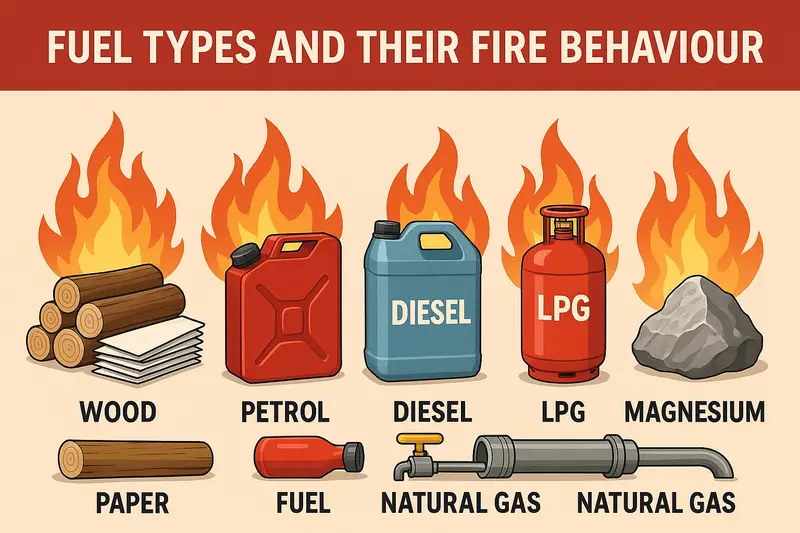
Fuel Types and Their Fire Behaviour

Fuel Types and Their Fire Behaviour

Fuel Types and Their Fire Behaviour

Fuel is one of the three essential elements of the fire triangle. Without fuel, a fire cannot start or continue burning. In industrial, commercial, and residential environments, many different fuels exist in solid, liquid, gaseous, and metallic forms — each with its own ignition characteristics and fire behaviour.

Understanding how different fuels behave is critical for:

  • Choosing the correct extinguishing agent
  • Designing fire protection systems
  • Planning storage and handling procedures
  • Carrying out realistic fire risk assessments

This guide breaks down fuel types, ignition properties, fire behaviour, hazards, and control measures in a structured, practical way.


Understanding Fuel in Fire Science

What Is Fuel?

In fire science, fuel is any material that can undergo combustion when exposed to sufficient heat and oxygen.

Fuel may be:

  • Solid – e.g., wood, paper, cloth, plastics
  • Liquid – e.g., petrol, diesel, solvents
  • Gas – e.g., LPG, methane, hydrogen
  • Metal – e.g., magnesium, sodium, aluminum dust

Each behaves differently with respect to ignition, flame spread, heat release, and smoke production.

Why Fuel Characteristics Matter

The same ignition source can produce:

  • A small, slow fire with one fuel
  • A violent flash fire or explosion with another

Key fuel properties that influence fire behaviour include:

  • Flash point – temperature at which a liquid gives off enough vapour to ignite briefly
  • Fire point – temperature at which vapours support continuous burning
  • Auto-ignition temperature – temperature at which fuel ignites without any external flame
  • Heat of combustion – how much energy is released
  • Vapour pressure – how readily a liquid produces flammable vapours
  • Surface area – fine particles vs. solid blocks
  • Moisture content – wet vs. dry material
  • Fuel load – quantity of combustible material per square metre

Classification of Fuel Types

Solid Fuels

Solid fuels remain in solid state under normal conditions.

Common examples:

  • Wood and timber products
  • Paper and cardboard
  • Textiles and clothing
  • Rubber and some plastics
  • Coal, charcoal
  • Foam and furnishing materials

Fire Behaviour of Solid Fuels

Solid fuels usually burn in stages:

  1. Heating
    • Fuel absorbs heat from an ignition source.
    • Temperature rises toward ignition.
  2. Pyrolysis
    • Chemical decomposition due to heat.
    • Solid fuel breaks down and releases flammable gases.
    • These gases are what actually burn above the surface.
  3. Flaming combustion
    • Gases ignite and produce visible flames.
    • Heat feeds back into the fuel, releasing more vapours.
  4. Smouldering
    • After flames die, glowing combustion may continue.
    • Can persist for hours inside walls, furniture, or piles of material.

Hazards of Solid Fuels

  • Heavy smoke (often toxic)
  • Smouldering fires hidden in cavities
  • Structural charring that weakens building integrity
  • Risk of backdraft if a smouldering, oxygen-depleted fire suddenly gets fresh air

Liquid Fuels

Liquids do not burn directlytheir vapours burn. The liquid must first vaporize.

Common liquid fuels:

  • Petrol (gasoline)
  • Diesel
  • Kerosene
  • Alcohols (methanol, ethanol)
  • Paint thinners and solvents
  • Cutting oils, lubricants

Key Properties for Liquid Fuel Behaviour

  • Flash point
    • Lower flash point → easier to ignite.
    • Petrol: very low flash point (highly flammable).
    • Diesel: higher flash point (less easily ignited, but intense once burning).
  • Vapour pressure
    • High vapour pressure → produces flammable vapours easily, even at low temperature.
  • Specific gravity
    • Determines whether the liquid floats on water or sinks.
    • Hydrocarbon fuels (petrol, diesel) float on water → important in firefighting.

Fire Behaviour of Liquid Fuels

  • Pool fires
    • Fuel forms a flat pool and burns at the surface.
  • Running fires
    • Burning fuel flows along floors, trenches, or drains.
  • Flash fires
    • Vapour cloud ignites rapidly across its surface.

Hazards

  • Extremely rapid fire spread across floors and channels
  • Explosive vapour clouds in confined spaces
  • Re-ignition risk if vapour generation continues after apparent extinguishment

Gaseous Fuels

Gaseous fuels are often the most dangerous because they mix readily with air and can ignite instantly.

Common gas fuels:

  • LPG (propane, butane)
  • Natural gas (methane)
  • Acetylene
  • Hydrogen
  • Biogas

Critical Properties of Gas Fuels

  • Flammable limits (LFL–UFL)
    • Gases only burn when their concentration in air is within a specific range.
    • Example (typical values):
      • LPG: approx. 2–10% in air
      • Methane: approx. 5–15% in air
      • Hydrogen: very wide range
  • Vapour density
    • Heavier than air (e.g., LPG) → collects at low levels, pits, basements.
    • Lighter than air (e.g., methane, hydrogen) → accumulates near ceilings and roofs.

Gas Fire Behaviour

  • Jet fires
    • High-pressure gas escapes and ignites as a long, intense flame.
  • Flash fires
    • A gas cloud in the flammable range ignites and burns through rapidly.
  • Explosions (VCE)
    • Vapour cloud explosion when ignited in a confined or congested area.
  • BLEVE
    • Boiling Liquid Expanding Vapour Explosion – catastrophic failure of heated pressurized tank (common with LPG).

Hazards

  • Difficult to see and detect, sometimes odourless
  • Potential for massive explosions
  • Fireballs and high radiant heat

Metal Fuels

Certain metals act as powerful fuels, especially when in powdered or finely divided form.

Common combustible metals:

  • Magnesium
  • Sodium and potassium
  • Aluminium powder / dust
  • Titanium
  • Zirconium

Behaviour of Metal Fires

  • Very high-temperature flames (often > 2000°C)
  • Bright white or intense coloured flames
  • Many react violently with water, producing hydrogen gas and steam explosions
  • Melted metal droplets can spread fire

Hazards

  • Extremely difficult to extinguish with normal agents
  • Water or foam can make the fire much worse
  • Requires special Class D extinguishing powders

According to HSE fire and explosion guidance, different fuel types such as solids, liquids, and gases behave differently in a fire depending on their physical and chemical properties.


Fuel Form and Fire Behaviour

Solid Fuel Fires

  • Slow ignition compared to gases and liquids
  • Fire growth depends on surface area and ventilation
  • High smoke generation and possible hidden smouldering

Liquid Fuel Fires

  • Rapid ignition especially for low flash point fuels like petrol
  • Form pool fires and running fires
  • High radiant heat and risk of spread via drains, gaps, and slopes

Gas Fuel Fires

  • Instant ignition possible from very small sparks
  • Explosion risk if gas accumulates before ignition
  • Difficult to visually confirm presence before ignition

Metal Fuel Fires

  • High-energy, intense fires
  • React with water and sometimes CO₂
  • Can cause violent explosions and molten metal splatter

Ignition Properties and Fuel Hazard Assessment

Flash Point

  • Minimum temperature at which a liquid produces enough vapour to ignite momentarily.
  • Lower flash point → higher fire risk in normal ambient conditions.

Fire Point

  • Temperature at which vapours burn continuously once ignited.

Auto-Ignition Temperature (AIT)

  • Temperature at which a fuel ignites without any spark or flame.

Examples (approximate, varies by conditions):

  • Paper: ~218°C
  • Wood: ~300°C
  • Petrol vapour: ~280–470°C
  • LPG: ~410°C

Surface Area Effect

  • High surface area = faster ignition and more rapid burning:
    • Sawdust vs. solid wood
    • Cotton waste vs. folded cloth
    • Metal powder vs. solid sheet

Fuel Load

  • Quantity of combustible material per square metre.
  • High fuel load → higher temperatures, longer duration, more difficult firefighting.

Fuel Type and Choice of Extinguishing Agent

Solid Fuels (Class A)

Typical extinguishing media:

  • Water – best for cooling deep-seated fires
  • Water mist / spray – reduced water damage, improved cooling
  • Foam – when both solid and liquid fuels are involved
  • ABC dry chemical – for quick knockdown

Key point: Cooling is the main mechanism.


Liquid Fuels (Class B)

Never use a plain water jet – it can:

  • Spread liquid
  • Increase fire area

Preferred agents:

  • Foam (AFFF/AR-AFFF) – forms a vapour-suppressing blanket
  • Dry chemical powder (DCP) – rapid knockdown of flames
  • Water spray – for cooling surfaces like tank walls (not direct on fuel surface in most cases)

Gas Fuels (often Class C)

First priority: Shut off the gas supply.

  • Close cylinder valves, isolation valves, or emergency shutoff systems.
  • Use DCP or fine water spray to control flames for protection and cooling until isolation is complete.

Metal Fuels (Class D)

Never use:

  • Water
  • Foam
  • CO₂

Use only Class D metal fire powders (e.g., sodium chloride, graphite-based) designed for that specific metal.


Fuel Storage Hazards and Controls

Solid Fuel Storage

Risks:

  • Large stacks → deep-seated fires
  • Poor ventilation → heat build-up and possible self-heating
  • Dust accumulation → secondary explosion hazard

Controls:

  • Limit stack height
  • Provide clear aisles and fire separations
  • Remove combustible waste regularly

Liquid Fuel Storage

Risks:

  • Vapour release due to poor sealing
  • Static electricity ignition
  • Leaks forming pool fires

Controls:

  • Use approved flammable liquid cabinets
  • Proper bonding and grounding of containers
  • Spill containment (bunds, dykes)
  • Good ventilation and “No Smoking/No Spark” control

Gas Fuel Storage

Risks:

  • Leaking cylinders or pipelines
  • Exposure to heat → BLEVE risk
  • Poorly ventilated rooms leading to gas build-up

Controls:

  • Store cylinders upright and secured
  • Keep away from heat sources
  • Use gas detection systems
  • Regular leak tests and regulator inspections

Metal Fuel Storage

Risks:

  • Dust explosions
  • Moisture-triggered reactions
  • Contaminated swarf (oil + metal) self-heating

Controls:

  • Store metal powders in dry, sealed containers
  • Avoid dust accumulation
  • Use only Class D agents in nearby fire points

Practical Checklist for Fuel Hazard Assessment

When you inspect a workplace, ask:

  1. What fuels are present?
    • Solid, liquid, gas, metal, or combinations?
  2. Where are they stored?
    • Are they near ignition sources (welding, heaters, electrical panels)?
  3. What are the critical fuel properties?
    • Flash point, flammable limits, ignition temperature, vapour density.
  4. What extinguishers are installed nearby?
    • Do they match the fuel class?
  5. Are quantities controlled?
    • Is fuel load limited in high-risk areas?
  6. Are people trained to recognize and handle these fuels safely?

Frequently Asked Questions (FAQs)

1. Why is petrol more dangerous than diesel in terms of fire risk?

Because petrol has a very low flash point and high vapour pressure, it produces flammable vapours even at low temperatures. These vapours can ignite from very small sparks. Diesel has a much higher flash point, so it is less likely to ignite at normal ambient temperatures, though once ignited it burns with high heat release.


2. If a gas leak catches fire, should we extinguish the flame immediately?

Not always. For pressurized gas leaks, it is often safer to keep the flame burning while you:

  • Cool cylinders or pipelines with water spray
  • Safely approach and close the gas valve

If you extinguish the flame without stopping the gas flow, an invisible gas cloud may form and later cause an explosion when it finds another ignition source.


3. Why is water dangerous on metal fires?

Many reactive metals (like sodium, potassium, magnesium) react with water to produce hydrogen gas and intense heat. This can cause explosions, splattering molten metal, and much larger fires. Only Class D powders should be used on metal fires.


4. What is the difference between flash point and auto-ignition temperature?

  • Flash point: Lowest temperature at which a liquid gives off enough vapour to ignite when an external flame or spark is applied.
  • Auto-ignition temperature: Temperature at which the fuel self-ignites without any spark or flame.

Both are important for evaluating how easily a fuel can start burning.


5. Can a high fuel load be dangerous even if individual fuels are not very flammable?

Yes. Even moderately combustible materials, when present in large quantities, can produce very large, long-duration fires with intense heat. High fuel load also increases the risk of flashover and structural collapse.


6. Why is vapour density important for gas and liquid fuels?

Vapour density tells you whether a gas or vapour will rise or sink:

  • Heavier than air (e.g., LPG, petrol vapours) → collect in low areas, pits, drains.
  • Lighter than air (e.g., methane, hydrogen) → accumulate near ceilings.

This helps you decide where to install gas detectors, ventilation, and how to plan emergency response.


7. How does fuel type influence the choice of fire extinguisher?

  • Solid fuels (Class A) → water, water mist, foam, ABC powder
  • Liquid fuels (Class B) → foam, DCP, sometimes CO₂ for small fires
  • Gas fires (often Class C) → DCP + gas isolation
  • Metal fires (Class D) → dedicated Class D powder only

Choosing the wrong extinguisher can spread the fire or create new hazards.


Conclusion

Fuel type is one of the most critical factors that determine fire ignition, spread, intensity, and suppression methods. Understanding the properties and behaviour of solid, liquid, gaseous, and metal fuels allows safety professionals to design effective prevention strategies, select appropriate extinguishing agents, and control fire hazards more efficiently. A strong grasp of fuel behaviour is essential for fire risk assessment, emergency preparedness, and industrial fire safety.

Fire Triangle Explained: Definition, Elements, Examples and Importance

Heat Sources in Industrial Fires: Causes, Risks, Control Measures and Prevention

Role of Oxygen in Combustion

Breaking the Fire Triangle: Methods and Applications

Electrical Fire Causes: Detailed Explanation, Scientific Background, Risk Factors, and Prevention

Mahendra Lanjewar – THE FIRE MANAGER

HSE Professional, Blogger, Trainer, and YouTuber with 12+ years of experience in construction, power, oil & gas, and petrochemical industries across India and the Gulf. Founder of The HSE Tools, The HSE Coach, and HSE STUDY GUIDE, sharing fire safety guides, safety templates, training tools, and certification support for safety professionals. 📘 Facebook | 📸 Instagram | 🎥 YouTube (The HSE Coach) | 🎥 YouTube (HSE STUDY GUIDE)

Leave a Comment