
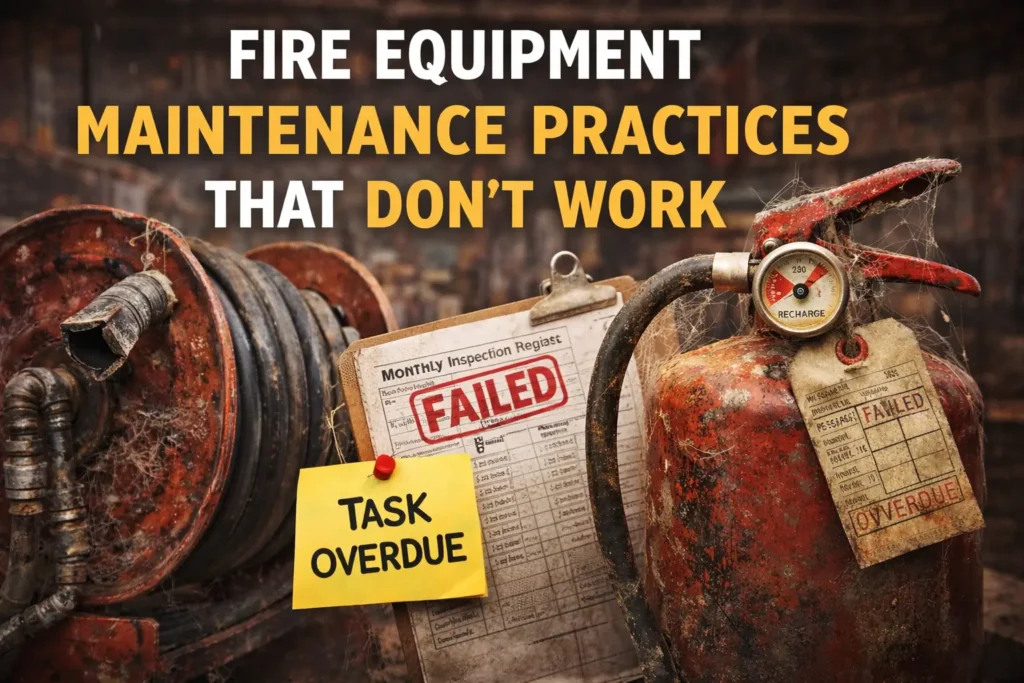
Fire Equipment Maintenance Practices That Don’t Work
Fire equipment is installed to work during the worst possible moment.
Not during audits.
Not during inspections.
Not during safety meetings.
It must work during a real fire.
Unfortunately, in many workplaces, fire equipment maintenance exists only on paper. Registers are filled, tags are updated, and checklists are signed, but the actual condition of equipment tells a different story.
When maintenance practices are weak, incomplete, or wrongly followed, fire equipment fails exactly when it is needed most.
This article explains common fire equipment maintenance practices that look correct but do not actually work in real emergencies, based on what is repeatedly seen in industries, construction sites, commercial buildings, and plants.
Why Fire Equipment Maintenance Is Critical
Fire equipment includes:
• Fire extinguishers
• Fire hydrants
• Hose reels
• Fire pumps
• Alarm systems
• Emergency lights
• SCBA
• Fire doors
These systems are interconnected.
Failure of one often leads to failure of others.
Maintenance is not just about compliance. It is about reliability under stress.
International fire protection guidance highlights that fire equipment must be regularly inspected, functionally tested, and maintained to ensure reliability during emergencies. According to guidance published by the National Fire Protection Association (NFPA), many fire protection system failures occur due to poor maintenance practices, lack of functional testing, and reliance on visual inspections alone. Following recognized fire safety standards helps organizations reduce system failures and improve emergency response effectiveness.
The Illusion of “Maintained” Fire Equipment
Many sites believe their fire equipment is maintained because:
• inspection tags are attached
• checklists are filled
• records are updated
• contractors visit once a year
But real maintenance is about function, not paperwork.
Let us look at the practices that do not work.
1. Checklist-Based Maintenance Without Physical Testing
One of the most common failures.
Inspections are done by:
• looking at equipment
• ticking boxes
• signing registers
Without actually:
• operating valves
• flowing water
• discharging extinguishers
• starting pumps
Visual checks alone cannot detect hidden failures.
A hydrant that looks perfect may not deliver water.
A pump that appears healthy may not start under load.
2. Outsourcing Maintenance Without Supervision
Many organizations fully depend on external vendors.
Problems occur when:
• contractor is not qualified
• work is rushed
• no internal verification
• no functional demonstration
Contractors may complete jobs quickly without proper testing.
Safety teams must witness testing, not just receive reports.
3. Annual Maintenance Only
Fire equipment deteriorates continuously.
But many sites rely only on:
• yearly servicing
• annual AMC visits
This creates long gaps where faults remain unnoticed.
Fire safety requires:
• daily checks
• weekly tests
• monthly inspections
• annual overhauls
Annual maintenance alone is not enough.
4. Ignoring Fire Pumps During Routine Checks
Fire pumps are the heart of fire protection.
Yet common failures include:
• pumps never started
• jockey pump only tested
• diesel fuel not checked
• battery not charged
• cooling system ignored
During fire, the pump fails to start.
A fire hydrant without pump pressure is useless.
5. Fire Extinguishers Never Discharged
Extinguishers are often:
• visually checked
• pressure gauge observed
• seal inspected
But never discharged.
Issues that go unnoticed:
• blocked nozzle
• hardened powder
• leaking valve
• internal corrosion
Without discharge testing, failure remains hidden.
6. Hose Reels and Hydrants Not Flow Tested
Opening the valve slightly is not testing.
Real testing means:
• full water flow
• adequate pressure
• proper jet pattern
• hose condition check
Many hoses leak, burst, or kink under pressure.
Only flow testing reveals real performance.
7. Emergency Lights Checked Only During Daytime
Emergency lights are meant for power failure.
But they are often checked:
• when main power is ON
• during office hours
• without battery discharge
During actual power failure:
• lights do not turn ON
• battery drains instantly
• escape routes go dark
Emergency lights must be tested under real outage conditions.
8. Fire Doors and Dampers Ignored Completely
Fire doors are often:
• blocked open
• damaged
• not closing properly
• missing seals
Fire dampers remain:
• stuck
• corroded
• never tested
During fire, smoke spreads uncontrollably.
Passive fire protection is as important as active systems.
9. Maintenance Records Without Equipment Identification
Another silent failure.
Records exist, but:
• equipment numbers mismatch
• location unclear
• wrong serial numbers
• duplicate entries
During emergency, teams cannot identify equipment quickly.
Records must match physical equipment exactly.
10. No Fire Equipment Failure Drills
Maintenance is not complete until performance is tested in drills.
Without drills:
• staff panic
• equipment misuse occurs
• response delays increase
Fire drills reveal weaknesses that inspections cannot.
Real Incident Example
In an industrial warehouse, a fire hydrant system was marked “maintained”.
During a real fire:
• pump did not start
• hydrant pressure was zero
• fire spread rapidly
Investigation revealed:
• pump never load tested
• diesel tank empty
• battery dead
Maintenance existed only in registers.
How to Fix Fire Equipment Maintenance Properly
Effective maintenance must include:
• functional testing
• flow tests
• pressure checks
• battery discharge tests
• pump auto start tests
• documented results
• corrective actions
Maintenance should be evidence based, not assumption based.
Conclusion
Fire equipment does not fail randomly.
It fails because maintenance practices fail.
Tick boxes do not stop fires.
Registers do not extinguish flames.
Tags do not deliver water.
Only working equipment saves lives.
Effective fire safety requires honest maintenance, real testing, and continuous verification.
Anything less is an illusion of safety.
Alarm Systems That Do Not Warn on Time
Hose Reels That Cannot Support Firefighting
Fire Pumps Installed but Not Reliable During Fires
Fire Hydrant Systems That Look Ready but Fail
Fire Hydrant System Explained, How It Works, Why It Fails, and How to Keep It Fire Ready
Frequently Asked Questions
1. Is visual inspection enough for fire equipment?
No. Functional testing is essential.
2. How often should fire pumps be tested?
Weekly no load start and periodic load testing are recommended.
3. Can third party contractors handle all maintenance?
Yes, but internal supervision and verification are critical.
4. Why do fire extinguishers fail even when tagged?
Because internal faults are not visible without discharge testing.
5. What is the biggest maintenance mistake?
Relying on paperwork instead of performance testing.
