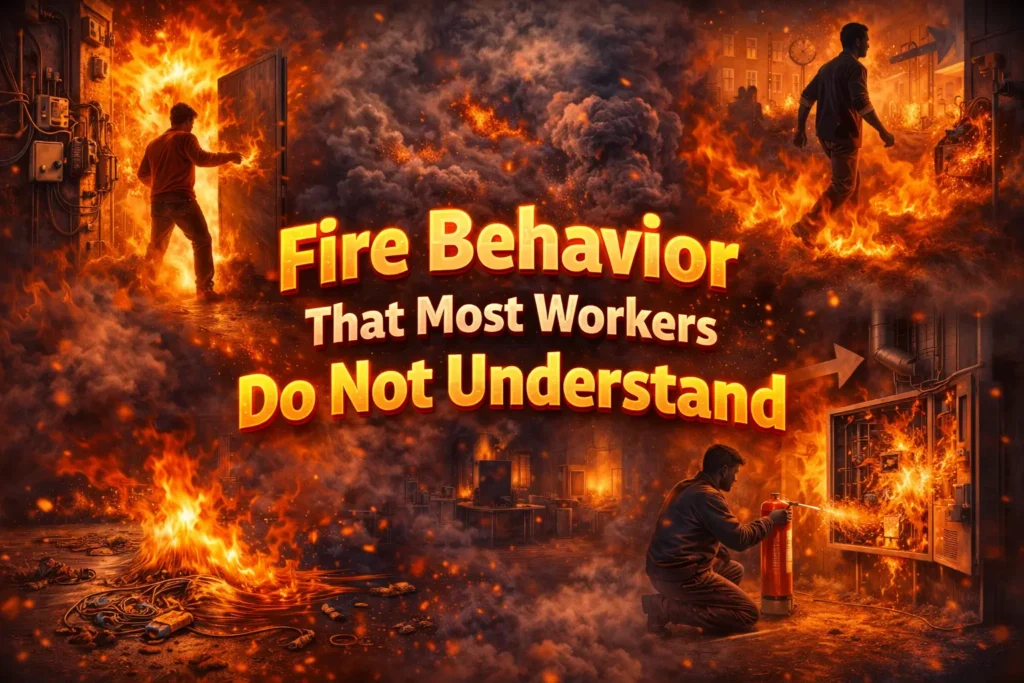
Fire Behavior That Most Workers Do Not Understand
Fire is often seen as a sudden and uncontrollable event, but in reality, fire follows predictable physical and chemical behaviors. Unfortunately, most workers, even those working in industrial and commercial environments, do not fully understand how fire actually behaves. This lack of understanding is one of the main reasons why small incidents escalate into major fire accidents.
Understanding fire behavior is supported by guidance from government safety authorities such as the Occupational Safety and Health Administration (OSHA), which explains how ignition sources, heat release, ventilation, and fuel load influence fire growth in workplaces. Limited awareness of these principles is a major contributor to fire incidents across industrial and commercial environments.
This article explains critical fire behavior concepts that are commonly misunderstood by workers, supervisors, and even some safety staff, using practical workplace examples rather than textbook definitions.
Why Understanding Fire Behavior Matters at the Workplace
Many workers believe fire safety is limited to:
- Knowing where the extinguisher is
- Following basic do’s and don’ts
- Calling the fire brigade during an emergency
In reality, fire behavior determines how fast a fire spreads, how intense it becomes, and whether escape is possible. When workers misunderstand fire behavior, they unknowingly make decisions that increase risk, delay evacuation, or worsen the fire.
Understanding fire behavior helps workers:
- React correctly during the early stages of a fire
- Avoid actions that intensify flames
- Protect themselves and others during evacuation
- Support emergency response instead of obstructing it
Fire Grows Faster Than Most Workers Expect
One of the most dangerous misconceptions is that fire grows slowly.
In real situations, fire growth can be exponential. A small ignition source such as a spark, overheated cable, or hot surface can turn into a fully developed fire within minutes.
Why workers underestimate fire growth
- Fire drills focus on evacuation, not fire development
- Early-stage fires appear manageable
- Workers assume someone else will control it
In reality, once combustible materials release flammable vapors, fire intensity increases rapidly, making manual firefighting unsafe.
Heat Moves Before Flames Are Visible
Many workers believe flames are the first sign of danger. This is incorrect.
Heat travels faster than flames through:
- Conduction in metal structures
- Convection through hot air
- Radiation across open spaces
Workers may feel safe because flames are not visible, while surrounding materials are already reaching ignition temperature.
This is why:
- Electrical panels ignite suddenly
- Storage racks catch fire without direct flame contact
- Ceiling-level fires spread unnoticed
Smoke Is More Dangerous Than Fire for Occupants
A major misunderstanding among workers is that fire kills, not smoke.
In reality:
- Smoke causes most fire-related deaths
- Toxic gases can render a person unconscious in seconds
- Visibility loss leads to panic and disorientation
Workers often:
- Stand upright instead of staying low
- Move toward smoke-filled areas
- Delay evacuation thinking smoke is harmless
Understanding smoke behavior is critical for survival, especially in enclosed workplaces.
Oxygen Supply Changes Fire Behavior Instantly
Many workers open doors or windows during a fire believing it will “release smoke” or “reduce heat”.
This is extremely dangerous.
When fresh oxygen enters a fire area:
- Fire intensity increases suddenly
- Flames spread rapidly toward the oxygen source
- Flashover risk increases
This behavior explains why fires sometimes explode when doors are opened. Workers must understand that oxygen control is as important as fire suppression.
Different Materials Burn in Different Ways
Workers often assume all fires behave the same. This is incorrect.
Fire behavior varies based on:
- Type of fuel
- Surface area
- Arrangement and spacing
- Presence of liquids or gases
For example:
- Plastic fires produce dense toxic smoke
- Electrical fires spread internally before becoming visible
- Liquid fires spread horizontally instead of vertically
Without understanding fuel behavior, workers may choose the wrong extinguisher or approach the fire incorrectly.
Fire Can Travel Through Hidden Paths
Another misunderstood aspect is hidden fire spread.
Fire can move through:
- Cable trays
- False ceilings
- Ducts and ventilation shafts
- Wall cavities
Workers may believe a fire is controlled in one area while it is spreading unseen elsewhere. This false sense of control leads to delayed evacuation and increased damage.
Wind and Airflow Influence Fire Direction
Fire does not always spread upward. Airflow created by:
- Exhaust fans
- Open doors
- HVAC systems
- Natural wind
can push fire sideways or downward.
Workers unaware of airflow effects may:
- Run toward fire unknowingly
- Block safe escape routes
- Misjudge fire direction
Understanding airflow behavior is essential during both firefighting and evacuation.
Why Fire Behavior Is Rarely Taught to Workers
Fire behavior training is often missing because:
- Toolbox talks focus on rules, not science
- Fire drills prioritize evacuation speed
- Training time is limited
- Fire behavior is seen as “technical”
However, basic fire behavior knowledge can be explained without technical complexity, and doing so significantly improves safety awareness.
Practical Fire Behavior Awareness Workers Should Have
Every worker should understand:
- Fire grows exponentially, not linearly
- Heat and smoke travel before flames
- Oxygen increases fire intensity
- Smoke kills faster than flames
- Fire spreads through hidden paths
- Airflow changes fire direction
This awareness alone can prevent panic-driven decisions that cost lives.
Conclusion
Fire behavior is not random. It follows predictable patterns influenced by heat, fuel, oxygen, and environmental conditions. Most workers are not taught these fundamentals, which leads to dangerous assumptions during emergencies.
By improving worker-level understanding of fire behavior, organizations can reduce injury risk, improve evacuation response, and prevent small incidents from turning into major disasters. Fire safety is not only about equipment and procedures, it is about understanding how fire actually behaves in real workplaces.
Why Fire Starts Even When All Safety Rules Are Followed
Fire Triangle Explained, Practical Fire Risk Control Guide for Workplaces
Heat Sources in Industrial Fires, Where Ignition Really Starts and How to Stop It
Fuel Types and Their Fire Behaviour, Why Different Fuels Burn Differently and How Fires Escalate
Role of Oxygen in Combustion, How Oxygen Makes Fires Grow and Why It Becomes Dangerous
Frequently Asked Questions (FAQs)
Why do workers underestimate fire danger?
Because early-stage fires appear small and manageable, leading to delayed response and false confidence.
Is smoke really more dangerous than flames?
Yes. Smoke contains toxic gases and reduces visibility, causing unconsciousness and panic before flames reach occupants.
Why does fire suddenly intensify when doors are opened?
Opening doors introduces fresh oxygen, which increases combustion and flame spread instantly.
Do all fires behave the same way?
No. Fire behavior depends on fuel type, arrangement, ventilation, and environmental conditions.
Can understanding fire behavior actually save lives?
Yes. Basic fire behavior awareness helps workers make safer decisions during evacuation and early response.
