
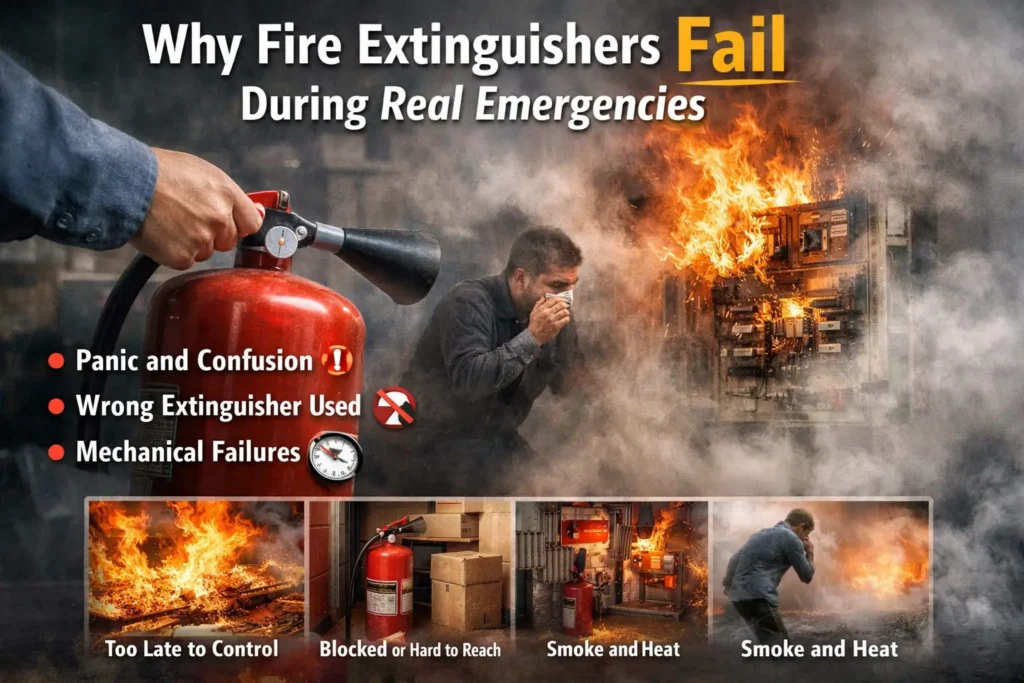
Why Fire Extinguishers Fail During Real Emergencies
For globally accepted fire safety guidance, extinguisher performance principles, and emergency response education, readers can refer to official learning resources published by the National Fire Protection Association (NFPA).
Fire extinguishers are considered the first line of defense against fire. They are installed in offices, factories, hospitals, residential buildings, and industrial plants. Inspections are conducted, tags are updated, and compliance is documented.
Yet when real fire emergencies occur, fire extinguishers often fail to stop the fire, fail to operate as expected, or are not used effectively at all. In many post-incident investigations, the extinguisher was present, certified, and suitable, but the fire still escalated.
Understanding why fire extinguishers fail in real emergencies is essential for improving fire safety and preventing repeat incidents.
Fire Extinguishers Are Designed for Limited Scenarios
Fire extinguishers are designed to control incipient-stage fires only, meaning fires that are small, localized, and detected early.
In real situations, fires often grow rapidly due to:
- High fuel load
- Synthetic materials producing intense heat
- Delayed detection
- Poor ventilation control
Once a fire passes the incipient stage, a portable extinguisher becomes ineffective regardless of its type or rating.
Panic and Stress Reduce Human Performance
Most fire extinguisher training is conducted in calm, controlled conditions. Real emergencies are completely different.
During actual fires, people experience:
- Panic and fear
- Loss of fine motor skills
- Reduced decision-making ability
- Difficulty remembering procedures
Even trained individuals may forget to pull the pin, aim correctly, or maintain a safe distance. This is a natural human response, not incompetence.
Wrong Extinguisher Used Under Pressure
In emergencies, people often select the nearest extinguisher rather than the correct one.
Common mistakes include:
- Using water extinguishers on electrical fires
- Using CO₂ extinguishers on deep-seated Class A fires
- Applying foam without isolating fuel sources
- Discharging powder extinguishers without controlling re-ignition risks
Misapplication reduces effectiveness and may increase danger.
Fire Growth Is Faster Than Expected
Many extinguisher failures occur because the fire has already grown beyond control by the time action is taken.
Factors contributing to rapid fire growth include:
- Delayed alarm response
- Underestimation of fire severity
- Smoke reducing visibility
- Hesitation to intervene
A delay of even one or two minutes can turn a controllable fire into an uncontrollable one.
Extinguishers Are Poorly Accessible During Emergencies
Fire extinguishers are often installed correctly but become ineffective due to changes in the workplace.
Typical access issues include:
- Storage blocking extinguisher cabinets
- Equipment installed in front of extinguishers
- Poor visibility due to smoke
- Extinguishers mounted too high or too low
If an extinguisher cannot be reached immediately, it cannot be used when needed.
Mechanical Issues Go Undetected
Routine inspections usually focus on visual indicators. However, internal faults may remain unnoticed.
Common hidden problems include:
- Compacted dry chemical powder
- Loss of pressure in CO₂ extinguishers
- Corrosion of internal components
- Blocked discharge hoses
An extinguisher may appear compliant but fail to discharge properly during an emergency.
Fuel and Energy Sources Are Not Isolated
Fire extinguishers suppress flames but do not eliminate the underlying energy source.
Failures often occur because:
- Electrical power is not shut off
- Gas supply continues flowing
- Hot surfaces remain energized
- Fuel pumps keep operating
Without isolating the source, the fire re-ignites even after extinguisher discharge.
Smoke and Heat Prevent Safe Approach
Real fires generate intense smoke and radiant heat very quickly.
This results in:
- Reduced visibility
- Breathing difficulty
- Inability to approach the fire safely
In such conditions, people instinctively retreat to protect themselves, abandoning extinguisher use.
Overconfidence Delays Evacuation
A dangerous assumption is that the extinguisher will “handle the fire.”
This mindset causes:
- Delay in evacuation
- Prolonged exposure to smoke and heat
- Increased injury risk
Fire extinguishers are first-response tools, not firefighting equipment.
Lessons from Real Fire Incidents
Post-fire investigations repeatedly show that extinguisher failure is rarely due to absence of equipment.
The real causes are:
- Late response
- Incorrect use
- Human limitations under stress
- Fire size exceeding extinguisher capacity
Fire safety systems must be designed with real human behavior in mind.
How to Reduce Fire Extinguisher Failure Risk
Improving performance requires moving beyond compliance-based fire safety.
Effective measures include:
- Risk-based extinguisher selection
- Regular hands-on discharge training
- Clear extinguisher visibility and access
- Integration with isolation procedures
- Emphasis on early evacuation decisions
Fire extinguishers should support a complete fire safety system, not replace it.
Frequently Asked Questions (FAQs)
Why do fire extinguishers fail even when they are certified?
Certification confirms compliance at the time of inspection. It does not guarantee performance under real emergency conditions such as panic, smoke, heat, or delayed response.
Can a fire extinguisher stop any fire?
No. Fire extinguishers are designed only for small, early-stage fires. Once a fire grows beyond that stage, evacuation is the safest option.
Is lack of training the main reason for extinguisher failure?
Training is important, but even trained people may fail under stress. Human behavior during emergencies must be considered in fire safety planning.
Which extinguisher fails most often?
Dry chemical powder extinguishers commonly fail due to powder compaction if not properly maintained.
Should employees fight fires or evacuate?
Employees should attempt extinguisher use only if the fire is small, they are trained, and escape routes are clear. Evacuation must always be the priority.
Conclusion
Fire extinguishers fail during real emergencies not because they are poorly designed, but because real fires do not behave like training scenarios.
Stress, rapid fire growth, incorrect use, and delayed response all contribute to failure. Understanding these limitations helps organizations design safer systems that prioritize early detection, proper training, and timely evacuation.
Fire safety is not about trusting equipment alone. It is about preparing people and systems to respond effectively when conditions are far from ideal.
Types of Fire Extinguishers Explained, How to Select the Right One for Real Workplace Fires
Water Extinguisher, When It Works, When It Fails, and How People Misuse It
Foam Fire Extinguishers, When They Are the Best Choice and When They Are Dangerous
CO₂ Fire Extinguisher, Where It Works Perfectly and Where It Becomes Dangerous
DCP Fire Extinguisher, Why It Works So Fast and Why It Often Fails After That
