
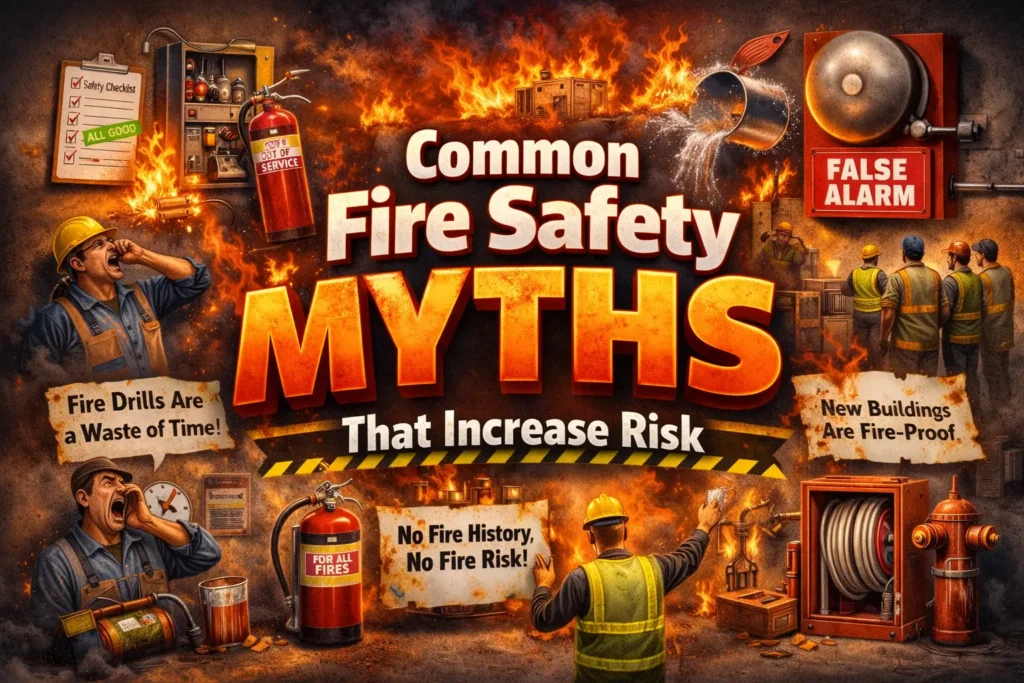
Common Fire Safety Myths That Increase Risk
For official fire safety education, standards, and research used globally by safety professionals, refer to the National Fire Protection Association’s educational resources.
Fire safety is often misunderstood due to long-standing myths, assumptions, and half-truths passed down through workplaces, homes, and even professional environments. These myths create a false sense of security and significantly increase the risk of fire incidents, injuries, and property loss.
Many fire accidents occur not because safety systems are absent, but because people believe incorrect information about fire behavior, extinguishers, alarms, and emergency response. Understanding and correcting these myths is a critical step toward effective fire prevention and preparedness.
This article exposes the most common fire safety myths, explains why they are dangerous, and provides the correct fire-safety understanding every safety professional and worker must know.
Myth 1: Fire Will Always Be Visible Before It Becomes Dangerous
One of the most dangerous myths is the belief that fire gives enough warning before becoming life-threatening. In reality, fires can grow rapidly and produce deadly smoke long before flames are visible.
Smoke inhalation causes most fire-related deaths, not burns. Toxic gases such as carbon monoxide can render occupants unconscious within minutes, even if the fire itself seems small.
Reality: Fire can become fatal within minutes due to smoke and heat, even without visible flames.
Myth 2: Fire Extinguishers Are Easy to Use Without Training
Many people assume that fire extinguishers can be used effectively without prior knowledge. This myth leads to panic, incorrect extinguisher selection, and unsafe fire-fighting attempts.
Using the wrong extinguisher, such as water on electrical or flammable liquid fires, can worsen the situation and cause serious injuries.
Reality: Fire extinguishers require basic training, correct selection, and understanding of fire classes.
Myth 3: Smoke Alarms Are Only Needed in Large Buildings
Some believe smoke alarms are unnecessary in small homes, offices, or temporary structures. This myth results in delayed fire detection and reduced escape time.
Even small fires can become uncontrollable within minutes, especially during night hours when occupants are asleep.
Reality: Smoke alarms are essential in all occupied buildings, regardless of size.
Myth 4: If There Is No Fire History, There Is No Fire Risk
A common workplace misconception is that a facility with no previous fire incidents is low-risk. This belief discourages inspections, maintenance, and fire risk assessments.
Fire risk depends on current conditions, not past history. Changes in equipment, storage, electrical load, or processes can introduce new hazards at any time.
Reality: Absence of past fires does not mean absence of fire risk.
Myth 5: Water Can Be Used to Put Out Any Fire
Water is widely available, which leads many to assume it is suitable for all fire situations. This is one of the most dangerous fire myths.
Water can spread flammable liquid fires, conduct electricity, and react violently with certain metals.
Reality: Water is only safe for Class A fires involving ordinary combustibles.
Myth 6: Fire Safety Is Only the Responsibility of Safety Officers
Some employees believe fire safety is solely the responsibility of safety officers, fire wardens, or management. This attitude leads to poor housekeeping, unsafe practices, and ignored hazards.
Fire prevention requires collective responsibility, from reporting hazards to following safe work practices.
Reality: Fire safety is everyone’s responsibility.
Myth 7: Modern Buildings Are Fire-Proof
Fire-resistant materials and modern design can slow fire spread, but no building is fire-proof. Furniture, electrical systems, stored materials, and human behavior still create fire risks.
Overconfidence in building design often results in poor emergency planning and complacency.
Reality: Fire-resistant does not mean fire-proof.
Myth 8: Fire Drills Are a Waste of Time
Fire drills are sometimes seen as unnecessary disruptions. This myth leads to poor evacuation behavior during real emergencies.
During actual fires, people revert to practiced behavior. Without drills, confusion and panic increase evacuation time.
Reality: Fire drills save lives by preparing people for real emergencies.
Myth 9: Fires Spread Slowly
Movies and media often show fires spreading gradually. In real life, fire growth can be exponential, especially in enclosed spaces with synthetic materials.
Flashover can occur within minutes, making escape impossible.
Reality: Fires can escalate from small to deadly very quickly.
Myth 10: Fire Safety Equipment Always Works When Needed
Assuming fire alarms, extinguishers, and sprinklers will function perfectly without maintenance is a serious misconception.
Poor maintenance, blocked access, expired extinguishers, or disabled alarms often cause safety systems to fail during emergencies.
Reality: Fire safety equipment must be inspected and maintained regularly.
Why Fire Safety Myths Persist
Fire safety myths continue due to lack of training, outdated knowledge, overconfidence, and poor safety culture. Many people rely on assumptions rather than verified safety principles.
Breaking these myths requires continuous education, practical training, and strong safety leadership.
How to Reduce Fire Risk by Eliminating Myths
Organizations and individuals can reduce fire risk by:
- Conducting regular fire safety training
- Educating workers on fire behavior and extinguisher use
- Performing routine inspections and audits
- Encouraging reporting of unsafe conditions
- Practicing evacuation drills
- Following recognized fire safety standards
Knowledge replaces myths, and preparedness replaces panic.
Frequently Asked Questions (FAQs)
Are fire safety myths really dangerous?
Yes. Fire safety myths create false confidence and lead to unsafe actions during emergencies.
Why do people still believe fire myths?
Lack of training, outdated information, and reliance on assumptions are the main reasons.
Can fire safety training reduce accidents?
Yes. Proper training significantly improves response time, decision-making, and survival rates.
Is fire safety only important in industries?
No. Fire safety is equally important in homes, offices, schools, and public places.
How often should fire safety awareness be updated?
At least once a year or whenever work conditions or equipment change.
Conclusion
Fire safety myths are silent hazards that increase risk without being visible. Believing incorrect information about fires, extinguishers, alarms, and emergency response can be more dangerous than having no safety systems at all.
Replacing myths with accurate fire safety knowledge is essential for protecting lives, property, and workplaces. Awareness, training, and accountability remain the strongest tools in fire prevention.
Why Fire Starts Even When All Safety Rules Are Followed
Fire Triangle Explained, Practical Fire Risk Control Guide for Workplaces
Heat Sources in Industrial Fires, Where Ignition Really Starts and How to Stop It
Fuel Types and Their Fire Behaviour, Why Different Fuels Burn Differently and How Fires Escalate
Role of Oxygen in Combustion, How Oxygen Makes Fires Grow and Why It Becomes Dangerous
