
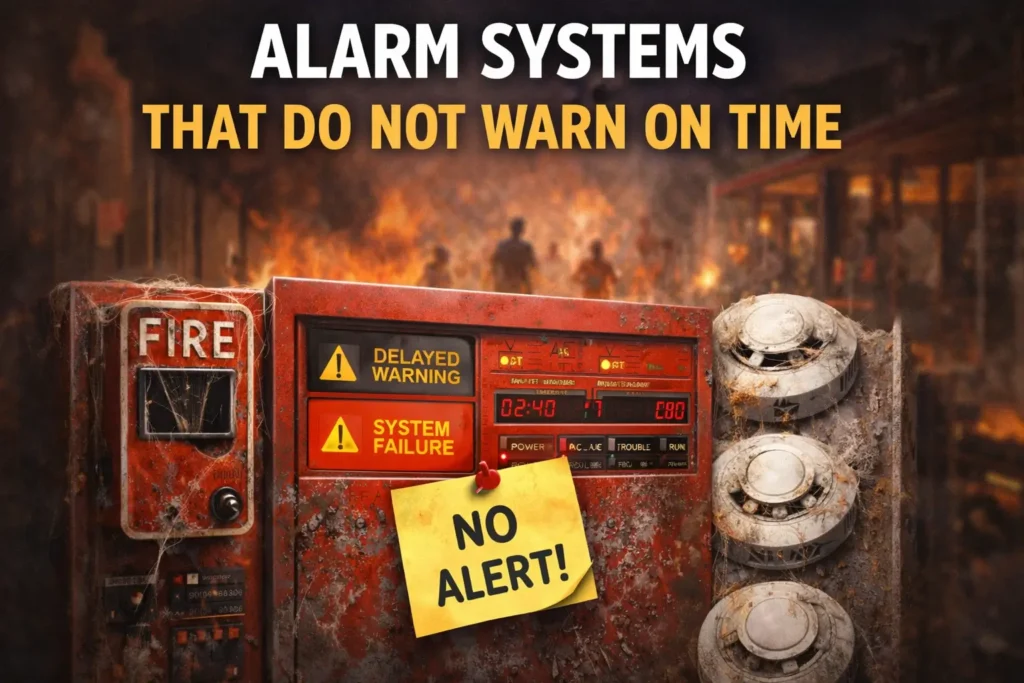
Alarm Systems That Do Not Warn on Time
A fire alarm system is designed to perform one essential function.
Provide early warning.
This early warning gives people time to evacuate, allows emergency teams to respond quickly, and helps control the fire before it escalates.
However, in many workplaces, alarm systems fail at the most critical moment. They activate too late, sound too weak, or do not operate at all.
When an alarm does not warn on time, the most important safety factor is lost, which is time.
In fire emergencies, even a delay of 60 seconds can significantly increase the risk of injury, property damage, and loss of life.
How Fire Develops Faster Than Expected
Fire growth is rapid and often underestimated.
Within minutes:
- Smoke spreads through corridors
- Visibility drops drastically
- Toxic gases accumulate
- Temperature rises quickly
- Escape routes become unsafe
The alarm system is the first line of defense in this situation.
If detection or warning is delayed, evacuation becomes difficult and response time is reduced.
What a Proper Fire Alarm System Should Do
A reliable fire alarm system must:
- Detect smoke or heat at an early stage
- Send signals immediately to the control panel
- Activate audible and visual alarms
- Alert occupants without delay
- Support evacuation procedures
- Operate automatically without human intervention
All of these actions should occur within seconds.
If people detect the fire before the system does, the system has already failed.
Common Reasons Alarm Systems Do Not Warn on Time
Incorrect Detector Placement
Detector location plays a critical role in early detection.
Common installation mistakes include:
- Placement near walls or corners
- Installation behind beams or obstructions
- Positioning near ventilation ducts
- Installation above false ceilings
- Dead air spaces where smoke does not reach
These mistakes delay detection because smoke cannot reach the sensor quickly.
Even a delay of a few minutes can result in significant fire growth.
Dirty or Contaminated Detectors
Smoke detectors are highly sensitive devices.
In environments such as:
- Warehouses
- Construction sites
- Workshops
- Industrial plants
Dust, insects, and debris accumulate inside detectors.
This reduces sensitivity and delays response time.
In many cases, detectors fail completely due to lack of cleaning.
Disabled or Isolated Zones
During maintenance or renovation work:
- Detection zones may be disabled
- Circuits may be isolated
- Systems may not be reactivated
These areas remain unprotected without anyone realizing it.
If fire starts in these zones, no alarm will be triggered.
Power Supply and Battery Failure
Fire alarm systems rely on continuous power.
Common failures include:
- Backup batteries not replaced
- Charging system malfunction
- Power supply interruptions
During power failure, the system may shut down completely.
Without power, there is no detection and no warning.
Aging or Faulty Devices
Over time, system components deteriorate.
Typical issues include:
- Old smoke detectors
- Corroded wiring
- Faulty sounders
- Malfunctioning control panels
Aging devices may respond slowly or unpredictably, increasing risk.
Alarm Sound Not Audible
Even when the system works, it may not be effective if people cannot hear it.
Common reasons include:
- High background noise
- Machinery operation
- Poor sounder placement
- Thick walls blocking sound
Alarm sound levels must exceed ambient noise levels to ensure effective warning.
Over-Reliance on Manual Reporting
In some workplaces, fire detection depends on:
- Workers noticing smoke
- Security personnel reporting incidents
- Manual activation of alarm systems
This introduces delay.
Automatic detection systems must always be the primary method.
Lack of Regular Testing
One of the biggest failures is not testing the system regularly.
Without testing:
- Hidden faults remain undetected
- Batteries fail silently
- Devices degrade over time
A system that is not tested cannot be trusted.
What Safety Officers Commonly Miss
During inspections, the following issues are often overlooked:
- Dust accumulation inside detectors
- Permanently isolated zones
- Low alarm sound levels
- Fault indicators ignored on control panels
- Lack of testing records
These are early warning signs of system failure.
Real Workplace Example
In a manufacturing unit, a fire started inside a storage room during night hours.
Smoke detectors were installed, but they were heavily covered with dust.
Detection was delayed.
By the time the alarm activated:
- Smoke had already spread across the facility
- Visibility was severely reduced
- Fire had grown beyond initial control
Investigation revealed that detectors had not been cleaned or tested for over two years.
The system existed, but it did not function effectively.
Fire Alarm System Testing and Maintenance Checklist
Daily Checks
- Verify panel status
- Check for fault indicators
- Ensure system is powered
Weekly Checks
- Test manual call points
- Check alarm sounders
- Confirm panel response
Monthly Checks
- Test multiple detectors
- Clean sensors in dusty areas
- Verify alarm audibility
Quarterly Checks
- Test battery backup
- Inspect wiring connections
- Verify all zones are active
Annual Checks
- Full system inspection
- Replace aging components
- Conduct evacuation drills
- Professional servicing
Importance of Proper System Design
Maintenance alone cannot compensate for poor design.
A properly designed system must include:
- Correct detector spacing
- Coverage of all risk areas
- Adequate sound levels
- Visual alarms for noisy environments
- Accessible control panel location
Design determines how quickly a system can detect and warn.
Training and Human Response
Even the best alarm system will fail if people do not respond correctly.
Workers must be trained to:
- Recognize alarm signals
- Follow evacuation routes
- Move to assembly points
- Avoid panic
Training ensures that early warning leads to effective action.
Industry Guidance and Standards
According to the National Fire Protection Association, fire alarm systems must be regularly inspected, tested, and maintained to ensure immediate and reliable warning during emergencies.
Proper maintenance significantly improves early detection, evacuation time, and overall fire safety performance.
For detailed guidance, refer to:
👉 https://www.nfpa.org/News-and-Research/Publications-and-media/NFPA-Journal
Warning Signs Your Alarm System May Fail
Look for these indicators:
- Frequent false alarms
- Dust-covered detectors
- Disabled zones
- Weak alarm sound
- Lack of maintenance records
- Battery faults
These signs indicate that the system may not perform during a real fire.
Conclusion
A fire alarm system is not just another piece of equipment.
It is a life-saving system that provides critical time during emergencies.
If it does not warn on time, people lose their chance to evacuate safely.
Installing alarms is not enough.
They must be:
- Cleaned
- Tested
- Maintained
- Verified
Because in a real fire, seconds matter.
And delayed warning can cost lives.
For a complete understanding, read our full Workplace Fire Safety Guide.
Complete Workplace Fire Safety Guide (2026): Prevention, Equipment, Risk & Response
Hose Reels That Cannot Support Firefighting
Fire Pumps Installed but Not Reliable During Fires
Fire Hydrant Systems That Look Ready but Fail
Fire Hydrant System Explained, How It Works, Why It Fails, and How to Keep It Fire Ready
Components of a Fire Hydrant System, How Each Part Fails or Saves a Fire Response
Frequently Asked Questions
How often should fire alarms be tested
Weekly checks and annual full inspections are recommended.
Why do alarms activate late
Usually due to poor placement, dust, or faulty sensors.
How loud should alarms be
At least 10 to 15 decibels above background noise.
Can old detectors be used
Most detectors should be replaced after 8 to 10 years.
Is manual activation enough
No. Automatic detection is essential for early warning.
