
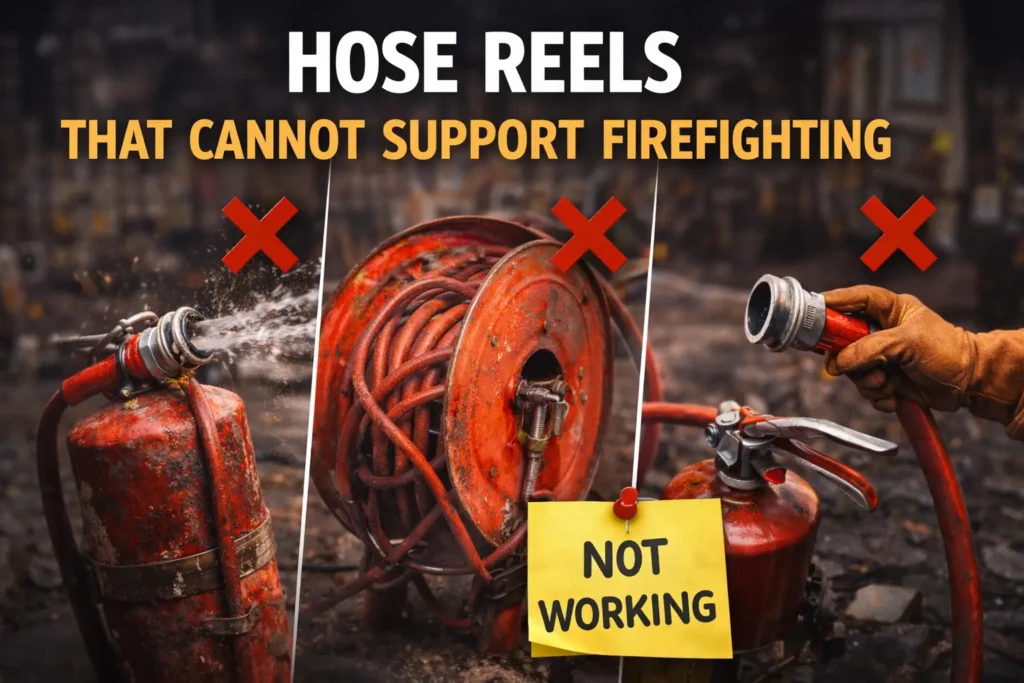
Hose Reels That Cannot Support Firefighting
Fire hose reels are installed in almost every workplace. They are visible, accessible, and designed for immediate use during the early stages of a fire.
They create confidence.
But during actual emergencies, many hose reels fail when they are needed the most.
Workers open the valve and find:
- No water pressure
- Hose stuck or tangled
- Broken or missing nozzle
- Leakage from multiple points
- Valve not opening
- Hose too short to reach the fire
In these situations, valuable time is lost. By the time the system becomes usable, the fire has already grown.
A hose reel that does not function properly is not just ineffective. It creates a false sense of safety, which is more dangerous than having no system at all.
Purpose of a Fire Hose Reel
A fire hose reel is intended for:
- Immediate response to small fires
- Use by trained occupants
- Quick suppression before fire spreads
It should:
- Deliver continuous water supply
- Maintain adequate pressure
- Be easy to operate
- Cover the entire risk area
- Function without delay
Unlike hydrant systems, hose reels are designed for fast action within the first few minutes of fire.
Why Hose Reels Fail in Real Workplaces
Lack of Regular Testing
In many workplaces, hose reels are installed and then ignored.
No one checks:
- Water pressure
- Hose condition
- Valve operation
- Coverage area
Mechanical systems that are not tested regularly are highly likely to fail.
No Water Pressure
This is one of the most common failures.
When the valve is opened:
- No water flows
- Pressure is too low
- Flow is inconsistent
Typical causes include:
- Fire pump not running
- Empty or insufficient water tank
- Closed isolation valves
- Blocked pipelines
- Air lock in system
Without proper pressure, firefighting is impossible.
Hose Cannot Be Unrolled
During emergencies, quick deployment is critical.
However, many reels:
- Get stuck
- Are tangled
- Have rusted drums
- Are improperly wound
Workers waste valuable time trying to pull the hose.
In some cases, they abandon the attempt completely.
Leakage from Hose
Old or damaged hoses often develop:
- Cracks
- Weak joints
- Burst sections
This leads to:
- Loss of pressure
- Reduced reach
- Ineffective firefighting
Instead of controlling the fire, water is wasted.
Nozzle Malfunction
The nozzle controls water delivery.
Common issues include:
- Broken or missing nozzle
- Jammed mechanism
- Inability to switch spray pattern
- Only jet mode available
A proper nozzle should provide both jet and spray patterns.
Without spray mode, cooling and protection become difficult.
Insufficient Hose Length
Poor planning during installation leads to:
- Limited coverage area
- Inability to reach fire locations
- Blind spots in protection
Every hose reel must be able to cover its entire designated area.
Valve Difficult to Operate
In older systems:
- Valves may be rusted
- Too tight to open
- Completely jammed
During a fire, there is no time to struggle with equipment.
Operation must be smooth and immediate.
Obstructed Access
Hose reels are often blocked by:
- Stored materials
- Furniture
- Equipment
- Locked enclosures
Firefighting equipment must always be accessible.
Blocked access can delay response and increase fire damage.
Lack of Worker Training
Even a perfectly maintained hose reel is useless if workers cannot operate it.
Common issues include:
- Lack of knowledge on valve operation
- No understanding of nozzle control
- Panic during emergency
- Hesitation to use equipment
Training is essential for effective response.
What Safety Officers Commonly Miss
In real workplaces, the following issues are frequently overlooked:
- Hose reels not tested under pressure
- Valves never operated
- Nozzle condition ignored
- Coverage area not verified
- Reels blocked by materials
- No training provided to workers
These gaps lead to failure during emergencies.
Real Workplace Example
In a warehouse, cartons caught fire near a loading area.
Workers attempted to use a nearby hose reel.
Problems occurred:
- Valve was difficult to open
- Hose was tangled
- Water pressure was low
Workers spent several minutes trying to operate the system.
By the time water reached the fire, it had already spread to adjacent storage.
The investigation revealed that the hose reel had not been tested for over two years.
It appeared ready, but it was not functional.
Fire Hose Reel Maintenance Checklist
Weekly Checks
- Visual inspection of hose reel
- Ensure no obstruction
- Check accessibility
- Confirm valve condition
Monthly Checks
- Fully unroll hose
- Run water through system
- Check pressure level
- Inspect for leakage
- Test nozzle spray pattern
- Rewind hose correctly
Quarterly Checks
- Pressure testing
- Drum rotation check
- Pipeline inspection
- Lubrication of moving parts
- Replacement of damaged components
Annual Checks
- Full system performance testing
- Coverage verification
- Replacement of worn hoses
- Staff training and drills
- Third-party inspection
Importance of Proper System Design
Maintenance alone cannot fix poor design.
A properly designed system should include:
- Correct hose length
- Adequate water pressure
- Strategic placement
- Full area coverage
- Easy accessibility
- Clear signage
Design determines whether the hose reel can actually reach and control a fire.
Industry Guidance and Standards
According to the National Fire Protection Association, first aid firefighting equipment such as hose reels must be regularly inspected, tested, and maintained to ensure reliable operation during emergencies.
Proper maintenance ensures:
- Adequate water pressure
- Correct flow rate
- Immediate usability
For detailed guidance, refer to:
👉 https://www.nfpa.org/News-and-Research/Publications-and-media/NFPA-Journal
Warning Signs of Unreliable Hose Reels
Look for these indicators:
- Dust accumulation
- Hose never tested
- Leakage marks
- Missing nozzles
- Rusted valves
- Low pressure complaints
- Blocked access
- No inspection records
These signs indicate potential failure during emergencies.
Role of Safety Officers
Responsibility must be clearly assigned.
Safety officers should:
- Conduct regular inspections
- Ensure functional testing
- Maintain accurate records
- Take corrective action
- Train workers
Without accountability, equipment becomes unreliable.
Conclusion
Installing hose reels is simple.
Ensuring they work during a fire is the real challenge.
A hose reel that fails during an emergency does not provide protection. It creates dangerous overconfidence.
Reliability depends on:
- Regular testing
- Proper maintenance
- Correct design
- Worker training
If a hose reel has not been tested recently, it cannot be trusted.
For a complete understanding, read our full Workplace Fire Safety Guide.
Complete Workplace Fire Safety Guide (2026): Prevention, Equipment, Risk & Response
Fire Pumps Installed but Not Reliable During Fires
Fire Hydrant Systems That Look Ready but Fail
Fire Hydrant System Explained, How It Works, Why It Fails, and How to Keep It Fire Ready
Components of a Fire Hydrant System, How Each Part Fails or Saves a Fire Response
How to Operate a Fire Hydrant Safely During an Emergency
Frequently Asked Questions
How often should hose reels be tested
Monthly operational checks and annual performance testing are recommended.
What pressure is required
Typically 4 to 7 bar at the nozzle for effective firefighting.
Can damaged hoses be reused
No. Damaged hoses must be replaced immediately.
Who should operate hose reels
Trained staff or emergency response teams.
Are hose reels enough for large fires
No. They are only for early-stage fire control.
