
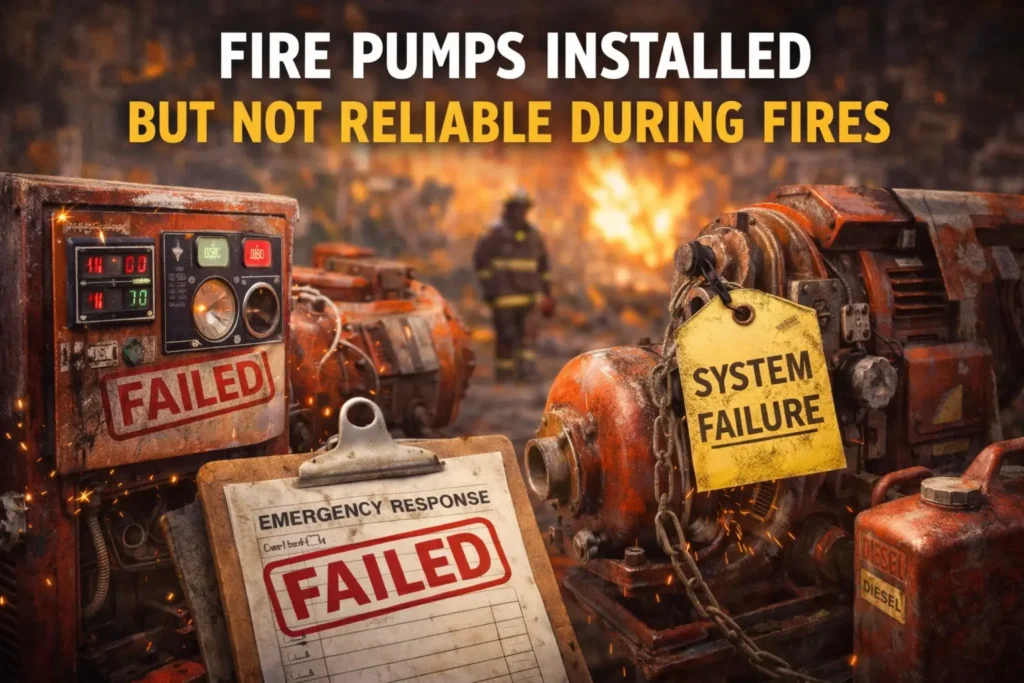
Fire Pumps Installed but Not Reliable During Fires
In many factories, warehouses, and commercial buildings, fire pump systems look complete and well installed.
You see:
- Diesel pump
- Electric pump
- Jockey pump
- Control panels
- Pressure gauges
- Large red pipelines
Everything appears ready.
However, during actual fire emergencies, many of these systems fail when they are needed most.
The pump may not start, pressure may drop, or water may not reach the fire.
This creates a dangerous situation.
A fire pump that is installed but not reliable is worse than having no system at all, because it creates false confidence and delays emergency response.
What a Fire Pump Is Supposed to Do
A fire pump has a single critical function.
Deliver water at the required pressure and flow instantly during a fire.
It must:
- Start automatically
- Maintain stable pressure
- Run continuously without interruption
- Supply sufficient water to hydrants and sprinklers
- Operate without manual intervention
If any of these fail, the entire fire protection system becomes ineffective.
The Hidden Problem in Most Workplaces
In many industries, fire pumps are treated as “install and forget” equipment.
After installation:
- No regular testing is conducted
- Maintenance is ignored
- Responsibility is unclear
Months or even years pass without operating the system.
Mechanical equipment that is not used regularly will degrade over time.
Pumps are machines. They require regular operation, inspection, and maintenance.
Without this, failure is inevitable.
Common Reasons Fire Pumps Fail During Fires
Failure to Start Automatically
This is the most critical failure.
During a fire:
- System pressure drops
- Pump should start automatically
- But nothing happens
Common causes include:
- Auto mode turned off
- Control panel faults
- Battery failure in diesel pump
- Faulty pressure sensors
- Wiring issues
- Isolation switches left open
Without automatic start, water does not reach firefighting systems.
Diesel Engine Problems
Diesel pumps are essential during power failure.
However, they often fail due to neglect.
Typical issues include:
- Empty diesel tank
- Contaminated fuel
- Dead battery
- Starter motor failure
- Cooling system problems
- No regular running
Diesel engines must be started weekly.
If left unused, they may not start when needed.
Electrical Pump Tripping
Electric fire pumps may trip immediately after starting.
Common reasons include:
- Incorrect overload settings
- Low voltage
- Loose wiring
- Motor insulation damage
- Control panel faults
Repeated tripping results in unstable pressure and ineffective firefighting.
Low Discharge Pressure
Sometimes the pump runs but does not deliver sufficient pressure.
This can occur due to:
- Worn impeller
- Air in suction line
- Blocked suction strainer
- Pipeline leakage
- Incorrect pump selection
- Partially closed valves
Low pressure leads to poor water flow and reduced firefighting capability.
Poor Pump Room Conditions
Pump rooms are often neglected.
Common issues include:
- Dust and dirt accumulation
- Oil leakage
- Rusted components
- Poor lighting
- Lack of ventilation
- Storage of unrelated materials
These conditions accelerate equipment failure.
A fire pump room must be clean, accessible, and well maintained.
Empty or Inadequate Water Supply
In many cases, the fire water tank is not properly maintained.
Issues include:
- Tank used for other purposes
- No level monitoring
- Leakage
- No automatic refill
Without water, even a fully functional pump cannot operate.
Jockey Pump Failure
The jockey pump maintains system pressure.
If it fails:
- Pressure drops frequently
- Main pump starts unnecessarily
- System becomes unstable
This increases wear and reduces reliability of the main pump.
What Safety Officers Commonly Miss
During inspections, these issues are often overlooked:
- Pumps never tested under real conditions
- Diesel levels not checked regularly
- Batteries not maintained
- Pressure gauges ignored
- Pump room conditions neglected
These gaps create a false sense of readiness.
Real Workplace Example
In a manufacturing plant, a fire started on a conveyor system.
The sprinkler system activated, but the fire pump failed to start.
Investigation revealed:
- Diesel tank was empty
- Pump had not been tested for six months
- Battery was not functional
The system was installed correctly, but not maintained.
The fire caused major damage before external firefighting support arrived.
Fire Pump Testing and Maintenance Checklist
Weekly Checks
- Run diesel pump for 10 to 15 minutes
- Operate electric pump
- Check battery condition
- Verify pressure readings
- Inspect fuel level
Monthly Checks
- Test automatic start function
- Inspect control panel alarms
- Check valves and pipelines
- Clean suction strainers
- Verify jockey pump operation
Quarterly Checks
- Conduct flow test
- Measure discharge pressure
- Inspect electrical connections
- Lubricate moving parts
- Clean pump room
Annual Checks
- Full performance testing
- Engine servicing
- Replacement of worn components
- Sensor calibration
- Third-party inspection
Importance of Functional Testing
Visual inspection is not enough.
Fire pumps must be tested under real conditions, including:
- Automatic start
- Full load operation
- Continuous running
- Pressure stability
Only testing can confirm reliability.
Industry Guidance and Standards
According to the National Fire Protection Association, fire pumps must be regularly inspected, tested, and maintained to ensure they operate reliably during emergencies.
NFPA guidance emphasizes:
- Weekly pump operation
- Periodic flow testing
- Maintenance based on performance
- Immediate correction of faults
For detailed guidance, refer to:
👉 https://www.nfpa.org/News-and-Research/Publications-and-media/NFPA-Journal
Warning Signs of Unreliable Fire Pumps
Look for these indicators:
- Pump never tested
- No maintenance records
- Diesel leakage or smell
- Rusted valves
- Pressure gauge always zero
- Battery issues
- Alarm faults ignored
- Dirty pump room
These signs indicate high risk of failure.
Role of Safety Officers
Fire pump reliability requires clear ownership.
Safety officers must:
- Conduct regular testing
- Maintain records
- Identify faults
- Ensure repairs
- Train personnel
Without accountability, systems fail silently.
Conclusion
Installing a fire pump is only the first step.
Reliability depends on:
- Regular testing
- Proper maintenance
- Accurate monitoring
- Clear responsibility
A fire pump that fails during a fire is not protection.
It is a dangerous illusion.
If the system has not been tested recently, it cannot be trusted.
For a complete understanding, read our full Workplace Fire Safety Guide.
Complete Workplace Fire Safety Guide (2026): Prevention, Equipment, Risk & Response
Fire Hydrant Systems That Look Ready but Fail
Fire Hydrant System Explained, How It Works, Why It Fails, and How to Keep It Fire Ready
Components of a Fire Hydrant System, How Each Part Fails or Saves a Fire Response
How to Operate a Fire Hydrant Safely During an Emergency
Fire Pump Room Layout and Requirements Explained Simply and Practically
Frequently Asked Questions
How often should fire pumps be tested
Weekly operational tests and annual performance testing are recommended.
Is diesel or electric pump better
Both are necessary. Diesel works during power failure, electric provides regular operation.
Can new pumps fail
Yes. Without testing, even new systems can fail.
Who should manage fire pump systems
Trained safety or maintenance personnel.
Why is automatic mode important
Because manual operation causes delay during emergencies.
