
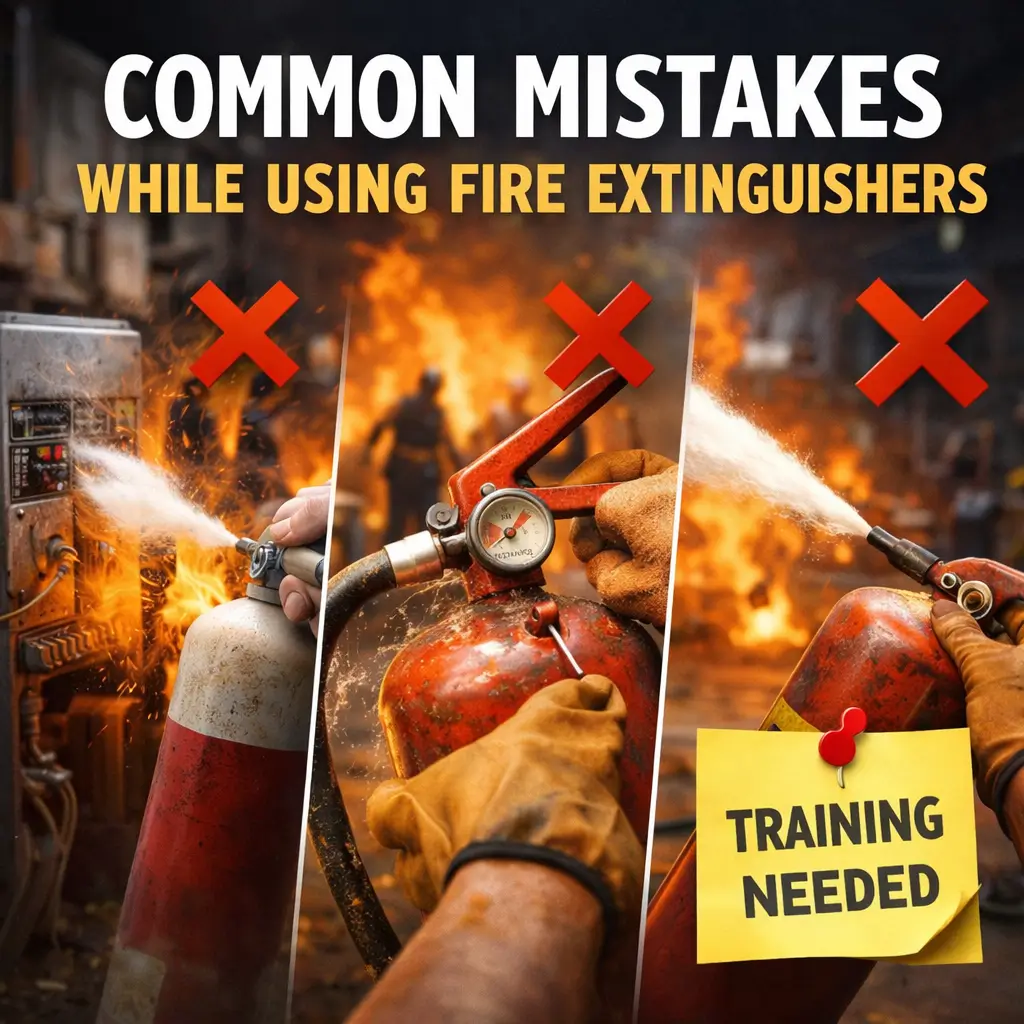
Common Mistakes While Using Fire Extinguishers
Fire extinguishers are widely installed in workplaces, commercial buildings, and industrial facilities.
However, during real emergencies, many extinguishers fail to control fires, not because of equipment failure, but due to human mistakes.
Fire emergencies create:
- Panic
- Confusion
- Time pressure
In such conditions, people react instinctively instead of following correct procedures.
In many workplaces, extinguishers are installed for compliance, but practical training and real preparedness are ignored.
As a result, even available equipment becomes ineffective.
The Role of Human Behavior in Fire Emergencies
In real fire situations:
- Stress affects decision-making
- Memory of training reduces
- Coordination becomes difficult
- Fear delays action
Even trained workers can make mistakes under pressure.
This is why fire safety must focus not only on equipment, but also on behavior and practice.
Most Common Mistakes While Using Fire Extinguishers
Using the Wrong Type of Fire Extinguisher
This is one of the most dangerous errors.
Examples include:
- Using water on electrical fires
- Using CO₂ on deep-seated materials
- Using foam on reactive metals
Consequences:
- Fire intensifies
- Risk of electric shock
- Re-ignition occurs
How to Avoid
- Clearly label extinguishers
- Train workers on fire classes
- Conduct practical drills
Not Pulling the Safety Pin
Under stress, people often forget basic steps.
Result:
- Extinguisher does not operate
- Time is lost
- Fire spreads rapidly
How to Avoid
- Teach the PASS method
Pull, Aim, Squeeze, Sweep - Conduct hands-on training
Standing at the Wrong Distance
Improper positioning reduces effectiveness.
Common errors:
- Too close, leading to risk and poor control
- Too far, causing ineffective discharge
Correct Practice
- Maintain recommended distance
- Aim at the base of the fire
- Move forward gradually
Spraying Randomly Instead of Sweeping
Uncontrolled discharge leads to:
- Wastage of extinguishing agent
- Incomplete coverage
- Fire spreading
Correct Practice
- Sweep side to side
- Start from nearest edge
- Maintain steady pressure
Attempting to Fight Large Fires
Extinguishers are designed only for small fires.
Mistakes occur when people try to control:
- Large flames
- Rapidly spreading fires
- Smoke-filled areas
Correct Decision
- Evacuate immediately
- Activate alarm
- Call emergency services
Using Poorly Maintained Extinguishers
Common issues include:
- Expired units
- Low pressure
- Blocked nozzles
- Broken seals
These extinguishers fail during emergencies.
Prevention
- Monthly inspection
- Annual servicing
- Immediate replacement of faulty units
Lack of Training and Confidence
Untrained workers:
- Hesitate to act
- Panic during emergencies
- Misuse equipment
Solution
- Conduct live demonstrations
- Provide hands-on practice
- Repeat training regularly
Ignoring Re-Ignition Risk
Some fires appear extinguished but restart due to:
- Residual heat
- Smoldering materials
- Incomplete cooling
Best Practice
- Monitor area after extinguishing
- Ensure complete cooling
- Do not leave immediately
Poor Placement of Fire Extinguishers
Even trained workers fail when extinguishers are:
- Blocked
- Hidden
- Installed incorrectly
Correct Placement
- Near exits
- Clearly visible
- Easily accessible
Treating Fire Safety as a Formality
In many workplaces:
- Equipment is installed for audits
- No real ownership exists
- No follow-up is done
This leads to poor preparedness.
What Safety Officers Commonly Miss
In real workplaces, these gaps are often overlooked:
- No practical extinguisher training
- Workers unaware of fire classes
- Poor placement and accessibility
- Lack of inspection records
- Overconfidence in equipment
These issues significantly reduce emergency response effectiveness.
Real Workplace Example
In an office environment, a small electrical fire occurred.
An employee used a water extinguisher.
This resulted in:
- Increased risk due to electricity
- Delay in proper response
- Fire spreading to nearby equipment
The investigation showed lack of training and awareness.
The extinguisher was available, but used incorrectly.
Fire Extinguisher Usage Checklist
Before Emergency
- Know extinguisher types
- Identify fire risks
- Ensure accessibility
- Attend training sessions
During Emergency
- Follow PASS method
- Use correct extinguisher
- Maintain safe distance
- Keep exit behind you
- Stop if fire grows
After Use
- Monitor for re-ignition
- Report incident
- Replace used extinguisher
Practical Steps to Prevent Mistakes
- Conduct regular fire drills
- Provide hands-on training
- Display fire class charts
- Assign fire wardens
- Review incidents and near-misses
Industry Guidance and Standards
According to the National Fire Protection Association, proper fire extinguisher use depends on correct selection, regular maintenance, and effective user training.
NFPA emphasizes:
- Practical training
- Awareness of fire classes
- Proper maintenance
- Integration with emergency response
For detailed guidance, refer to:
👉 https://www.nfpa.org/News-and-Research/Publications-and-media/NFPA-Journal
Warning Signs of High Risk
Look for these indicators:
- Workers unsure how to use extinguishers
- No training records
- Blocked equipment
- Frequent misuse
- Poor inspection practices
These signs indicate increased fire risk.
Conclusion
Fire extinguishers are effective only when used correctly.
Most failures during emergencies are not due to equipment defects, but due to human mistakes.
By improving:
- Training
- Awareness
- Practice
- Supervision
workplaces can significantly reduce fire risks.
Fire safety is not about having equipment.
It is about using it correctly when it matters most.
For a complete understanding, read our full Workplace Fire Safety Guide.
Complete Workplace Fire Safety Guide (2026): Prevention, Equipment, Risk & Response
Why Monthly Fire Extinguisher Checks Are Ignored
Types of Fire Extinguishers Explained, How to Select the Right One for Real Workplace Fires
Water Extinguisher, When It Works, When It Fails, and How People Misuse It
Foam Fire Extinguishers, When They Are the Best Choice and When They Are Dangerous
CO₂ Fire Extinguisher, Where It Works Perfectly and Where It Becomes Dangerous
Frequently Asked Questions
Can untrained workers use fire extinguishers
Yes, but training is essential for safe and effective use.
What is the most common mistake
Using the wrong extinguisher type.
Should large fires be fought with extinguishers
No. Evacuation is the priority.
How often should training be conducted
At least annually, with regular refreshers.
Why do extinguishers fail in real emergencies
Due to incorrect use, lack of training, and delayed response.
