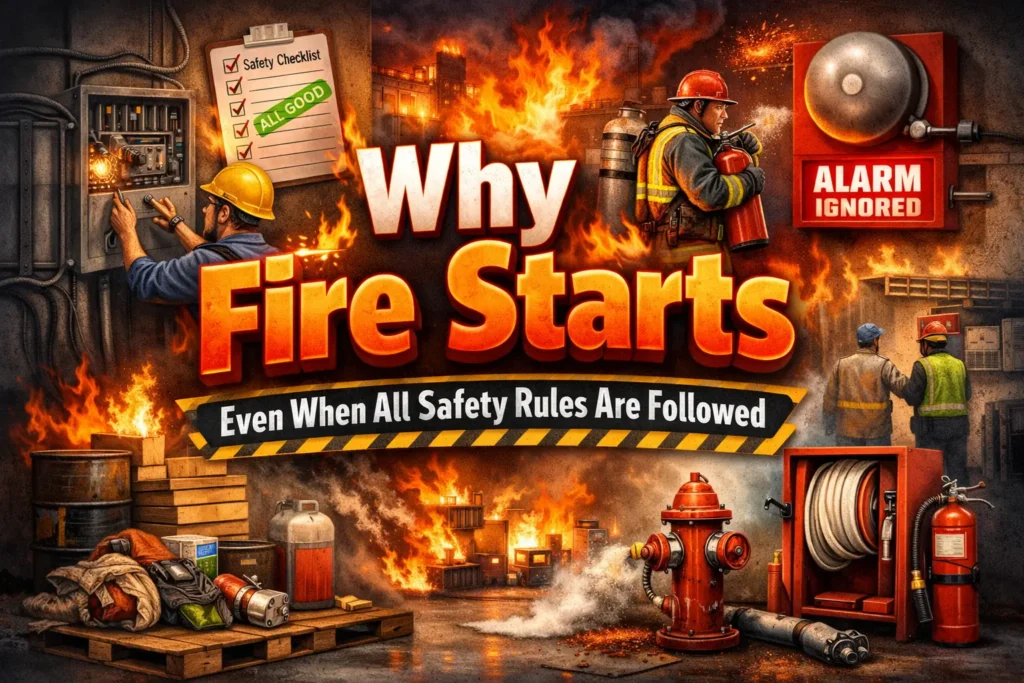
Why Fire Starts Even When All Safety Rules Are Followed
In many fire investigations, one assumption is repeated:
“Safety rules were not followed.”
However, real workplace incidents often tell a different story.
There are many cases where:
- Procedures exist
- Workers are trained
- Fire equipment is installed
- Inspections are conducted
Yet, fire still occurs.
This creates confusion.
The problem is not always the absence of rules.
The problem is that rules do not always control real-world conditions.
The Difference Between Compliance and Real Control
Most organizations focus on:
- SOPs
- Checklists
- Permits
- Audit reports
These create compliance.
But fire is not controlled by documentation.
Fire occurs when:
- Heat
- Fuel
- Oxygen
come together under the right conditions.
Even with perfect documentation, if physical conditions are not controlled, fire can still start.
Fire Risk Changes Constantly, Rules Do Not
Workplaces are dynamic environments.
Conditions change continuously:
- Electrical loads increase
- Machines age
- Materials change
- Layouts are modified
- Temporary setups become permanent
However, safety rules are often static.
This mismatch creates hidden fire risks.
A rule that was correct five years ago may not be effective today.
Human Behavior Creates Hidden Risks
Workers naturally adapt to their environment.
When unsafe actions do not immediately cause harm, they become normal.
Common examples include:
- Permanent use of temporary wiring
- Ignoring minor overheating
- Bypassing safety devices
- Performing hot work slightly outside control areas
These are not always intentional violations.
They become routine behavior.
Fire incidents often originate from these normalized practices.
Fire Safety Equipment Does Not Guarantee Protection
Installing equipment does not eliminate fire risk.
Common real-world issues include:
- Extinguishers available but not understood
- Hose reels that cannot reach hazard areas
- Fire pumps tested without real load conditions
- Alarm systems ignored due to frequent false alerts
Equipment must be:
- Functional
- Accessible
- Understood by users
Otherwise, it provides only a false sense of safety.
Change Management Is Often Ignored
Workplace changes increase fire risk when not properly managed.
Typical situations include:
- New machinery installed without reassessment
- Layout changes blocking access
- Flammable materials introduced without review
- Temporary storage becoming permanent
Fire safety rarely gets the same attention as production during change.
This creates uncontrolled risk.
Overconfidence Based on Past Safety Records
Many workplaces rely on statements like:
“We never had a fire here.”
This creates overconfidence.
Fire incidents are rare, but they are not impossible.
Fire does not consider past performance.
It depends only on current conditions.
Inspections Do Not Always Capture Real Risk
Routine inspections focus on:
- Equipment presence
- Certification
- Documentation
But they often miss:
- Heat buildup patterns
- Temporary unsafe practices
- Worker shortcuts
- Night-shift conditions
- Maintenance activities
This leads to a situation where:
Compliance is confirmed, but risk still exists.
Fire Starts in System Gaps, Not in Procedures
Fire safety involves multiple systems:
- Electrical safety
- Mechanical safety
- Housekeeping
- Maintenance
- Training
When these systems are not integrated, gaps form.
Fire often starts in these gaps.
Not because rules are missing, but because systems do not work together.
Real Workplace Example
In an industrial unit:
- All procedures were followed
- Fire extinguishers were installed
- Workers were trained
However, a fire started due to:
- Heat buildup in a motor
- Dust accumulation
- Continuous operation
The condition was not covered in procedures.
The fire occurred due to real physical conditions, not rule violation.
Practical Fire Risk Control Checklist
Daily Controls
- Observe actual work practices
- Identify abnormal heat or smell
- Check temporary setups
Weekly Controls
- Inspect equipment condition
- Review housekeeping
- Verify safe work practices
Monthly Controls
- Update risk assessment
- Review changes in process
- Evaluate near-miss incidents
After Any Change
- Reassess fire risk
- Update controls
- Train workers
- Verify equipment suitability
How to Prevent Fire Beyond Compliance
To reduce fire risk effectively:
- Focus on real conditions, not just documentation
- Observe behavior, not only procedures
- Encourage reporting of unsafe practices
- Test systems under real conditions
- Continuously update risk assessments
Fire prevention must be dynamic.
Industry Guidance and Standards
According to the National Fire Protection Association, effective fire prevention requires continuous hazard identification, system evaluation, and alignment of safety controls with real operating conditions.
NFPA emphasizes:
- Dynamic risk assessment
- Integration of safety systems
- Real-condition testing
- Continuous improvement
For detailed guidance, refer to:
👉 https://www.nfpa.org/News-and-Research/Publications-and-media/NFPA-Journal
Warning Signs That Fire Risk Exists Despite Compliance
Watch for these indicators:
- Repeated minor overheating
- Temporary arrangements becoming permanent
- Workers bypassing controls
- Equipment running continuously without inspection
- Overconfidence in safety systems
These signs indicate hidden risk.
Conclusion
Fire can start even when safety rules are followed.
Because rules do not control reality.
Fire depends on:
- Physical conditions
- Human behavior
- System integration
True fire safety requires:
- Continuous observation
- Adaptation to change
- Practical understanding
- Active control
Compliance proves that systems exist.
Control ensures that systems work.
Fire Triangle Explained, Practical Fire Risk Control Guide for Workplaces
Heat Sources in Industrial Fires, Where Ignition Really Starts and How to Stop It
Fuel Types and Their Fire Behaviour, Why Different Fuels Burn Differently and How Fires Escalate
Role of Oxygen in Combustion, How Oxygen Makes Fires Grow and Why It Becomes Dangerous
Breaking the Fire Triangle, How Fires Are Actually Stopped in Real Situations
Frequently Asked Questions
Can fire occur even in compliant workplaces
Yes. Fire depends on conditions, not documentation.
What is the biggest hidden cause of fire
Heat buildup combined with routine unsafe practices.
Are audits enough to prevent fire
No. Real condition monitoring is essential.
Why do trained workers take risks
Because unsafe behavior becomes normalized over time.
What is more important, rules or behavior
Both are important, but behavior determines real outcomes.
