
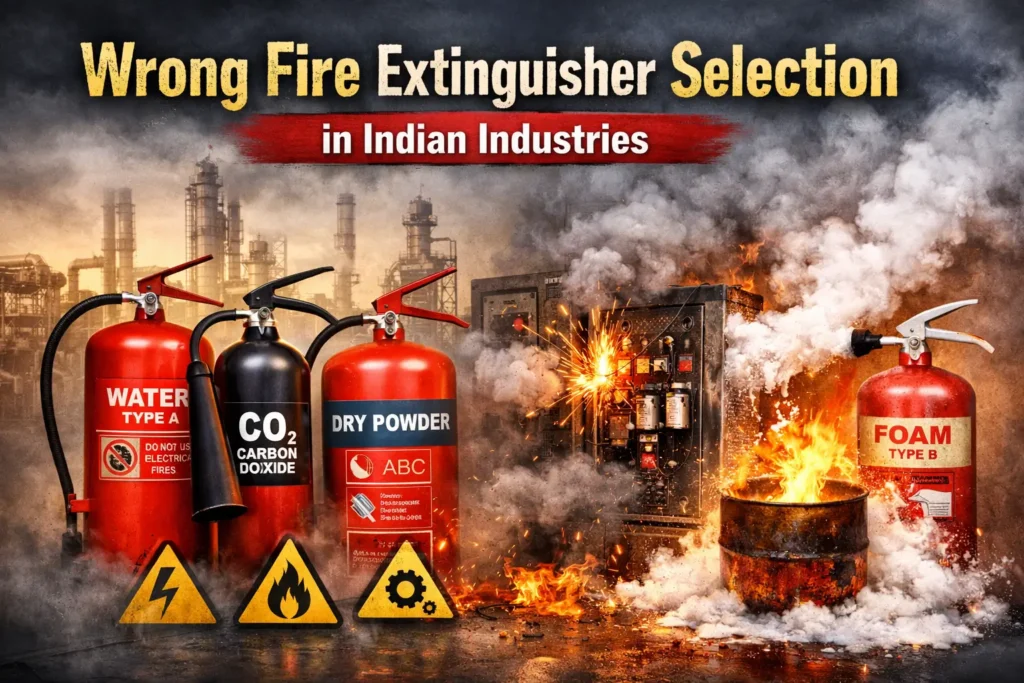
Wrong Fire Extinguisher Selection in Indian Industries
According to guidance published by the National Fire Protection Association (NFPA), proper fire safety planning includes correct extinguisher selection, employee awareness, and understanding fire risks in residential and workplace environments. NFPA emphasizes that lack of basic fire safety knowledge is a major reason fires escalate during emergencies.
Fire extinguishers are mandatory in Indian industries under various safety regulations, audits, and insurance requirements. Almost every factory, warehouse, office, and construction site displays fire extinguishers at designated locations.
Yet, during real fire incidents, investigations frequently reveal a critical issue: the wrong type of fire extinguisher was installed or used.
Incorrect fire extinguisher selection is one of the most common and dangerous fire safety failures in Indian industries. This mistake often turns small, controllable fires into major incidents, causing injuries, equipment damage, and production losses.
Why Fire Extinguisher Selection Matters
Fire extinguishers work based on fire class compatibility. Each extinguisher is designed to control specific types of fires.
When the wrong extinguisher is selected:
- Fire may intensify instead of reducing
- Electrical shock risk increases
- Re-ignition becomes likely
- Extinguisher discharge becomes ineffective
In Indian workplaces, extinguisher selection is often driven by cost, availability, or audit pressure, rather than actual fire risk.
Common Fire Classes in Indian Industries
Understanding industrial fire risks is the first step toward correct selection.
Class A Fires
Involving solid combustibles such as:
- Wood
- Paper
- Packaging material
- Textiles
- Rubber
Common in offices, warehouses, and manufacturing plants.
Class B Fires
Involving flammable liquids such as:
- Diesel
- Petrol
- Solvents
- Paints
- Lubricants
Very common in refineries, workshops, and storage areas.
Class C Fires
Involving flammable gases such as:
- LPG
- Propane
- Acetylene
Found in kitchens, fabrication yards, and gas storage areas.
Electrical Fires
Energized electrical equipment including:
- Panels
- Motors
- Control rooms
- Server rooms
Extremely common across all industries.
Class D Fires
Involving combustible metals such as:
- Magnesium
- Aluminum powder
- Sodium
Rare but critical in specialized industries.
Most Common Wrong Extinguisher Selections in India
Water Extinguishers Used Near Electrical Equipment
This is one of the most dangerous mistakes.
Why it happens:
- Water extinguishers are cheaper
- Easy availability
- Poor hazard understanding
Risks involved:
- Electric shock
- Equipment damage
- Fire spread
Water extinguishers should never be used on live electrical fires.
CO₂ Extinguishers Installed for Solid Fuel Areas
CO₂ extinguishers are frequently installed in offices and storage areas containing paper and furniture.
Why this fails:
- CO₂ removes oxygen temporarily
- No cooling effect
- High chance of re-ignition
CO₂ is unsuitable for deep-seated Class A fires.
Dry Powder Used Without Re-Ignition Control
Dry chemical powder is widely used because it is marketed as “multipurpose.”
However:
- Powder knocks down flames only
- Does not cool fuel
- Leaves fire source active
Without follow-up cooling or isolation, fires often restart.
Foam Extinguishers Installed Without Fuel Isolation
Foam extinguishers work best on liquid fires when fuel supply is controlled.
Common failure:
- Continuous fuel flow
- Overflowing tanks
- Pump systems running
Foam alone cannot stop a flowing fuel fire.
One Type of Extinguisher Used Everywhere
Many Indian factories install only ABC powder extinguishers throughout the site.
Problems with this approach:
- Electrical damage
- Visibility issues
- Cleanup difficulties
- Inappropriate for some risks
Fire safety requires risk-based selection, not uniform placement.
Why Wrong Selection Happens in Indian Industries
Compliance-Driven Safety Culture
Fire extinguishers are often installed to:
- Pass audits
- Satisfy inspectors
- Meet minimum legal requirements
Actual fire scenarios are rarely evaluated.
Poor Fire Risk Assessment
Many sites:
- Copy extinguisher layouts from old drawings
- Use contractor recommendations without review
- Ignore process-specific hazards
Without a proper fire risk assessment, selection is guesswork.
Lack of Technical Knowledge
Decision-makers may not fully understand:
- Fire behavior
- Extinguisher limitations
- Industrial fire loads
Selection is left to vendors or junior staff.
Cost-Cutting Decisions
Cheaper extinguishers are preferred, even when unsuitable.
This leads to:
- Under-rated extinguishers
- Inadequate coverage
- Increased failure risk
Real Incident Patterns in India
Fire investigation reports commonly highlight:
- Water extinguisher used on electrical panel fires
- CO₂ extinguishers failing on paper storage fires
- Powder extinguishers used in enclosed spaces causing visibility loss
- No suitable extinguisher for liquid fuel fires
In many cases, the extinguisher was present but ineffective due to wrong selection.
How to Select the Right Fire Extinguisher
Correct selection must be based on:
- Fire load assessment
- Type of fuel present
- Electrical energization status
- Ventilation conditions
- Occupant training level
No single extinguisher suits all hazards.
Role of Safety Officers and Engineers
Safety professionals must ensure:
- Extinguishers match actual hazards
- Locations are reviewed periodically
- Changes in process trigger reassessment
- Training includes selection awareness
Fire extinguisher selection is a technical decision, not an administrative one.
Frequently Asked Questions (FAQs)
Can ABC powder extinguishers be used everywhere?
No. Although multipurpose, they are not ideal for all situations and may cause secondary hazards.
Why are water extinguishers still installed in electrical areas?
Due to poor awareness, low cost, and outdated layouts.
Is CO₂ safe for indoor use?
CO₂ can displace oxygen and should be used with caution in enclosed spaces.
Who is responsible for extinguisher selection?
The employer and safety management are legally responsible, not the supplier alone.
How often should extinguisher selection be reviewed?
Whenever there is a process change, layout change, or new hazard introduction.
Conclusion
Wrong fire extinguisher selection is a silent but serious fire safety failure in Indian industries. The presence of extinguishers does not guarantee protection unless they are technically suitable for the actual fire risk.
Fire safety must move beyond compliance and focus on real-world fire behavior, human response, and industrial conditions. Correct extinguisher selection can mean the difference between a minor incident and a major disaster.
Types of Fire Extinguishers Explained, How to Select the Right One for Real Workplace Fires
Water Extinguisher, When It Works, When It Fails, and How People Misuse It
Foam Fire Extinguishers, When They Are the Best Choice and When They Are Dangerous
CO₂ Fire Extinguisher, Where It Works Perfectly and Where It Becomes Dangerous
DCP Fire Extinguisher, Why It Works So Fast and Why It Often Fails After That
