
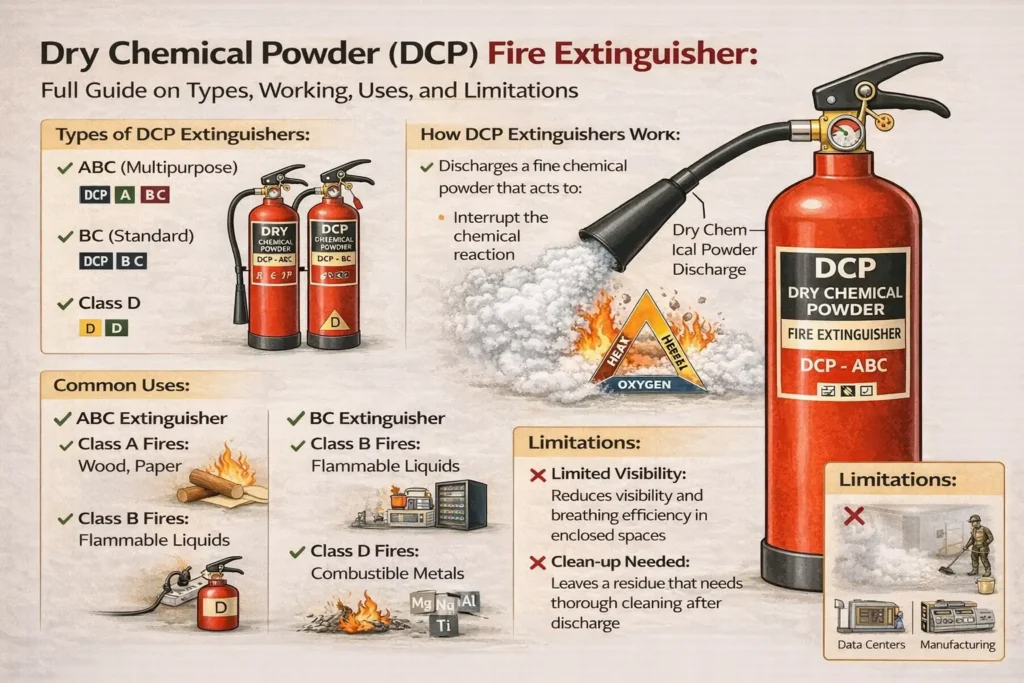
Dry Chemical Powder DCP Fire Extinguisher: Full Guide on Types, Working, Uses, and Limitations
Dry Chemical Powder (DCP) fire extinguishers are among the most widely used and versatile extinguishers in the world. They are effective on multiple classes of fire and work by interrupting the chemical chain reaction that sustains combustion. Because of this, DCP extinguishers are considered a “universal” choice for many facilities, especially where flammable liquids, gases, and electrical systems are present.
You will see DCP extinguishers in homes, offices, vehicles, fuel stations, warehouses, factories, workshops, chemical plants, mining sites, and emergency response vehicles.
This guide converts your original article into high-value, in-depth content suitable for AdSense by:
- Adding technical depth (science, selection criteria, ratings, placement).
- Including practical examples and scenario-based guidance.
- Providing structured sections and an FAQ for better user experience.
- Expanding on standards, maintenance, and comparison with other extinguisher types.
What Is a Dry Chemical Powder (DCP) Fire Extinguisher?
A Dry Chemical Powder extinguisher uses a finely divided chemical powder expelled under pressure to extinguish fire. The powder interferes with the combustion process by:
- Interrupting the chemical chain reaction in the flame zone
- Smothering the fuel surface
- Partially insulating the fuel from oxygen
Unlike water or CO₂, DCP is not only cooling or oxygen displacement – it primarily attacks the chemistry of the flame, which is why it is so effective on flammable liquids, gases, and energized electrical fires.
Where DCP Extinguishers Are Commonly Used
- Residential buildings and apartments
- Offices and commercial complexes
- Fuel stations and tank farms
- Automotive workshops and garages
- Warehouses and logistics centers
- Manufacturing plants and process industries
- Chemical, petrochemical, and refinery installations
- Mining, construction equipment, heavy machinery
- Data centers (with caution – due to powder contamination)
Wherever there is a mix of solid combustibles, flammable liquids, gases, and electrical equipment, DCP is usually part of the protection strategy.
According to HSE fire and explosion guidance, dry chemical powder extinguishers interrupt the chemical reaction of fire and are suitable for multiple fire classes, but they have visibility and residue limitations.
Fire Classes and DCP Compatibility
The suitability of a DCP extinguisher depends on the powder formulation inside it.
Fire Classes
- Class A – Solid combustibles: wood, paper, cloth, rubber, some plastics
- Class B – Flammable liquids: petrol, diesel, kerosene, paints, solvents
- Class C – Flammable gases and energized electrical fires
- Class D – Combustible metals: magnesium, sodium, potassium, titanium, etc.
(For cooking oil and fat fires – Class F/ K – DCP is generally not recommended; wet chemical extinguishers are preferred.)
Types of DCP by Fire Class
- ABC Powder (Mono Ammonium Phosphate)
- Works on: Class A, B, C fires
- Melts and sticks to Class A materials, forming an insulating layer
- Interrupts flame chemistry in Class B and C fires
- Most common “general-purpose” DCP
- BC Powder (Sodium Bicarbonate / Potassium Bicarbonate / Purple-K)
- Works on: Class B and C fires (liquids and gases)
- Does not perform well on deep-seated Class A fires
- Widely used where liquid and gas risks dominate (fuel stations, engine rooms)
- Class D Metal Powders
- Special formulations for reactive metal fires
- Examples: sodium chloride-based powders, graphite powder, metal-specific blends
- Used in foundries, metal processing, aircraft and defense applications
How DCP Extinguishers Work – The Science
DCP extinguishers act on the fire tetrahedron – not just fuel, oxygen, and heat, but also the chemical chain reaction.
Chemical Chain Reaction Inhibition
In a flame, free radicals (highly reactive chemical species) sustain combustion. The powder:
- Decomposes at high temperature
- Releases chemical species that neutralize flame radicals
- Interrupts the self-sustaining chain reaction
- Collapses the flame front quickly
This makes DCP exceptionally fast at knocking down flames, especially in liquid and gas fires.
Smothering and Surface Coating
Once the powder lands on the burning surface, it:
- Forms a barrier between fuel and oxygen
- Reduces vapor release from flammable liquids
- Helps prevent re-ignition to some extent (especially ABC powder on Class A fires)
Limited Cooling Effect
DCP does not cool the fuel as effectively as water or foam. Some heat is absorbed, but:
- Fuel surfaces can remain hot
- There is a risk of re-ignition if the source of heat or ignition remains
- That is why post-extinguishment monitoring is crucial
Composition of Dry Chemical Powders
ABC Powder – Mono Ammonium Phosphate
- Yellowish powder
- Melts and forms a sticky, glass-like coating on Class A materials
- Interrupts flames in Class B and C fires by chemical reaction suppression
BC Powder – Bicarbonate-Based
- Usually sodium bicarbonate or potassium bicarbonate
- White powder
- On heating, releases CO₂, diluting oxygen near the flame
- Very effective on flammable liquid and gas fires
Class D Powders
- Formulations vary by metal type
- Common: sodium chloride, graphite-based powders, or special blends
- Functions by:
- Smothering metal surface
- Absorbing heat
- Forming a crust to prevent air contact
- Never use water or standard DCP on metal fires – it can cause violent reactions
Types of DCP Fire Extinguishers
Stored Pressure Type
- Most common in buildings
- Powder and propellant gas (usually nitrogen or dry air) are stored in the same cylinder
- Features:
- Pressure gauge visible on the valve
- Quick to use and simple to maintain
- Available in sizes like 1 kg, 2 kg, 4 kg, 6 kg, 9 kg
Cartridge-Operated Type
- Powder stored in main cylinder, propellant gas stored in a separate cartridge
- On activation, cartridge is pierced, releasing gas to pressurize the main body
- Preferred in some industrial locations because:
- Easier to service in harsh environments
- Pressure is normally zero until activation
Wheeled / Trolley-Mounted DCP Units
- Capacities from 25 kg to 75 kg or more
- Used in:
- Tank farms
- Airport apron areas
- Refineries and chemical plants
- Designed for large fires or scenarios with significant fuel load
Fixed and Vehicle-Mounted DCP Systems
- Installed on:
- Fuel tankers
- Mining trucks
- Large machinery
- Often activated manually or automatically to protect critical equipment
Main Components of a DCP Fire Extinguisher
- Cylinder Body – Steel container holding powder (and sometimes gas).
- Internal Siphon Tube – Carries powder from bottom of cylinder to valve.
- Valve Assembly and Handle – Controls discharge (open/close).
- Pressure Gauge (stored pressure type) – Shows if unit is in the green zone (operational).
- Safety Pin and Tamper Seal – Prevents accidental discharge; seal shows if the unit was used or tampered with.
- Discharge Hose and Nozzle – Directs powder at the base of the fire; length and design affect reach and control.
- Gas Cartridge (for cartridge-operated units) – CO₂ or nitrogen cartridge that pressurizes the cylinder when activated.
Understanding each part helps in both operation and inspection.
Advantages of DCP Fire Extinguishers
- Multi-class coverage (especially ABC type) – suitable for A, B, C fires
- Fast flame knockdown – excellent for rapidly developing fires
- Non-conductive – generally safe on energized electrical equipment
- Effective outdoors – less affected by wind than CO₂
- Wide industrial acceptance – standard choice for hydrocarbon and gas risks
- Long shelf life – powder remains usable for years if cylinder is intact and dry
Limitations and Risks of DCP Extinguishers
- Limited cooling – high chance of re-ignition if heat source remains
- Heavy clean-up – powder contaminates a large area and penetrates equipment
- Unsuitable for sensitive electronics – can damage PCs, servers, medical devices
- Respiratory irritation – powder clouds may cause coughing and breathing discomfort
- Visibility reduction – thick cloud can reduce visibility during firefighting
- Some powders can be mildly corrosive if not cleaned promptly, particularly in humid environments
Because of these limitations, many sites use a combination of DCP, CO₂, foam, and clean agent extinguishers.
How to Operate a DCP Fire Extinguisher (Step-by-Step)
The basic operation follows the well-known P.A.S.S. method – Pull, Aim, Squeeze, Sweep.
Step 1 – Assess the Situation
- Raise the alarm
- Ensure you have a safe escape route
- Only attempt extinguishment if the fire is small, contained, and not spreading rapidly
Step 2 – Pull the Safety Pin
- Hold the extinguisher upright
- Break the tamper seal and pull the pin firmly
Step 3 – Aim at the Base of the Fire
- Stand at a safe distance (typically 2–3 meters to start)
- Point the nozzle or hose at the base of the flames, not at the flames themselves
Step 4 – Squeeze the Handle
- Squeeze the handles together to start the discharge
- Some delay of a second or two may occur as pressure builds and powder starts to flow
Step 5 – Sweep Side to Side
- Use a sweeping motion from side to side
- Progressively move closer as the fire reduces, always aiming at the base
- Cover all burning material to prevent re-ignition
Step 6 – Monitor for Re-Ignition
- Even after the flame is out, hot surfaces or vapors may still be present
- Stay nearby, watch the area, and be ready to apply more powder or call the fire brigade if needed
Using DCP Extinguishers in Different Fire Scenarios
Flammable Liquid Spill (Class B)
- Attack from upwind to avoid fumes
- Aim at the edge of the spill, not directly into the liquid
- Gently sweep to push the flame back and cover the entire surface with powder
Gas and Electrical Fires (Class C)
- For gas fires, close the gas supply if safely possible – do not extinguish a gas flame if gas keeps escaping
- For electrical panels, stand back, aim through vents or openings, and avoid touching live parts
Solid Fuel Fire (Class A)
- Applicable only for ABC powder
- Aim at embers and hot spots
- After extinguishment, if possible, cool with water to prevent re-ignition
Metal Fires (Class D)
- Use only metal-specific D powders
- Never use water or ABC/BC powder on metal fires, as it can cause explosions or sparking
Placement and Installation of DCP Extinguishers
Proper positioning helps both safety and compliance. Always follow your local fire code, but general good practices include:
- Mounting height:
- Smaller units (≤ 4–6 kg) – top at approx. 1.5 m above floor
- Heavier units – mounted lower for safe handling
- Visibility:
- Clearly visible, not hidden behind furniture or doors
- Fire extinguisher sign above the unit
- Travel distance:
- Users should not travel excessively long distances to reach an extinguisher; typically 15–30 m depending on risk
- Near likely hazards:
- Near exits from high-risk rooms
- Near fuel storage, electrical panels, workshops, boiler rooms, etc.
- Environmental protection:
- Avoid direct exposure to rain or harsh weather without proper cabinets
- Avoid areas with extreme heat or vibration, which may compact powder
Inspection, Servicing, and Testing of DCP Extinguishers
Monthly Visual Inspection (User Level)
Check and record:
- Extinguisher present and unobstructed
- Safety pin and seal intact
- Pressure gauge in green zone (for stored-pressure)
- No visible corrosion, dents, or mechanical damage
- Hose and nozzle intact and free from blockages
- Label and instructions readable
- Last service date within acceptable period
Annual Maintenance (By Competent Person)
- Check internal condition and powder fluidity
- Weigh extinguisher (to confirm powder quantity)
- Inspect valve assembly, O-rings, and hose
- Clean, lubricate, and replace parts as needed
- Re-pressurize and leak test
Powder Replacement
- Typically every 3–5 years, depending on local standards and manufacturer guidance
- Humid climates may require more frequent inspection or replacement
Hydrostatic Testing
- Cylinder must be tested at specified intervals (often every 5 years) for pressure integrity
- Any cylinder that fails the test must be condemned and removed from service
Record Keeping
- Maintain a fire extinguisher register
- Record inspections, maintenance, testing, and refilling
- Essential for audits, insurance, and legal compliance
DCP vs Other Types of Fire Extinguishers
DCP vs CO₂
- DCP
- Better on Class A (with ABC) and flammable liquid spill fires
- Leaves residue and requires clean-up
- CO₂
- Clean agent – no residue
- Best for electrical panels and sensitive electronics
- Less effective outdoors or with strong airflow
DCP vs Foam
- DCP – Fast knockdown but limited cooling
- Foam – Excellent for flammable liquid surface fire control and cooling, but usually not for electrical fires
DCP vs Water / Water Mist
- Water excels on deep-seated Class A fires (cooling)
- DCP offers broader class coverage but poor cooling
In practice, no single extinguisher type is “perfect”. A balanced fire protection plan uses DCP alongside foam, CO₂, water, or clean agents, depending on the risk profile.
Industrial Applications of DCP Extinguishers
- Fuel Stations and Tank Farms
- For petrol, diesel, and solvent fires near dispensers and storage tanks
- Chemical and Petrochemical Plants
- For flammable liquid and gas process units
- Protection around reactors, pumps, loading bays
- Automotive and Mechanical Workshops
- Engine fires, oil and grease fires, welding work areas
- Manufacturing and Warehousing
- Mixed hazards: packaging, flammable liquids, electrical equipment
- Mining and Heavy Equipment
- Onboard DCP systems on dumpers, excavators, drills
- Aviation and Marine
- Trolley DCP units near fueling and maintenance areas
FAQs About Dry Chemical Powder (DCP) Fire Extinguishers
1. Can I use a DCP extinguisher on electrical fires?
Yes, ABC and BC DCP extinguishers are generally safe on energized electrical equipment, because the powder is non-conductive. However, the residue can damage sensitive electronics, so CO₂ or clean agent extinguishers are often preferred in server rooms and control centers.
2. Why did the fire re-ignite after using a DCP extinguisher?
DCP has limited cooling effect. It can extinguish flames quickly, but the fuel or equipment may still be hot. If the ignition source persists or vapors are still present, re-ignition is possible. After extinguishing, try to remove heat if possible and keep monitoring the area.
3. How often should DCP extinguishers be serviced?
- Monthly – Basic visual inspection
- Annually – Thorough service by a competent technician
- Every few years – Powder replacement as per standards and manufacturer instructions
- Every 5 years (typical) – Hydrostatic pressure testing of the cylinder
Always follow your national standard and manufacturer’s manual.
4. Is DCP safe for use in confined spaces?
DCP itself is non-toxic, but the powder cloud can cause breathing discomfort and reduced visibility. In confined spaces:
- Use respiratory protection if possible
- Ventilate the area quickly after use
- Avoid unnecessary exposure to the powder cloud
5. Can I use one DCP extinguisher type for all fires?
No single extinguisher is truly “universal”. While ABC DCP covers A, B, and C fires, it is:
- Not recommended for cooking oil/fat fires (Class F/K)
- Not appropriate for metal fires (Class D) unless it is a metal-specific powder
- Not ideal for areas with sensitive electronics
A fire risk assessment will usually recommend a mix of extinguisher types.
6. What should I do after discharging a DCP extinguisher?
- Make sure the fire is completely out and monitored
- Report the use of the extinguisher
- Remove the used unit from service and send it for refilling and servicing
- Arrange for thorough cleaning of affected equipment and surfaces
7. Are DCP extinguishers environmentally harmful?
DCP powders are generally non-ozone-depleting, but the residue can contaminate soil or water if large quantities are used and not cleaned. Always follow local environmental guidelines for cleanup and disposal.
Conclusion
Dry Chemical Powder fire extinguishers remain one of the most practical and effective firefighting tools for mixed-risk environments. Their ability to interrupt the chemical chain reaction of combustion makes them extremely powerful on flammable liquids, gases, and many electrical fires.
Types of Fire Extinguishers: Complete Guide to Uses, Classes, Color Codes and Selection
Water Extinguisher: Uses and Limitations
Foam Fire Extinguishers and AFFF Explained: Working, Types, Uses, and Limitations
CO₂ Fire Extinguisher: Working Principle, Uses, Limitations, and Industrial Applications