
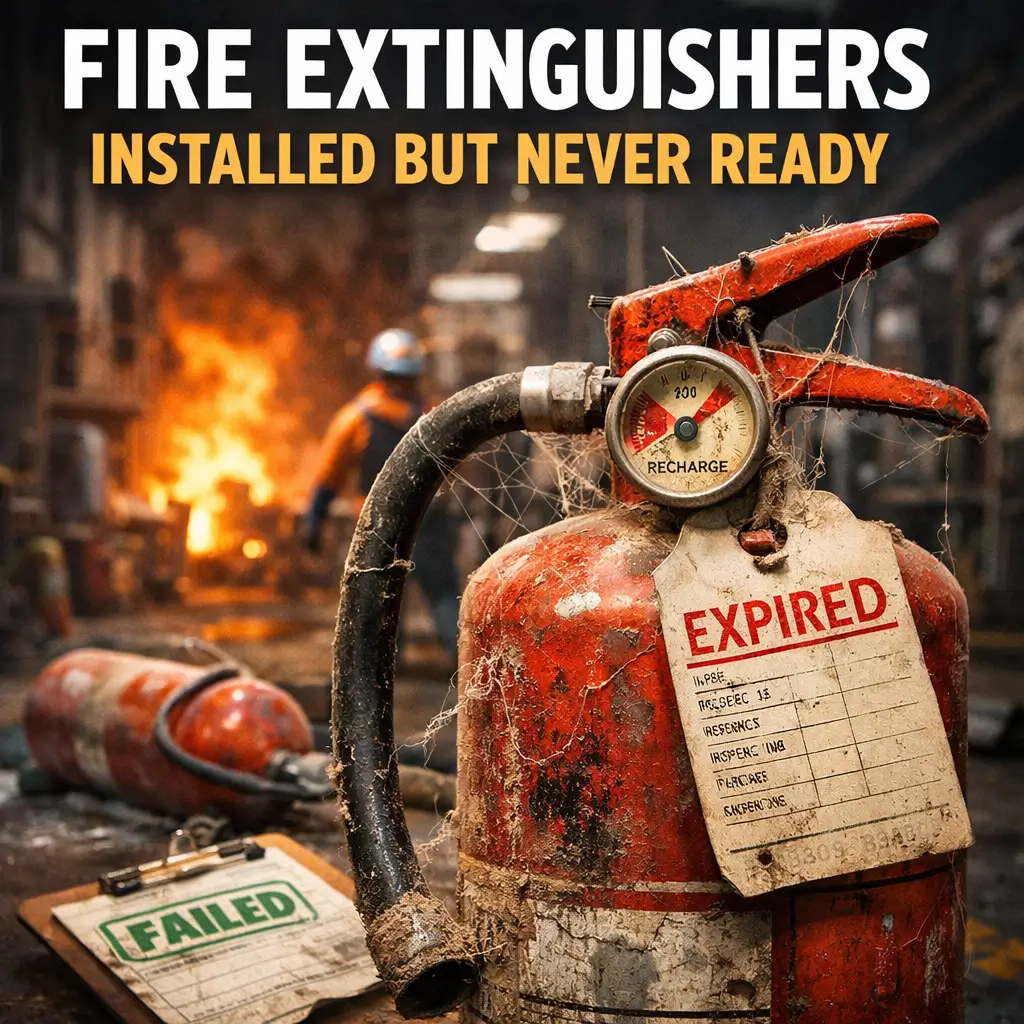
Fire Extinguishers Installed but Never Ready
In most Indian workplaces, fire extinguishers are visible everywhere.
They are mounted on:
- Walls
- Pillars
- Exit routes
- Work areas
During audits and inspections:
- They are counted
- Tags are checked
- Compliance is recorded
Everything appears correct.
However, during real fire emergencies, a critical issue is often exposed.
The extinguisher is present, but it is not usable.
This is one of the most dangerous failures in fire safety. A non-functional extinguisher creates a false sense of protection, which can delay response and increase damage.
What Does “Not Ready” Actually Mean
A fire extinguisher is considered not ready when it:
- Cannot be operated immediately
- Fails to discharge properly
- Is unsafe to use
- Is not suitable for the fire type
In such cases, the extinguisher becomes ineffective during the most critical moment.
Common Reasons Fire Extinguishers Are Not Ready
Expired or Overdue for Refilling
This is one of the most common problems.
Issues include:
- Refilling date exceeded
- Service tag missing
- Hydrostatic test overdue
Many extinguishers remain unattended for years after installation.
Loss of Pressure
Pressure loss is common in stored pressure and CO₂ extinguishers.
Signs include:
- Gauge needle in red zone
- Weak discharge
- No output during operation
Without proper pressure, the extinguisher cannot function effectively.
Blocked or Damaged Nozzles
In industrial environments, nozzles can become:
- Blocked with dust
- Filled with debris
- Affected by paint or corrosion
These issues prevent proper discharge.
Missing Safety Pins or Broken Seals
Common issues include:
- Safety pin removed and not replaced
- Seal broken due to tampering
- Unauthorized use
This affects reliability and safety during operation.
Corrosion and Physical Damage
Exposure to harsh conditions leads to:
- Rust formation
- Cylinder weakening
- Leakage
- Structural damage
A damaged extinguisher can fail during use or become unsafe.
Improper Mounting and Accessibility
Many extinguishers are:
- Installed at incorrect height
- Blocked by materials
- Locked inside cabinets
In emergencies, delayed access reduces effectiveness.
Why This Problem Is So Common
Fire Safety Treated as a One-Time Activity
Extinguishers are often installed:
- During project completion
- Before audits
- For compliance
After installation, maintenance is neglected.
No Clear Responsibility
In many workplaces:
- No one is assigned responsibility
- Maintenance is outsourced without monitoring
- Inspections are not verified
Without accountability, equipment deteriorates.
Inadequate Inspection Practices
Common issues include:
- Visual checks without detailed inspection
- Checklist-based verification
- No functional testing
A quick check does not ensure readiness.
Lack of Training and Awareness
Workers often:
- Cannot identify pressure loss
- Do not understand inspection requirements
- Are unaware of maintenance schedules
Without awareness, issues remain unnoticed.
Real Workplace Example
In a manufacturing unit, a small fire started in a storage area.
An employee attempted to use a nearby extinguisher.
However:
- The pressure was low
- Discharge was weak
- Fire was not controlled
The fire spread and caused significant damage.
Investigation revealed:
- The extinguisher had not been serviced for over two years
- Inspection records were inaccurate
The equipment was present, but not ready.
Fire Extinguisher Readiness Checklist
Monthly Checks
- Check pressure gauge
- Inspect safety pin and seal
- Verify hose and nozzle condition
- Ensure accessibility
- Check for physical damage
Quarterly Checks
- Clean extinguisher body
- Inspect mounting condition
- Verify labeling and instructions
- Review inspection records
Annual Checks
- Perform servicing and refilling
- Conduct hydrostatic testing if required
- Replace damaged units
- Audit overall system
Practical Steps to Ensure Readiness
- Assign responsibility to specific personnel
- Maintain inspection logbooks
- Conduct surprise checks
- Train workers on basic inspection
- Tag defective extinguishers immediately
- Replace or repair without delay
Role of Safety Officers
Safety professionals must ensure:
- Regular inspections are conducted
- Records are accurate
- Defects are corrected immediately
- Training is provided
Fire safety requires continuous monitoring, not occasional checks.
Industry Guidance and Standards
According to the National Fire Protection Association, fire extinguishers must be regularly inspected, tested, and maintained to ensure they are fully operational at all times.
NFPA emphasizes:
- Routine inspection
- Functional readiness
- Proper maintenance
- User awareness
For detailed guidance, refer to:
👉 https://www.nfpa.org/News-and-Research/Publications-and-media/NFPA-Journal
Warning Signs of Unready Fire Extinguishers
Watch for these indicators:
- Expired service tags
- Pressure gauge in red zone
- Dust accumulation
- Blocked access
- Missing pins or seals
- Lack of inspection records
These signs indicate high risk.
Legal and Safety Consequences
Non-functional extinguishers can result in:
- Legal penalties
- Insurance claim rejection
- Regulatory violations
- Liability for management
Authorities treat non-maintained safety equipment as negligence.
Conclusion
Fire extinguishers save lives only when they are ready.
In many workplaces, the issue is not absence, but lack of readiness.
A non-functional extinguisher is more dangerous than having none, because it creates false confidence and delays action.
Fire safety is not about installation.
It is about reliability at the moment of need.
Ensuring readiness is one of the simplest and most effective ways to prevent fire escalation.
For a complete understanding, read our full Workplace Fire Safety Guide.
Complete Workplace Fire Safety Guide (2026): Prevention, Equipment, Risk & Response
Common Mistakes While Using Fire Extinguishers
Why Monthly Fire Extinguisher Checks Are Ignored
Types of Fire Extinguishers Explained, How to Select the Right One for Real Workplace Fires
Water Extinguisher, When It Works, When It Fails, and How People Misuse It
Foam Fire Extinguishers, When They Are the Best Choice and When They Are Dangerous
Frequently Asked Questions
Can an expired extinguisher still work
It may discharge, but reliability is not guaranteed and it should not be used.
How often should extinguishers be inspected
Monthly visual inspections and periodic servicing are required.
Is pressure gauge enough to confirm readiness
No. Full inspection is necessary.
Who is responsible for maintenance
The employer and safety management.
Are damaged extinguishers dangerous
Yes. They can fail or rupture during use.
