
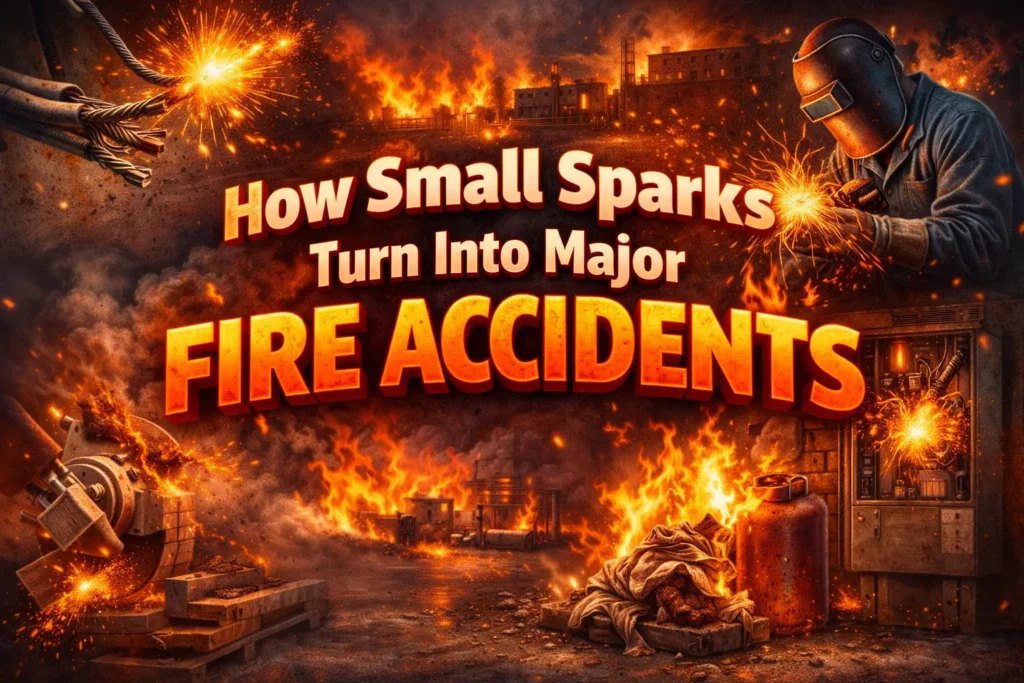
How Small Sparks Turn Into Major Fire Accidents
Most major fire accidents do not begin with large explosions or visible flames.
They start with something very small:
- A tiny spark
- A brief electrical flash
- A momentary overheating
- A hidden ignition inside equipment
These events are often ignored because they appear insignificant.
However, when a small spark meets the right conditions, it can escalate rapidly into a serious fire.
Understanding how this process works is critical for preventing fire incidents in workplaces, industries, and construction environments.
What Is a Spark in Fire Safety Terms
A spark is a small discharge of energy that generates enough heat to ignite combustible materials.
Even though it is short-lived, its temperature can be extremely high.
Sparks become dangerous when they occur in the presence of:
- Flammable materials
- Combustible dust
- Vapors
- Oxygen-rich environments
In such conditions, ignition can occur instantly.
Common Sources of Small Sparks in Workplaces
Electrical Sparks
Electrical sparks are one of the most frequent causes of fire incidents.
They occur due to:
- Loose electrical connections
- Faulty switches and relays
- Short circuits
- Damaged cables
- Overloaded systems
These sparks often occur inside panels or junction boxes, making them difficult to detect.
Mechanical Sparks
Mechanical sparks are produced when metal surfaces strike or rub against each other.
Typical sources include:
- Grinding and cutting operations
- Worn bearings
- Misaligned equipment
- Dropped tools
These sparks can ignite dust, oil residues, or nearby combustible materials.
Static Electricity Sparks
Static charge builds up during material movement.
Common situations include:
- Handling flammable liquids
- Plastic processing
- Powder transfer operations
- Conveyor systems
A sudden static discharge can ignite vapors instantly.
Hot Work Activities
Hot work processes such as:
- Welding
- Gas cutting
- Brazing
- Soldering
produce sparks and molten metal particles that can travel long distances.
Without proper control, these sparks can ignite hidden combustible materials.
Why Small Sparks Become Major Fires
Presence of Hidden Fuel
Many workplaces contain hidden fuel sources such as:
- Combustible dust
- Flammable vapors
- Insulation materials
- Packaging waste
- Oily rags
These materials are not always visible but can ignite easily.
Rapid Fire Growth
Once ignition occurs, fire spreads quickly due to:
- High oxygen availability
- Accumulated fuel
- Confined spaces
- Poor ventilation control
A small spark can develop into a large fire within minutes.
Delayed Detection
Spark-related fires often start in hidden locations such as:
- Electrical panels
- Ceiling voids
- Behind walls
- Inside machinery
Initial combustion may produce minimal smoke, delaying detection.
Lack of Immediate Response
Many incidents worsen because of delayed response.
Common reasons include:
- Lack of training
- Fear of using fire extinguishers
- Uncertainty about emergency procedures
This delay allows the fire to grow beyond control.
Real Workplace Examples
Electrical Panel Fire
A loose electrical connection creates a spark inside a panel.
Over time, insulation material ignites and spreads fire to nearby equipment.
Dust Explosion
A spark from machinery ignites suspended dust particles.
This results in rapid flame spread and possible secondary explosions.
Welding-Related Fire
Hot work sparks fall through floor openings and ignite materials stored below.
The fire develops unnoticed until it becomes severe.
Fire Triangle Perspective
A spark acts as the heat source in the fire triangle.
When fuel and oxygen are already present, ignition becomes immediate.
Preventing fires means controlling at least one element of the triangle.
In most cases, controlling ignition sources is the most effective strategy.
How to Prevent Small Sparks from Causing Fires
Electrical Safety Controls
- Inspect wiring regularly
- Avoid overloading circuits
- Use certified components
- Repair damaged cables immediately
Mechanical Safety Controls
- Maintain equipment properly
- Lubricate moving parts
- Ensure correct alignment
- Use spark arrestors where necessary
Static Electricity Control
- Ground and bond equipment
- Use anti-static materials
- Maintain proper humidity levels
Hot Work Management
- Implement permit-to-work systems
- Assign fire watch personnel
- Remove combustible materials
- Keep firefighting equipment ready
Early Detection and Training
- Install smoke and heat detectors
- Conduct fire drills
- Train employees on fire response
- Improve awareness of ignition risks
Fire Prevention Checklist
Daily Controls
- Check electrical systems
- Remove combustible waste
- Monitor hot work areas
Weekly Controls
- Inspect machinery condition
- Verify grounding systems
- Test detection systems
Monthly Controls
- Conduct fire risk assessment
- Review control measures
- Train workers
Role of Fire Risk Assessment
Fire risk assessment helps identify:
- Ignition sources
- Fuel accumulation
- Oxygen availability
- Control gaps
Regular assessments ensure hazards are identified before incidents occur.
Industry Guidance and Standards
According to the National Fire Protection Association, controlling ignition sources such as sparks is one of the most effective methods of fire prevention in industrial and commercial environments.
NFPA guidance emphasizes:
- Identification of ignition hazards
- Proper control measures
- Regular inspection and maintenance
- Worker training and awareness
For detailed fire safety guidance, refer to:
👉 https://www.nfpa.org/News-and-Research/Publications-and-media/NFPA-Journal
Warning Signs That Spark Risks Are High
Watch for these indicators:
- Frequent electrical faults
- Dust accumulation
- Poor housekeeping
- Uncontrolled hot work
- Lack of grounding
- No inspection records
These conditions significantly increase ignition risk.
Conclusion
Small sparks should never be underestimated.
They are often the starting point of major fire accidents.
The severity of a fire is not determined by the size of the spark, but by the conditions surrounding it.
By controlling ignition sources, managing fuel, and improving awareness, organizations can prevent small incidents from becoming catastrophic events.
Fire safety begins with attention to the smallest details.
For a complete understanding, read our full Workplace Fire Safety Guide.
Complete Workplace Fire Safety Guide (2026): Prevention, Equipment, Risk & Response
Hidden Ignition Sources in Everyday Workplaces
Fire Behavior That Most Workers Do Not Understand
Common Fire Safety Myths That Increase Risk
Why Fire Starts Even When All Safety Rules Are Followed
Fire Triangle Explained, Practical Fire Risk Control Guide for Workplaces
Frequently Asked Questions
Can a small spark really cause a large fire
Yes. If fuel and oxygen are present, even a small spark can cause ignition.
Why are spark-related fires difficult to detect
They often start in hidden areas and develop slowly before becoming visible.
Are electrical sparks more dangerous than flames
They can be more dangerous because they occur unexpectedly.
How fast can a fire grow from a spark
Some fires can become severe within minutes.
Is hot work the main cause of spark fires
It is one of the most common causes when not properly controlled.
